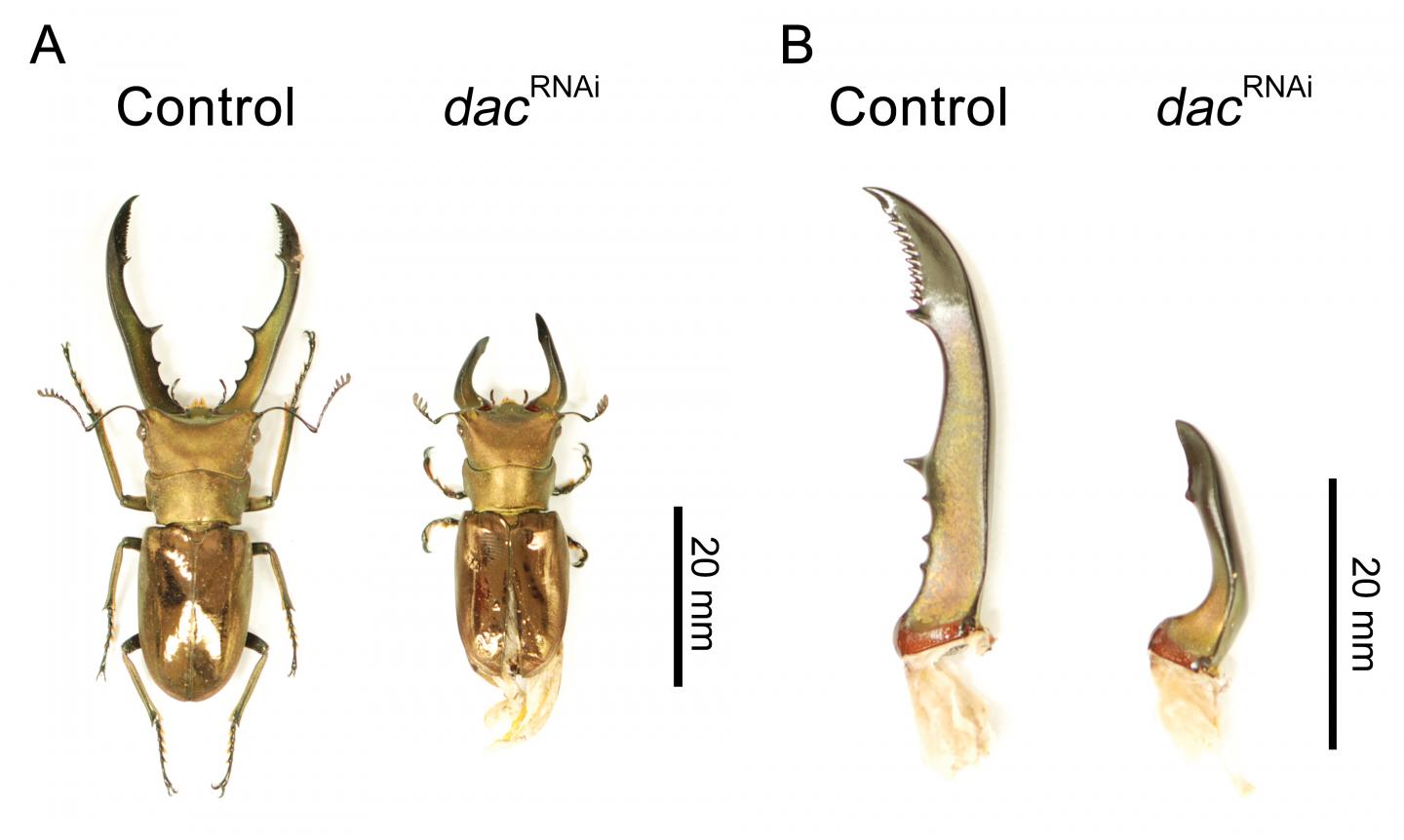
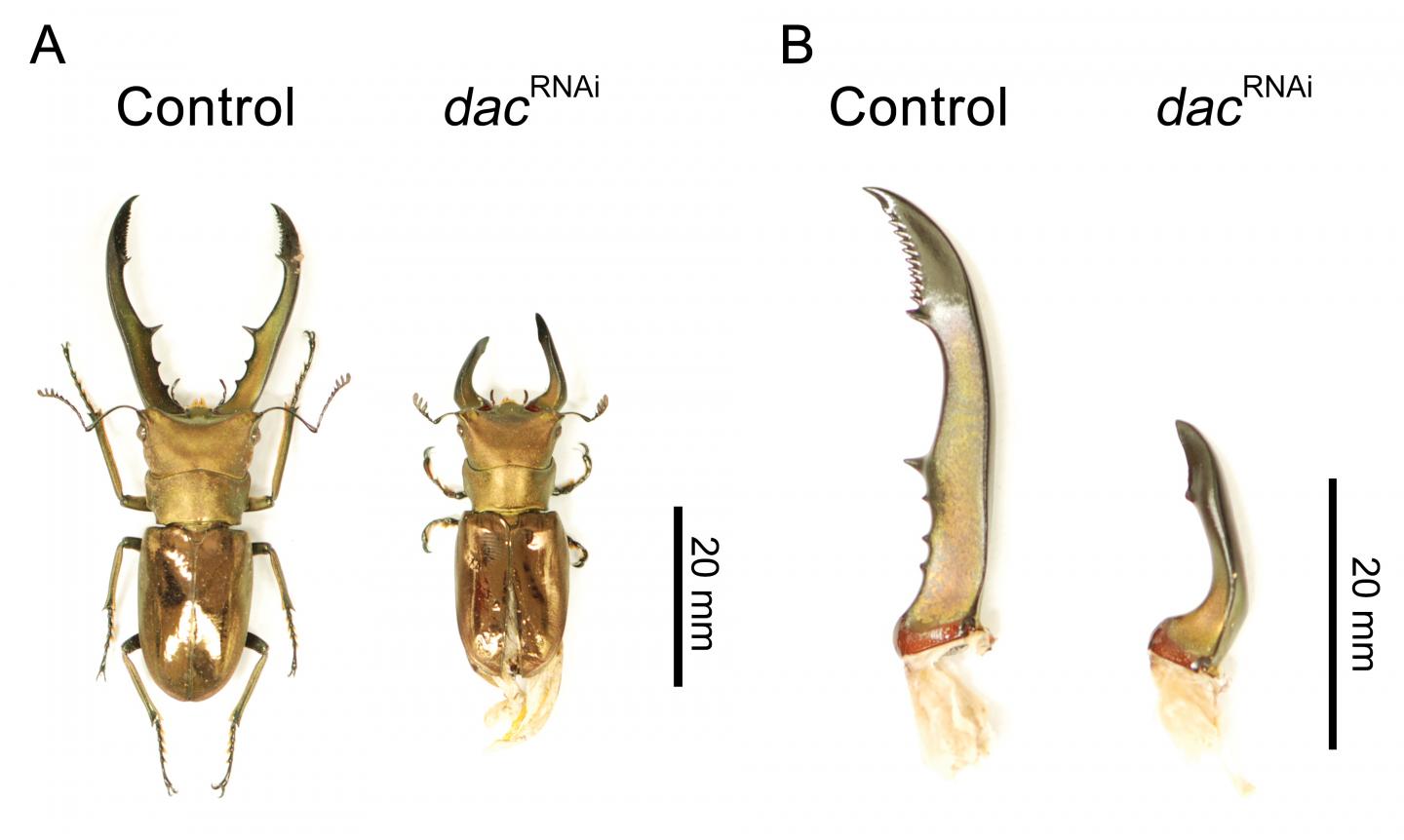
Credit: Hiroki Gotoh
Nagoya, Japan – Insects are a biological success story with their high abundance, dominating biodiversity, and almost worldwide distribution. Their evolutionary prowess in part reflects their ability to diversify and fill a variety of ecological niches. One means of doing this is developing a range of mouthparts that enables different foodstuffs to be consumed. Mouthparts can be highly modified, as in the straw-like maxillae of butterflies, or exceptionally enlarged, as in the mandibles of stag beetles that are used for fighting rather than feeding. However, the molecular mechanisms underlying mandible enlargement have been poorly understood. Collaborative Japan-US research coordinated by Nagoya University has now shed light on the genetic control of stag beetle mandible development. The study was published in Developmental Biology.
The development of appendages, such as limbs and mouthparts, at different distances from the body wall (proximal through medial to distal) is controlled by a series of genes highly conserved among all insects. The researchers used a molecular silencing technique to sequentially knockdown the expression of seven of these genes to investigate their function in the development and enlargement of stag beetle mandibles.
The dachshund (dac) gene, which controls regulation of the middle region of appendages in Drosophila and many other insects, had the greatest effect on mandible development of all seven genes analyzed.
"Knockdown of dac greatly reduced mandible size in male but not female stag beetles, and affected mandible morphology in both sexes," corresponding author Hiroki Gotoh says. "Knocked-down animals did not develop the serrated teeth normally seen in all males, and also lacked the inner teeth characteristic of large males."
Genes aristaless (al) and homothorax (hth) were also shown to have important roles in the development of inner teeth. However, knockdown of the Distal-less (Dll) gene, which is functional in distal regions, had no effect on mandible development. This supports previous knowledge that insects lost their most distal mandible regions early in evolution.
Male-specific mandible enlargement in stag beetles is known to be regulated by juvenile hormone, such that larger males have disproportionately larger mandibles.
"We observed a size-specific link with the functions of dac, al, and hth in the knockdown studies," Gotoh adds. "This suggests that these genes control their function using a size-dependent factor – most likely juvenile hormone."
Genetic silencing also revealed that the seven genes largely controlled stag beetle leg development in a manner highly conserved with that of other insects, but that their roles in antennal formation were more diverse. These conserved developmental functions of some genes but varied roles of others are likely to have contributed to the evolution of mouthparts in different insect species.
###
The article, "The function of appendage patterning genes in mandible development of the sexually dimorphic stag beetle" was published in Developmental Biology at DOI: 10.1016/j.ydbio.2016.12.011
Media Contact
Koomi Sung
[email protected]
http://www.nagoya-u.ac.jp/en/