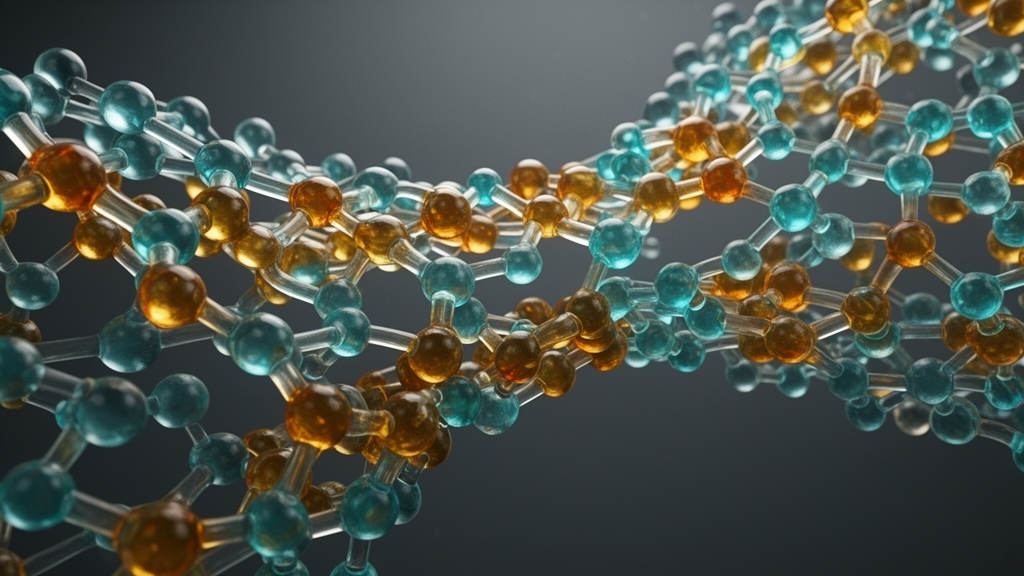
A new review published in Discover Polymers details how the incorporation of amine functional groups into polyolefins fundamentally alters their rheological behavior, transforming standard nonpolar plastics into materials capable of autonomous self-healing and strong adhesion. The study, led by researchers including Ziyue Zhang and Benjamin M. Yavitt, synthesizes recent progress in the molecular design of these associating polymers, highlighting how dynamic bonding associations create a new class of tunable materials. By integrating polar functional groups into the nonpolar backbone, scientists can broaden the application space of polyolefins, which are traditionally valued for their predictable and desirable properties. The review emphasizes that the specific arrangement of these groups allows for precise control over the material’s viscoelastic properties, opening avenues for advanced adhesive systems and stimuli-responsive applications.
The central mechanism driving these changes involves dynamic associative interactions, including hydrogen bonding, pi-pi stacking, and aggregate clustering. These interactions are highly tunable based on molecular design, allowing researchers to manipulate the material’s response to stress and temperature. This capability enables the materials to exhibit autonomous self-healing properties, where damaged surfaces can rejoin and recover mechanical strength without external intervention.
Historically, the synthesis of amine-containing polyolefins has been challenging due to the incompatibility of amine groups with standard polymerization techniques. To overcome these limitations, Schafer’s group developed a two-step synthetic protocol combining hydroaminoalkylation and ring-opening metathesis polymerization. This method allows for the creation of amine-functionalized monomers with complete atom economy, transforming simple starting materials into polar-functionalized polymers. The resulting materials, such as poly(aryl amine-containing cyclooctene) and poly(aryl amine-containing norbornene), exhibit a high density of amine groups, with one functional group per monomer unit.
This high level of functionalization is difficult to achieve through traditional copolymerization or post-polymerization methods, which typically limit amine content to below 15 mol% and 3 mol%, respectively. The ability to introduce such a high density of functional groups is crucial for observing the dramatic changes in rheological behavior. The review highlights that the zero-shear viscosity of these polymers does not follow the standard power-law relation seen in unfunctionalized references. Instead, the viscosity exhibits an exponential growth with molecular weight, a phenomenon attributed to the presence of different relaxation mechanisms arising from hydrogen bonding networks.
Rheological characterization of these materials reveals a transition from typical Rouse relaxation to gel-like and solid-like behavior as molecular weight increases. For poly(aryl amine-containing norbornene) samples, the storage modulus eventually dominates the loss modulus across the entire frequency range, indicating the formation of microstructures with long lifetimes. This solid-like behavior is a direct consequence of the hydrogen bonding network, which restricts segmental motions and increases the glass transition temperature. The review notes that the addition of intermolecular hydrogen bonding provides a clear path to tuning the glass transition temperature, which can vary from 48 degrees Celsius in unfunctionalized polynorbornene to 82 degrees Celsius in bromo-substituted variants. This tunability allows for the design of materials with specific thermal and mechanical properties.
A particularly interesting observation is the time-dependent behavior of poly(aryl amine-containing cyclooctene), which undergoes a process referred to as aging. When stored at room temperature, the material gradually transitions from a soft viscoelastic liquid to a gel-like state, and eventually to a viscoelastic solid over periods ranging from months to years. This aging process is driven by the polarity difference between the polymer backbone and the amine pendant groups, leading to physical aggregation through hydrogen bonding and pi-pi stacking. The review explains that this is essentially an equilibration process where polymer chains rearrange to minimize the system’s free energy. The transition kinetics are closely related to the horizontal shift factors obtained from master curves, allowing for the prediction of material state during long-term storage.
Molecular modeling using time-marching algorithms has been employed to capture the linear viscoelastic properties of these associating polymers. These models incorporate additional parameters to account for dynamic associations, such as the probability of a monomer creating an interchain association and the delay in the reptation process caused by associated stickers. For fully equilibrated samples, the delay is considered infinite, meaning associations function similarly to permanent crosslinks. In contrast, for non-equilibrated systems, a finite delay accounts for the overall delay from weak amine associations. The models effectively describe the two extremes of the equilibration process, providing insights into the evolving structural changes of the amine functionalities. This theoretical framework helps explain the complex rheological behaviors observed in experiments, such as the emergence of a secondary plateau in the storage modulus.
The mechanical properties of these materials can be tuned through sample formulation, such as blending low and high molecular weight components. Blends of low molecular weight poly(aryl amine-containing cyclooctene) with fully aged high molecular weight samples span the full range from solid-like to liquid-like behavior. The gel transition occurs close to a 1:1 ratio of low to high molecular weight polymer. Mechanical testing reveals that freshly synthesized samples exhibit strain softening after the yield point, reflecting their viscoelastic liquid behavior, while fully aged samples show pronounced strain hardening. This strain hardening suggests that strong aggregated associations act similarly to chemical crosslinks, providing the material with rubber-like mechanical properties. The ultimate stress and strain can be adjusted by varying the ratio of viscoelastic liquid and solid components in the blend.
Adhesive properties are also significantly influenced by the amine structure and the aging state of the polymer. Poly(aryl amine-containing cyclooctene) exhibits strong adhesion to low surface energy substrates, such as polytetrafluoroethylene, which is known for its resistance to adhesion. The peel strength of freshly synthesized samples increases with molecular weight, reaching 620 N/m for a sample with a molecular weight of 177 kg/mol. However, fully equilibrated samples exhibit lower peel strength due to adhesive failure, as the increased engineering stress exceeds the bonding strength between the polymer and the substrate. This finding highlights that strain hardening is not universally favorable for achieving high peel strength; it must be balanced within the cohesive and adhesive failure regions. The high adhesion performance is attributed to the soft and ductile nature of the materials, allowing sufficient energy dissipation before failure.
The self-healing ability of these polymers is hypothesized to result from a combination of hydrogen bonding and high chain mobility. Systematic evaluations show that freshly synthesized samples with higher molecular weights can achieve full recovery of mechanical properties at room temperature, though they require longer healing times. The review discusses the theoretical framework for self-healing dynamics, noting that the equilibrium time for freshly synthesized samples is estimated to be approximately 0.64 seconds, which is faster than any experimentally accessible timeframe. This suggests that reported self-healing experiments are conducted in the self-adhesion regime. The recovery of ultimate strain follows a power-law scaling with healing time, providing a valuable dataset for validating future theoretical models of entangled associating polymer networks.
Post-polymerization functionalization offers an alternative route for synthesizing amine-containing associating polymers, demonstrated for vinyl-terminated polypropylene and polyethylene. This method allows for the introduction of amine groups at the chain ends, which can form dimers through hydrogen bonding. The fraction of dimer structure decreases with increasing molecular weight of the precursor, due to reduced chain mobility limiting optimal association. In contrast, functionalized polybutadiene with amines distributed along the backbone exhibits long-time equilibrium behavior similar to poly(aryl amine-containing cyclooctene). Samples with a high density of amine functional groups undergo a sol-gel transition, with the gel point occurring between 5 and 15 stickers per chain. At 46 stickers per chain, the unentangled polymer forms a full gel network, demonstrating the potential of amine associations to enhance the mechanical strength of low molecular weight polymers.
The review concludes by outlining current research challenges and identifying promising directions for future investigation. While the hypothesis involving the evolution of hydrogen bonding architecture has been proposed, direct physical evidence of these structural changes remains limited. New characterization techniques and theoretical models are needed to fully understand the precise mechanisms of aggregation. The presence of secondary amines also provides opportunities for further functionalization, such as protonation for antimicrobial applications or post-polymerization modification with complementary groups. Copolymerization with various backbone structures and physical blending with other compatible polymers offer additional avenues for tailoring the properties of these materials. The emerging field of amine-containing associating polymers represents a significant advance in polymer science, offering new possibilities for designing materials with tunable rheological, mechanical, and adhesive properties.
Subject of Research: The impact of dynamic bonding associations on the rheology of amine containing polyolefins
Article Title: The impact of dynamic bonding associations on the rheology of amine containing polyolefins
Article References: Zhang, Z., Moradinik, N., Malmir, A., Ataie, S., Mohammadi, E., Schafer, L. L., Hatzikiriakos, S. G., & Yavitt, B. M. (2026). The impact of dynamic bonding associations on the rheology of amine containing polyolefins. Discover Polymers, 3(1), Article 6. https://doi.org/10.1007/s44347-026-00041-z
Image Credits: AI Generated
DOI: 10.1007/s44347-026-00041-z
Keywords: impact, dynamic, bonding, associations, rheology, amine, containing, polyolefins, scientific research
News Source: Bethany Barker. (November 10, 2026). Amine Bonds Transform Polyolefins Into Self-Healing Solids. Scienmag.