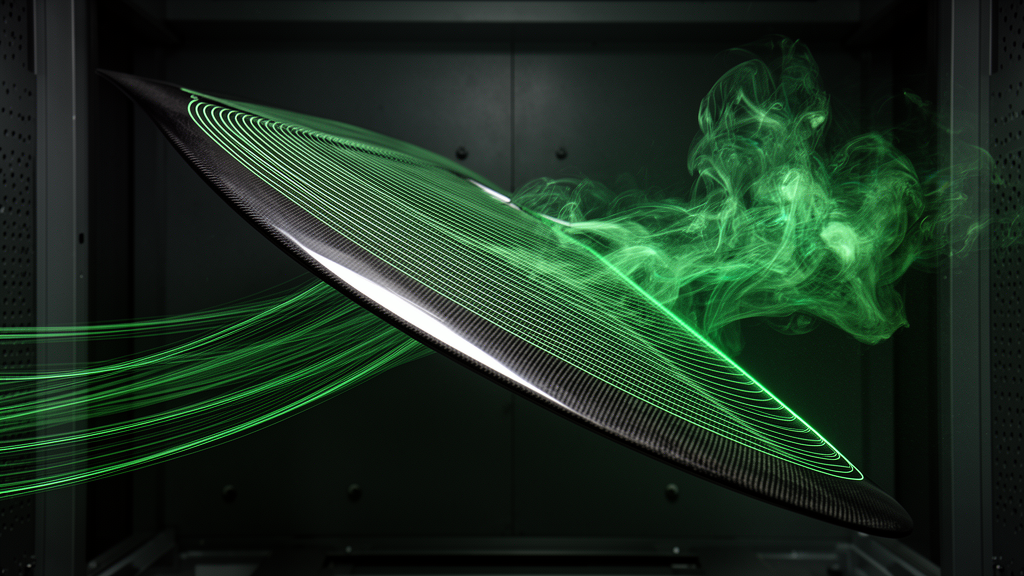
In computational fluid dynamics simulations of lifting bodies, accurately capturing aerodynamic forces at steep inclinations requires boundary conditions that account for massive drag as well as circulation. Researchers Narges Golmirzaee and David H. Wood from the University of Calgary have demonstrated that traditional far-field boundary conditions fail to capture the physics of two-dimensional, steady, and incompressible flow over an airfoil when the angle of attack reaches forty-five degrees. At this extreme orientation, drag forces reach the same order of magnitude as lift, creating severe wake displacement and mass deficits that conventional numerical setups cannot properly accommodate. By re-evaluating the control volume momentum and impulse equations, the study establishes that introducing a point source alongside the classic point vortex is mathematically necessary to eliminate artificial domain blockage and achieve accurate aerodynamic force predictions without demanding computationally prohibitive mesh domains.
Standard computational practice for two-dimensional airfoil flows has historically relied on the point vortex boundary condition to correct far-field velocities and pressures according to the Kutta-Joukowsky theorem. In prior investigations conducted at moderate angles of attack, such as five, ten, and fourteen degrees, lift dominated the flow field, while drag remained relatively small. Under those low-drag regimes, the point vortex condition provided sufficient far-field adjustments to allow substantial reductions in computational domain size while preserving accuracy relative to enormous benchmark domains extending five hundred chord lengths. However, previous verification benchmarks demonstrated that conventional domain truncations around thirty chord lengths without appropriate far-field representations caused significant errors in force coefficients, particularly in pressure drag, which distorted the aerodynamically vital lift-to-drag ratio. The new study extends these computational fundamentals to a post-stall regime where lift and drag are comparable, fundamentally altering far-field behavior.
To investigate these flow phenomena, the investigators conducted numerical simulations of a symmetrical NACA 0012 airfoil operating at a chord-based Reynolds number of six million and an angle of attack of forty-five degrees. Computations were executed using the simpleFOAM steady incompressible solver within the OpenFOAM framework, incorporating the one-equation Spalart-Allmaras turbulence model. The computational domain was configured as a square domain extending over distances ranging from ten chord lengths to five hundred chord lengths from the coordinate origin, which was positioned at the airfoil quarter-chord location. Structured grids generated in Pointwise utilized four embedded coarseness layers, maintaining smooth cell transitions with area growth ratios strictly below 1.19 and cell aspect ratios in the wake region below twenty. The near-wall resolution ensured non-dimensional wall distance values remained below 0.1 across the entire airfoil surface, yielding over two and a half million cells for the thirty-chord domain configuration and achieving strict grid convergence index uncertainties below 0.03 percent.
The mathematical foundation of the investigation relies on the impulse formulation of the Navier-Stokes equations, which replaces pressure terms on control volume boundaries with integrals of fluid vorticity. When applied to a square control volume coincident with the computational domain boundaries, conservation of mass and linear momentum dictates that the irrotational perturbation velocities must balance the mass deficit created by the downstream wake. In traditional boundary configurations, including common freestream conditions, symmetry walls, and the pure point vortex formulation, fluid is strictly prevented from crossing the lateral top and bottom boundaries. Consequently, the irrotational boundary integrals vanish in the far-field limit, leading to a severe mathematical contradiction wherein the physical drag integral must evaluate to zero. To restore physical consistency with the drag balance, the authors incorporated a point source singularity whose volumetric strength is directly proportional to the total drag divided by the product of fluid density and freestream velocity, an equivalence originally derived by Lagally and Filon.
The combined formulation, designated as the point-vortex-source boundary condition, applies velocity perturbations derived from the superposition of both singularities. In this combined framework, the point vortex accounts for circulation and lift, whereas the point source generates an outward radial velocity field that compensates for the fluid mass deficit carried downstream in the viscous wake. The resulting perturbation velocities decay inversely with distance from the airfoil, and the associated pressure perturbations are imposed at the outer boundaries via an irrotational Bernoulli relation updated iteratively during the simulation solution process. When evaluated in OpenFOAM across domain sizes between ten and five hundred chord lengths, the point-vortex-source boundary condition systematically produced force coefficients that converged rapidly toward the five-hundred-chord benchmark values, completely outperforming both standard non-penetration boundary conditions and the pure point vortex condition.
Crucially, the numerical findings revealed that when simulating an airfoil at a forty-five-degree angle of attack, the pure point vortex boundary condition performs no better than standard non-vortex boundary conditions. Because both formulations enforce zero normal velocity across the top and bottom computational boundaries, they trap the expanding streamlines and induce an artificial wall blockage effect analogous to solid wind tunnel walls. The authors demonstrated that this lateral constraint forces an artificial acceleration through the domain, causing the effective inlet velocity entering the computational grid to fall below the true freestream velocity at infinity. To quantify this effect, the authors formulated an analytical relationship termed the Lagally-Filon correction, which relates the average induced perturbation velocity to the computational domain size and the uncorrected drag coefficient. Applying this correction to the constrained simulations shifted the computed lift, drag, and moment coefficients into close agreement with the point-vortex-source results, confirming that the discrepancy stems directly from source-term omission.
The physical validity of the numerical simulations and the accompanying analytical corrections was further assessed against experimental measurements and independent computational datasets available in the literature for the NACA 0012 airfoil at high angles of attack. Comparisons included experimental wind tunnel data across varied blockage configurations, ranging from tight closed-wall test sections to specialized blockage-tolerant tunnels equipped with slatted walls that permit flow expansion. When corrected using the Lagally-Filon formulation and classical wind tunnel blockage equations, experimental lift and drag coefficients aligned closely with the point-vortex-source calculations, typically agreeing within ten percent across turbulent regimes. Furthermore, comparisons against detached eddy simulations and two-equation shear stress transport models highlighted that proper boundary condition specification enables steady Reynolds-averaged Navier-Stokes modeling to capture macroscopic force balances without incurring the massive computational overhead associated with resolving large-scale three-dimensional unsteady structures.
Despite the success of the point-vortex-source formulation in resolving the lift and drag balances, the impulse analysis revealed an inherent limitation regarding aerodynamic pitching moment. In the far-field impulse equation for moment, the trailing wake introduces a vorticity integral that diverges logarithmically with downstream distance. This divergence arises because the bound circulation of the lifting airfoil deflects the downstream wake downward, in the direction opposite to the aerodynamic lift vector, displacing the centerline of the velocity deficit. While the irrotational point source and point vortex perturbations integrate to zero across the outer boundary perimeter, the deflected wake vorticity produces an integrated angular momentum flux that grows monotonically with domain scale. Although theoretical analyses by Imai previously attempted to cancel this logarithmic divergence using higher-order streamfunction expansions, the present study found that empirical corrections along the upstream centerline yielded velocity increments on the order of ten to the negative fourth power, proving negligible for practical force determination.
Detailed inspection of the computational flow fields showed that the numerical simulation inherently compensates for the moment inconsistency through the spontaneous formation of thin vorticity layers along the lateral boundaries. When the outer control volume boundaries were shifted inward by a single chord length to exclude these boundary layers, the resulting control volume moment balance matched the computed aerodynamic moment with an error of just 0.05 percent, compared to a 66 percent discrepancy when integrating precisely along the outer mesh boundary. Wake profile analysis confirmed that the velocity defect remained remarkably symmetric about the locus of minimum velocity, adhering to classical turbulent self-preservation scalings where wake width grows with the square root of downstream distance while the centerline velocity defect decays inversely with the square root of distance.
Ultimately, the investigation establishes that accurate computational fluid dynamics simulations of heavily loaded airfoils operating at high angles of attack require far-field boundary conditions that explicitly incorporate point source terms. Omitting the point source produces significant artificial domain blockage that distorts velocity distributions and corrupts lift, drag, and moment predictions unless massive computational meshes are deployed. By implementing the point-vortex-source boundary condition, aerodynamicists can obtain highly accurate force predictions on compact computational domains without incurring measurable computational time penalties, providing a rigorous and computationally efficient framework for analyzing high-lift devices, vertical-axis wind turbine blades, and post-stall aerodynamic systems.
Subject of Research: Aerodynamic boundary condition modeling for high angle-of-attack airfoil simulations
Article Title: Far-field boundary conditions for airfoil simulation at high angle of attack in steady, incompressible, and two-dimensional flow
Article References: Golmirzaee, N., & Wood, D. H. (2026). Far-field boundary conditions for airfoil simulation at high angle of attack in steady, incompressible, and two-dimensional flow. Advances in Aerodynamics, 8(1), Article 2. https://doi.org/10.1186/s42774-025-00222-7
Image Credits: AI Generated
DOI: 10.1186/s42774-025-00222-7
Keywords: aerodynamics, computational fluid dynamics, airfoil simulation, boundary conditions, angle of attack, NACA 0012, OpenFOAM, point vortex, point source, fluid mechanics, Far-field, boundary
News Source: Audrey Campbell. (November 10, 2026). Airfoil Simulations at Steep Angles Require Far-Field Point Source Boundary Conditions. Scienmag.