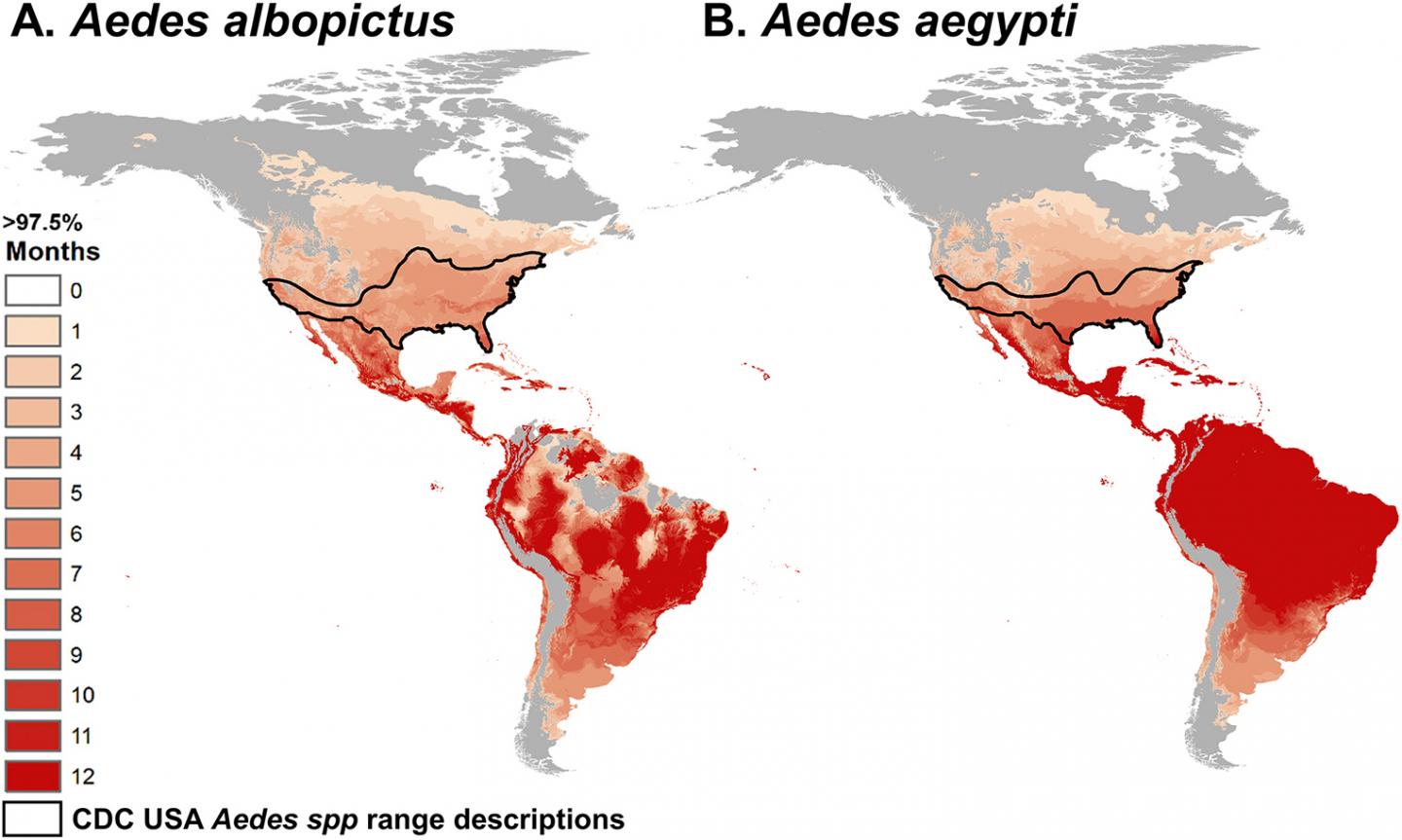
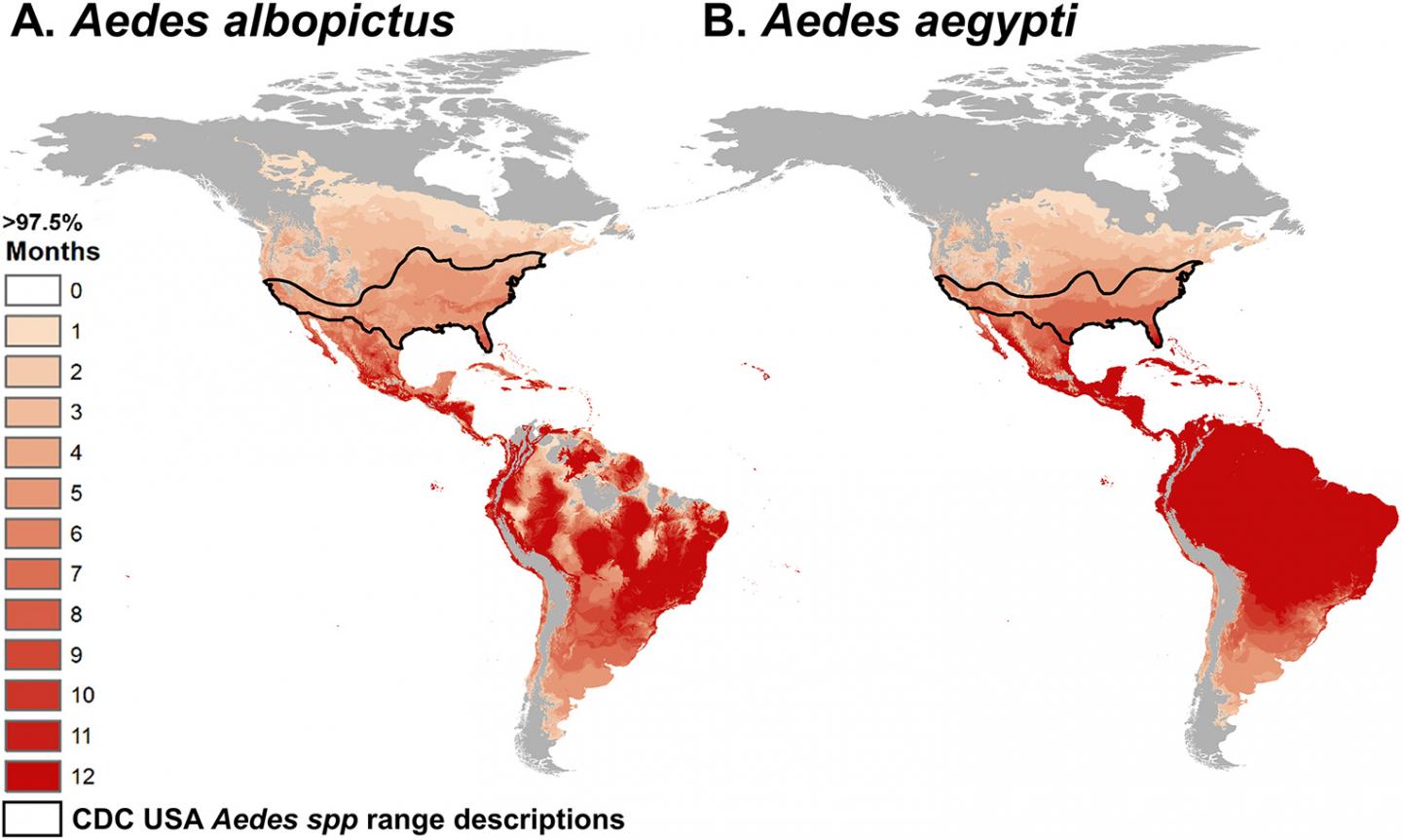
Credit: Image courtesy of study authors
TAMPA, Fla. (May 9, 2017) — Transmission of mosquito-borne diseases, such as Zika, occur at lower temperatures than previously thought, a recently released study co-authored by two University of South Florida researchers shows.
The study, led by Stanford University and published in the journal PLoS Neglected Tropical Diseases, found that transmission of dengue, chikungunya and Zika is highest at around 84 degrees Fahrenheit. Scientists had long considered 90 degrees to be the peak-transmission temperature. The finding is significant, especially as climate change causes temperatures to climb.
"This means that future transmission is much more likely to occur in subtropical and even temperate areas, such as the southern United States and northern Mexico," said Jeremy Cohen, PhD, a postdoctoral researcher studying integrative biology.
He and Jason Rohr, PhD, an associate professor of integrative biology, are coauthors on the study. From 2015-2016, they collected data on the incidences of dengue, chikungunya and Zika, as well as climate, gross domestic product and tourism, in Latin America and the Caribbean.
Their data were used to create a model that shows the potential effects of temperatures and temperature change on the transmission of dengue, chikungunya and Zika around the world, three diseases that are mosquito-vectored and increasing in the United States.
"Our findings should help to predict the areas at the greatest risk of dengue, chikungunya and Zika outbreaks," said Rohr.
Temperature affects how often mosquitoes bite, the amount of time it takes for them to ingest a virus from one human and inject it into another, and their life cycle. Cohen, Rohr and other members of the research team found that mosquitos posed the greatest risk to humans at 84 degrees and risk declined in cooler and warmer temperatures.
"Given that the predominant thinking was that transmission was most likely to peak at very hot temperatures, which would mostly limit the diseases to the tropics, we were certainly surprised that the model and the field data suggested that high rates of transmission could occur at lower temperatures, possibly impacting more northern regions in the future," Cohen said.
Pinpointing the optimal temperature for disease transmission is critical for predicting future disease rates and how diseases will spread with climate change, and more effectively implementing mosquito-control measures, said lead author Erin Mordecai of Stanford University.
"If we're predicting a 29-degree optimum and another model is predicting a 35-degree optimum, the other model will say that climate change will increase transmission," she said in a Stanford-issued media release, adding that if local temperatures are already near optimal temperature, infections may decline as temperatures rise.
###
In addition to USF and Stanford, researchers on the study represented institutions including Virginia Tech, University of Florida, University of Georgia College of Veterinary Medicine, University of California Los Angeles, SUNY Upstate Medical University, Penn State University and University of Michigan.
The study was funded by a grant from the National Science Foundation — Ecology and Evolution of Infectious Disease.
Media Contact
Adam Freeman
[email protected]
813-974-9047
@USFResearch
http://www.usf.edu/research-innovation/