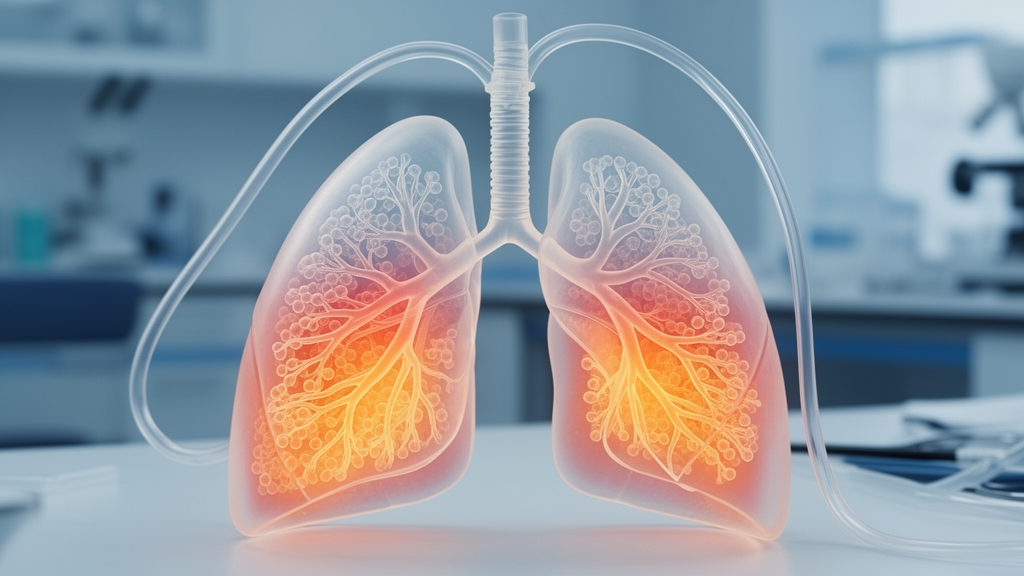
A new theoretical biomechanics framework called FAAST, or Fatigue-Aware Alveolar Stress and Strain Tracking, proposes a method for quantifying how mechanical ventilation distributes injury risk across different regions of the lung. Published in Frontiers in Bioengineering and Biotechnology, the study introduces a computational model designed to address the limitations of current bedside variables, which often fail to resolve regional load, deformation, time, repetition, and recovery. The framework suggests that ventilator-induced lung injury (VILI) is better understood as a regional dose-response and fatigue process rather than a single-threshold event, offering a potential path toward more personalized ventilation strategies.
The central premise of the FAAST hypothesis is that the lung does not experience ventilator settings as a single global number. Instead, it experiences distributed load and deformation across a heterogeneous, viscoelastic structure. In conditions such as acute respiratory distress syndrome (ARDS), regional differences in aeration, compliance, and resistance mean that the same airway pressure and tidal volume can produce markedly different regional stress and strain. The model aims to formalize this missing dimension by translating positive-pressure ventilation into regional mechanical exposure and evolving fatigue and damage states.
The deterministic implementation of the framework, known as FAAST2, maps a shared central-airway boundary into 20 distinct compartments to represent mechanically distinguishable lung regions. It defines functional-residual-capacity-referenced volumetric strain and closes generalized constitutive stress through regional specific elastance. The model tracks two primary exposure channels: Time-Accumulated Stress History (TASH), which represents the complete-cycle load-time dose, and Strain-Accumulated Strain History (SASH), which represents cumulative positive loading-branch deformation work. These channels are distinct from the evolving tissue state, which includes reversible fatigue memory and an irreversible damage index.
To test the framework, the authors applied the FAAST2 implementation to four idealized ventilation scenarios spanning healthy homogeneous mechanics, reduced functional residual capacity (FRC) homogeneous mechanics, higher tidal volume exposure, and heterogeneous acute lung injury. These calculations were not patient-specific predictions but rather deterministic demonstrations intended to test dimensional consistency, computational reproducibility, and directional correspondence with established clinical observations. The scenarios used declared lung phenotypes with specific tidal volumes, respiratory rates, and positive end-expiratory pressure (PEEP) settings to isolate the effects of reference volume, stiffness, and regional heterogeneity.
The results demonstrated that global ventilator settings can map to divergent regional burdens. In the heterogeneous ARDS phenotype, the preferentially loaded compliant regions carried the greatest mechanical burden, with 1-hour SASH values reaching 1,510.4 kPa. This was significantly higher than the stiff regions in the same scenario, which had a 1-hour SASH of 483.6 kPa. The study found that higher tidal volume increased mechanical burden despite fewer breaths, highlighting that lower cycle counts do not necessarily erase the larger mechanical dose delivered per cycle. The model showed that high load can coexist with limited deformation, whereas compliant regions can carry both sustained load and large positive work.
The authors also compared these acute scenarios against a chronic-stability boundary informed by selected values from a report on amyotrophic lateral sclerosis (ALS) patients. This comparator, which used declared PEEP and normal-lung mechanics, produced a 1-hour SASH of 88.9 kPa and a bounded steady fatigue of 0.015. Relative to this low-burden chronic comparator, the 1-hour regional SASH in the acute cases was 1.12 to 17.0 times higher. This comparison serves as an illustrative boundary to distinguish delivered exposure from inferred unrepaired damage, emphasizing that accumulated exposure is not synonymous with accumulated injury in chronic settings.
A key component of the model is the Continuum of Damage Index (CDI), a cycle-indexed metric that combines elemental load-time and deformation-work increments with inherited fatigue. The CDI is irreversible and bounded, meaning it does not decrease over time within the model’s acute horizon. A continuous recovery-opportunity factor accelerates the decay of reversible fatigue memory but does not subtract from the accumulated CDI. This distinction is crucial for understanding how mechanical ventilation might lead to progressive injury, as the model separates irreversible damage from reversible mechanical susceptibility.
The study also applied the framework to a sensitivity analysis of the OSCILLATE trial, which compared conventional ventilation with high-frequency oscillatory ventilation (HFOV). By applying reported day-1 arm settings to the same 20-compartment lung model for 24 hours, the researchers found that control ventilation produced a maximum compartment CDI of 0.596. Across declared HFOV tracheal oscillatory tidal volumes of 0.5 to 2.0 mL/kg predicted body weight, the CDI ranged from 0.575 to 0.777. The modeled SASH arm equivalence occurred at 0.573 mL/kg, which is identified as a mechanical comparison point rather than a biological injury threshold.
These findings are ecological sensitivity outputs and do not represent measured HFOV tidal volumes, patient reconstructions, or mortality predictions. The analysis explicitly notes that it cannot apportion deaths between pulmonary and cardiovascular mechanisms or infer individual regional strain. The authors emphasize that the framework requires regional construct validation and biological calibration before it can be used for clinical decision-making. The current implementation does not feed the CDI back into elastance, resistance, or recruitment, meaning it does not simulate the complete biological positive-feedback loop of lung injury.
The FAAST framework offers a common language for what the authors term the “economy of breath,” aiming to identify ventilation strategies that preserve gas exchange and recruitment while minimizing the worst-compartment mechanical dose. However, the study is limited by its use of idealized allocations and linear constitutive laws, which may not fully capture the complex, nonlinear behavior of biological lung tissue. The Protti interval used for dynamic-strain normalization is not a validated human injury threshold, and the CDI coefficients remain uncalibrated. Future work must focus on archived waveform testing, regional construct validation against imaging, and calibration of CDI coefficients against biological or clinical endpoints to determine if this framework can improve clinical decisions beyond established global targets.
The FAAST framework distinguishes between the mechanical energy delivered to the lung and the resulting state of the tissue, a separation that addresses a specific gap in current clinical monitoring. While airway pressure, tidal volume, and compliance are standard bedside observables, they are predominantly global measures that do not directly identify how mechanical exposure is distributed across the lung. The authors note that in acute lung injury, regional differences in aeration, compliance, and resistance mean that identical ventilator settings can produce markedly different local stress and strain. By mapping these shared boundary conditions into distinct regional compartments, the model attempts to formalize the missing dimension of regional dose accumulation, treating ventilation as a process where toxicity depends on concentration, duration, repetition, and distribution rather than a single threshold event.
The computational implementation relies on a linear constitutive closure that relates regional deformation to generalized load through specific elastance. This approach uses a constant secant specific elastance derived from compartment mechanics, anchored to a value of 13.5 cmH2O based on published measurements of whole-lung stress-strain relations. The authors explicitly state that this linear law is a reduced-order closure over a limited range and does not claim that lung tissue behaves linearly through failure. They acknowledge that experimental studies have identified loss of linearity and strain stiffening near the upper experimental range, but these findings are cited to motivate future nonlinear extensions rather than to validate the current linear approximation. The model also includes defined but inactive terms for local stress concentration and rate dependence, which would require waveform-resolved calibration to activate.
The framework’s treatment of fatigue and damage is designed to prevent the erasure of accumulated mechanical burden by subsequent unloading. The Continuum of Damage Index is updated once per physical cycle and is irreversible by model convention, meaning that expiration or active flow reversal cannot subtract from previously accumulated damage. This design choice reflects a continuum-damage engineering analogy where biological tissue carries forward recruitment state, strain history, and prior microstructural injury. In contrast, the fatigue state is reversible and represents mechanical memory that decays over time. A recovery-opportunity factor modulates this decay, accelerating it when loading is reduced, but it does not represent biological healing. This distinction ensures that the model separates the immediate mechanical response from the longer-term structural degradation, preventing a quiet interval from being misinterpreted as tissue repair.
Validation of the model’s internal logic was tested against established clinical observations, including the ARDSNet trial which demonstrated that lower tidal volumes improve outcomes. The FAAST results align with this by showing that higher tidal volumes increase per-cycle positive work and cumulative exposure channels, even when the respiratory rate is lower. The model also incorporates a dynamic-strain normalization interval derived from healthy pig studies, which is used as a reference scale for fatigue severity rather than a universal human failure threshold. The authors emphasize that these normalization scales are not independently measured injury thresholds, and the species-to-human translation remains an explicit sensitivity assumption. The use of these external references serves to test directional correspondence rather than to provide a calibrated clinical risk score.
The limitations of the current implementation are significant and define the scope of its current utility. The 20-compartment model does not reproduce a branching, actively recruited, or poroelastic lung, nor does it separate recruitment-related volume gain from distension without imaging. The OSCILLATE sensitivity analysis, for instance, relies on declared regional architectures and unmeasured tracheal oscillatory volumes, meaning the results are ecological sensitivities rather than patient-specific reconstructions. The model cannot apportion mortality between pulmonary and cardiovascular mechanisms, nor can it model the effects of sedation or vasopressors. Consequently, the framework is best understood as a computational observability tool that identifies which regional waveform-derived quantities should be observed, rather than a validated bedside treatment target. Future clinical application requires regional construct validation against imaging or transpulmonary-pressure measurements and calibration of the damage index against biological endpoints.
Subject of Research: Theoretical biomechanics framework for regional mechanical dose accumulation in ventilator-induced lung injury
Article Title: Fatigue-aware alveolar stress and strain tracking: a theoretical biomechanics framework for regional mechanical dose accumulation in ventilator-induced lung injury
Article References: Champagne, M. S. (2026). Fatigue-aware alveolar stress and strain tracking: a theoretical biomechanics framework for regional mechanical dose accumulation in ventilator-induced lung injury. Frontiers in Bioengineering and Biotechnology, 14, Article 1938944. https://doi.org/10.3389/fbioe.2026.1938944
Image Credits: AI Generated
DOI: 10.3389/fbioe.2026.1938944
Keywords: ventilator-induced lung injury, FAAST framework, regional lung mechanics, biomechanics, mechanical ventilation, ARDS, computational modeling, lung fatigue, Fatigue-aware, alveolar, stress, strain
News Source: Gregory Coleman. (November 10, 2026). New Model Tracks Regional Lung Fatigue During Mechanical Ventilation. Scienmag.