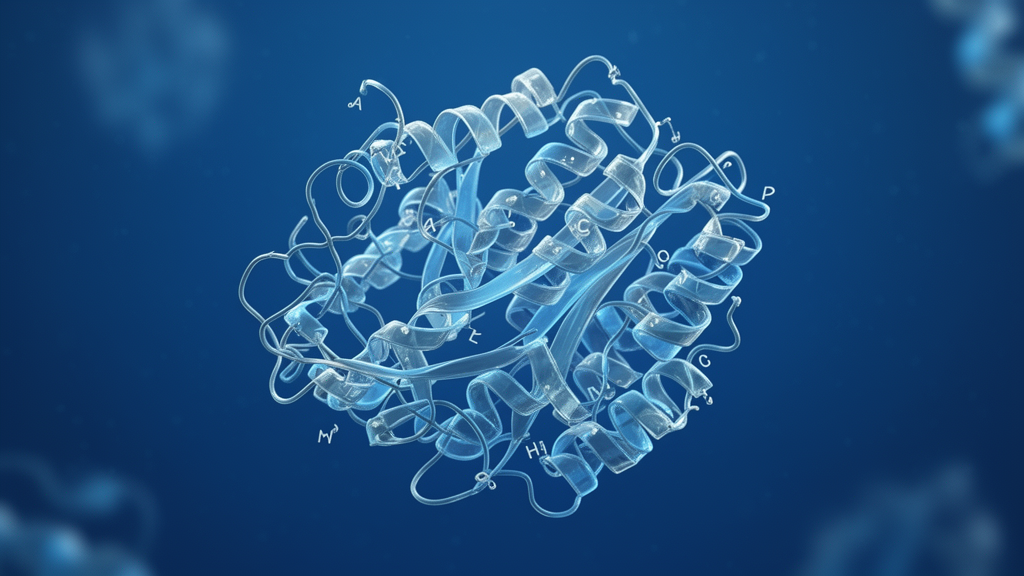
A computational analysis has demonstrated that an entire canonical amino acid can be removed from a proteome while broadly preserving native protein folds. All known life relies on a standard alphabet of twenty amino acids, yet determining which of these building blocks are structurally indispensable has remained untested across an entire proteome. Building on previous experimental work that eliminated isoleucine from ribosomal proteins in Escherichia coli, researchers developed a computational framework to evaluate whether a single amino acid could be systematically excised proteome-wide and to identify the most suitable candidate for removal.
To evaluate the structural necessity of each residue, the investigators introduced a metric termed the keep-score, defined as the fraction of sequence positions where the native amino acid remains the optimal choice. The team calculated this metric using two independent strategies: structure-based sequence probabilities generated by ProteinMPNN and evolutionary conservation derived from multiple sequence alignments. Both analytical approaches converged on glutamine as having the lowest keep-score across the proteome, whereas proline and glycine exhibited the highest scores, running counter to standard substitution-matrix expectations. The low keep-score of glutamine was not driven by a single dominant alternative, as glutamate was preferred in only fourteen percent of substitutions.
The researchers subsequently tested the structural consequences of proteome-scale recoding by replacing every glutamine residue across 4,148 proteins with alternatives identified as optimal by ProteinMPNN. When the recoded sequences were modeled using AlphaFold2, the resulting structures maintained native-like conformations. Specifically, 85.5 percent of the glutamine-free models achieved a TMscore greater than 0.8, a performance indistinguishable from the baseline rate of 85.9 percent observed when native sequences were rebuilt. Additional orthogonal evaluations, including structural predictions from ESMFold, energy calculations from Rosetta, and conformational ensemble comparisons, detected no evidence of systematic misfolding caused by the comprehensive removal of glutamine.
Evolutionary data and functional testing provided further support for the structural replaceability of the amino acid. Within prokaryotic genomes, twenty-four percent of Escherichia coli proteins possess naturally occurring glutamine-free orthologs, and glutamine also ranked lowest in keep-score within the eukaryotic model Saccharomyces cerevisiae. As an experimental consistency check, a glutamine-free variant of TEM-1 beta-lactamase designed using ProteinMPNN successfully conferred ampicillin resistance when expressed in Escherichia coli, demonstrating that structural preservation can translate into biological activity. Crucially, the authors emphasized that their findings represent a computational analysis of structural replaceability rather than proof of complete biological dispensability in living organisms.
Subject of Research: Proteome-scale computational removal of glutamine and structural fold preservation
Article Title: Folding without glutamine: Proteome-scale removal of a canonical amino acid
Article References: Garciarrubio, A., Ramos-Cerrillo, B., Morett, E., & Segovia, L. (2026). Folding without glutamine: Proteome-scale removal of a canonical amino acid. PLOS Computational Biology, 22(11), e1014931. https://doi.org/10.1371/journal.pcbi.1014931
Image Credits: AI Generated
DOI: 10.1371/journal.pcbi.1014931
Keywords: Protein Folding, Computational Biology, ProteinMPNN, AlphaFold2, Amino Acid Alphabet, Glutamine, Proteome Recoding, Escherichia Coli, Folding, without, Proteome-scale, removal
News Source: Drew Townsend. (November 10, 2026). Computational Study Shows Proteomes Can Preserve Folds Without Glutamine. Scienmag.