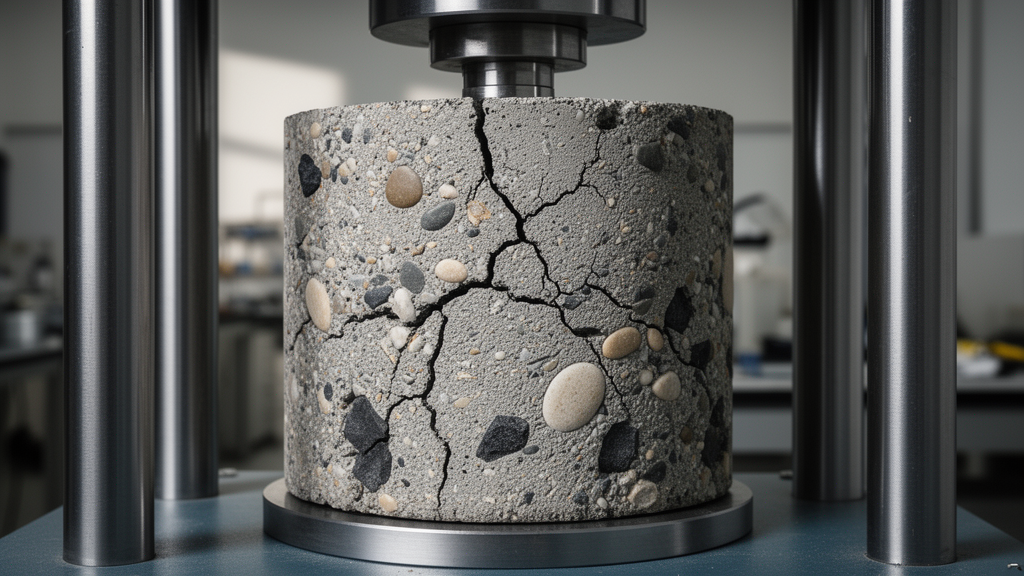
Compressive failure across mixed-aggregate concrete systems is governed by continuous mechanical competition among mortar matrix cracking, interfacial transition zone bond failure, and trans-aggregate fracturing rather than a single sudden phase collapse. In an investigation reported in Frontiers in Materials, researchers combined standardized physical laboratory testing with calibrated two-dimensional discrete element method simulations to track how internal stress and microstructural fractures redistribute across concrete formulated with differing proportions of lightweight porous shale ceramsite and dense crushed basalt coarse aggregates. By categorizing microscopic particle contacts into five distinct structural groups and monitoring simulated bond-breakage accumulations up to peak axial strain, the research team demonstrated that incorporating porous ceramic aggregates alters crack development patterns systematically without transferring primary failure control entirely away from the surrounding cementitious matrix.
To evaluate these interacting failure mechanisms experimentally, the investigators designed five distinct concrete mixtures using equal-volume coarse aggregate replacements of basalt with shale ceramsite across ratios of 0, 25, 50, 75, and 100 percent, labeled sequentially as mixtures C0, C25, C50, C75, and C100. Every mixture maintained an identical binder formulation comprising 408.0 kilograms per cubic meter of ordinary Portland cement, 76.5 kilograms per cubic meter of fly ash, 25.5 kilograms per cubic meter of silica fume, 745.8 kilograms per cubic meter of medium sand, and 163.2 kilograms per cubic meter of water, establishing a constant water-to-binder ratio of 0.32 along with 7.65 kilograms per cubic meter of polycarboxylate superplasticizer. Coarse aggregates spanned particle sizes between 5 and 20 millimeters, with the porous shale ceramsite possessing a cylinder compressive strength of 6.8 megapascals, an apparent density of roughly 1.35 tonnes per cubic meter, a bulk density of 0.78 tonnes per cubic meter, and a water absorption of 3.0 percent.
Standard experimental validation involved casting five 100-millimeter cubic specimens for each designated replacement mixture, curing them under controlled baseline laboratory environments for 28 days, and subjecting them to uniaxial compressive loading in a microcomputer-controlled universal servo testing machine at a prescribed loading rate of 0.5 megapascals per second. The physical compression results revealed a direct reduction in peak compressive strength as the volumetric proportion of shale ceramsite increased. The experimental mean compressive strength obtained from each batch served as the primary numerical target for adjusting mesoscale contact parameters within the computational discrete element framework, while macroscopic deformation profiles, axial peak strains, and visible crack trajectories across fractured cube surfaces provided direct physical context for evaluating simulated crack evolution paths.
The numerical modeling framework utilized particle flow code software to establish two-dimensional cross-sectional domains measuring 100 millimeters by 100 millimeters, reproducing the geometric cross section of the physical compression test cubes. Circular particles representing the cementitious mortar were generated with a minimum grain diameter of 0.5 millimeters, an upper-to-lower diameter ratio of 1.66, a material density of 2,630 kilograms per cubic meter, and a numerical local damping coefficient of 0.7. Coarse aggregate particles were not simplified as regular circular discs; instead, irregular aggregate clusters were produced by defining circular boundary limits according to prescribed spatial locations and particle sizes, followed by randomized vertex modifications that created realistic polygonal aggregate boundaries, repeating stochastic polygon generation until cross-sectional area discrepancies stayed within a strict one percent limit.
To simulate realistic interparticle cohesion and fracture, the computational framework incorporated the linear parallel-bond model, which assigns contact forces and moments across adjacent particles until limiting tensile or shear stress thresholds are exceeded. Contact interactions were segmented into five specific categories based on contacting material phases: mortar-to-mortar contacts, intra-ceramsite contacts, intra-basalt contacts, ceramsite-mortar interfacial transition zone contacts, and basalt-mortar interfacial transition zone contacts. Interfacial transition zones were represented without artificial physical layer thicknesses by directly assigning downscaled constitutive mechanical values to the boundary contacts.
Uniaxial compression was modeled numerically by advancing a rigid planar upper platen downward against the computational assembly at a steady velocity of 0.08 meters per second while restraining the opposing lower boundary wall, using an explicit dynamic time step of 1.942 times ten to the negative eighth seconds for mixture C50. The calibrated baseline model achieved close agreement with physical laboratory experiments, producing absolute relative deviations in peak compressive stress of 1.38 percent for C0, 0.28 percent for C25, 0.04 percent for C50, 0.31 percent for C75, and 1.10 percent for C100. Model deviations in axial strain at peak stress were slightly broader, recording deviations of 3.37 percent for C0, 7.80 percent for C25, 4.11 percent for C50, 14.66 percent for C75, and 2.38 percent for C100, closely capturing macroscopic diagonal shear cracking patterns observed experimentally.
Tracking individual bond-breakage occurrences across progressive strain levels revealed pronounced shifts in microcrack development governed by coarse aggregate composition. In the pure basalt mixture C0, simulated post-peak crack trajectories propagated almost exclusively through the cementitious mortar matrix and along basalt boundaries, leaving the basalt aggregate interiors virtually intact, which matched physical specimens where basalt aggregates remained unbroken and exposed on shear fracture surfaces. Conversely, as shale ceramsite was incorporated into mixtures C25 through C100, propagating cracks increasingly bisected the lightweight aggregate particles. In physical fracture inspections, sheared ceramsite particles showed trans-aggregate cleavage facets, affirming the numerical observation that crack trajectories preferentially intersect lower-strength porous inclusions rather than detouring around them.
Quantification of cumulative bond breakage at simulated peak axial strain using a dedicated phase-contribution index demonstrated a steady redistribution of damage across constituent phases. In mixture C25, intra-ceramsite fracture accounted for 19.99 percent of all recorded broken bonds, rising to 26.20 percent in C50, 29.11 percent in C75, and reaching 34.12 percent in the fully replaced C100 mixture. Concurrently, the relative contribution of matrix cracking diminished from 83.78 percent in pure basalt concrete C0 down to 57.40 percent in C100. Despite this substantial decrease in matrix damage proportion, cement mortar cracking consistently remained the single largest contributor to total peak-state microcracks across all five formulations, proving that incorporating weak aggregates leads to progressive damage redistribution rather than a total transfer of failure control.
Parametric simulations examining coupled interfacial transition zone properties, scaled simultaneously between 10 percent and 100 percent of bulk mortar values, revealed strong non-linear sensitivity during initial interfacial strengthening. Elevating the interface-to-mortar parameter ratio from 0.1 to 0.2 produced sharp compressive strength increases of 34.87 percent for C0, 28.31 percent for C50, and 18.14 percent for C100, whereas higher scaling increments yielded diminishing additional load-bearing gains. Monitoring accompanying bond histories demonstrated that when interfacial resistance was exceptionally weak, interfacial debonding dominated initial microcracking; as interfacial bonds were strengthened, premature interfacial cracking was suppressed, redirecting mechanical stress and driving subsequent microcrack formation deeper into the surrounding mortar matrix and within the interior of porous ceramsite inclusions.
Independent sensitivity analyses isolating aggregate interior strength revealed stark contrasts in how different mineral phases dictate overall structural resistance under compressive loading. Scaling internal bond cohesion and tensile strength between 100 percent and 300 percent of baseline values in the basalt-rich C0 model produced a negligible peak compressive stress gain of approximately 0.65 percent, demonstrating that reinforcing coarse rock that already resists fracturing provides minimal macroscale performance benefits. In sharp contrast, tripling the internal cohesion and tensile strength of ceramsite particles in the C100 model increased ultimate compressive stress by 18.01 percent, confirming that internal aggregate strength becomes a primary macroscopic governing factor only when inclusions possess lower intrinsic resistance than surrounding cementitious phases.
The authors noted specific analytical boundaries inherent to their numerical framework, emphasizing that the calibrated two-dimensional discrete element simulations neglect out-of-plane crack branching, three-dimensional particle interlocking, and spatial contact tortuosity found in physical cubic specimens. Furthermore, individual simulations utilized one representative aggregate geometry per replacement level, and parametric analyses adjusted cohesive, tensile, and elastic properties in coupled combinations rather than through isolated individual parameter sweeps. Future investigations incorporating three-dimensional rotational kinematics, multiple stochastic aggregate distributions, and full post-peak stress-strain tracking across diverse strain rates will help refine these mesoscale findings, providing a deeper mechanical foundation for designing balanced, crack-resistant lightweight mixed-aggregate concretes.
Subject of Research: Mesoscale damage redistribution and failure competition in shale ceramsite and basalt mixed-aggregate concrete
Article Title: Weak-phase competition and damage redistribution in shale ceramsite–basalt mixed-aggregate concrete: experimental observations and discrete element simulations
Article References: Yan, L., Xu, W., Liu, Y., Liu, Y., & Gao, H. (2026). Weak-phase competition and damage redistribution in shale ceramsite–basalt mixed-aggregate concrete: experimental observations and discrete element simulations. Frontiers in Materials, 13, Article 1934520. https://doi.org/10.3389/fmats.2026.1934520
Image Credits: AI Generated
DOI: 10.3389/fmats.2026.1934520
Keywords: concrete fracture, shale ceramsite, basalt aggregate, discrete element method, interfacial transition zone, compressive failure, mesoscale mechanics, structural materials, Weak-phase, competition, damage, redistribution
News Source: Denise Maddox. (November 10, 2026). Simulations Reveal How Damage Shifts Across Mixed Aggregate Concrete Under Compression. Scienmag.