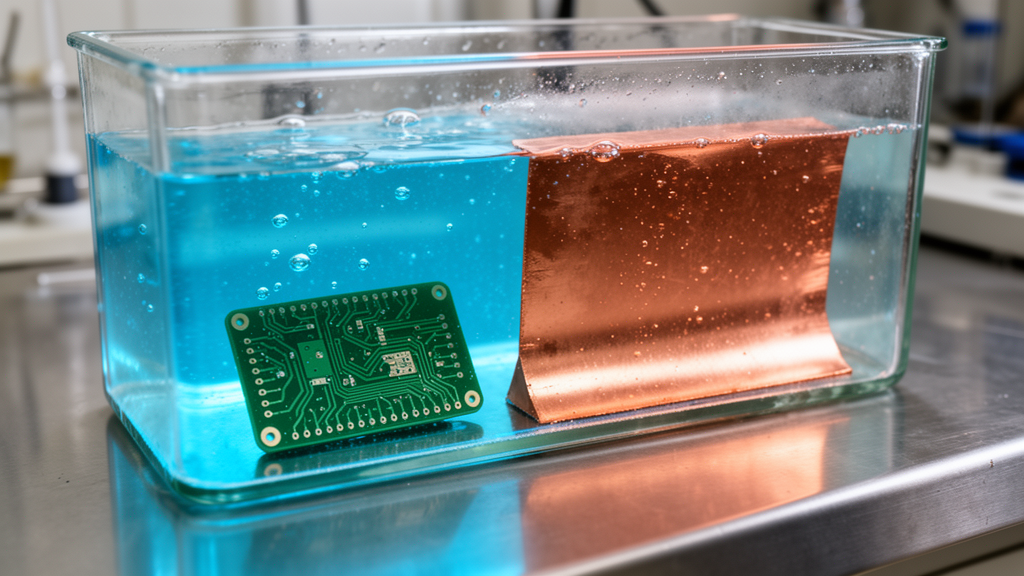
Researchers from a collaborative team led by Jaydeep Vishwakarma, Alexandre Chagnes, Alexandra Noirault, and Hakim Boudaoud have developed a low-temperature method for fabricating electrodes from waste printed circuit boards (WPCBs) to facilitate the electrorefining and electroplating of copper. Published in Results in Chemistry, the study presents a sustainable alternative to conventional high-temperature smelting, utilizing the inherent low-melting-point constituents of the waste material to bind powder particles at approximately half the standard sintering temperature of copper. This approach aims to reduce energy consumption and environmental impact while enabling the selective recovery of high-purity copper from electronic waste.
The motivation for this research stems from the growing volume of electronic waste, which the United Nations reported reached 62 million metric tons in 2022, an 82% increase compared to 2010. Waste printed circuit boards constitute 3–6% of this total and are rich in valuable metals such as copper, silver, and gold, but also contain hazardous substances like lead and mercury. Traditional recycling methods, including pyrometallurgy and hydrometallurgy, often require high capital costs, significant energy input, or generate hazardous byproducts. By targeting copper extraction through electrorefining before traditional hydrometallurgical processes, the researchers sought to reduce the burden on subsequent treatment steps and improve overall recycling efficiency.
The experimental process began with the mechanical and physical separation of WPCBs from mobile phones, computers, and other electronic equipment. The boards were crushed and ground to reduce particle size, followed by electrostatic separation to isolate metallic and non-metallic fractions. Magnetic separation and shaking table gravity segregation were then used to further refine the metallic concentrate. X-ray fluorescence spectroscopy (XRF) analysis revealed that the metallic concentrate contained 53% copper, along with significant amounts of zinc (6.1%), aluminum (11.3%), and silicon (2.8%). This composition confirmed that the concentrate was suitable for electrochemical processing, with copper as the dominant recoverable metal.
To prepare the powder for electrode fabrication, the researchers employed vibratory disc milling in a toluene solution to reduce the particle size from 0.2 to 0.5 mm to approximately 20 μm. This reduction in particle size was critical for achieving higher compaction density during die pressing. The fine powder was then compressed into electrodes using a hydraulic press at a pressure of 510 MPa. The compressed powder was sintered in a nitrogen inert atmosphere at three different conditions: 400 °C for 30 minutes, 420 °C for 2 hours, and 460 °C for 2 hours. Scanning electron microscopy (SEM) analysis indicated that the 420 °C treatment produced the optimal microstructure, with needle-like segregates and minimal porosity, whereas the 460 °C treatment resulted in undesirable globular segregates.
The study highlights the role of low-melting-point alloys, such as zinc and lead, in the sintering process. These elements acted as binders at lower temperatures, contributing to better binding of copper particles and improved electrode strength. This mechanism allowed the researchers to achieve sufficient mechanical integrity for electrochemical applications without the need for high-temperature melting, which typically causes metal loss, oxidation, and evaporation of volatile elements. The use of low-temperature sintering thus represents a significant energy efficiency improvement over conventional casting methods, which often require temperatures well above 1000 °C.
Electrorefining experiments were conducted in a self-made electrolytic chamber using a CuSO4/H2SO4 electrolyte solution. The sintered metallic concentrate served as the anode, while a pure copper plate acted as the cathode. The researchers tested three current densities: 190 A/m², 290 A/m², and 390 A/m². The goal was to identify the optimal conditions for balancing deposited copper quality, mass transport efficiency, and electrochemical efficiency. The tests were conducted for up to three hours, with samples analyzed at 30-minute intervals to monitor the morphology and composition of the deposited copper.
The results demonstrated that the electrorefining process could produce copper with high purity on the cathode. XRF analysis showed that the deposited copper purity remained high across all current densities, with no trace amounts of precious elements like gold or silver, or rare earth elements, detected on the cathode. This selectivity is a key advantage of the method, as it allows for the targeted extraction of copper while leaving other valuable metals in the anode slime for potential future recovery. The coulombic efficiency, which measures the ratio of experimental mass to theoretical mass, was found to be 80.8% at 190 A/m², 92.7% at 290 A/m², and 90.4% at 390 A/m² after three hours of operation.
Morphological analysis of the deposited copper revealed distinct differences based on current density. At the lowest current density of 190 A/m², the copper deposits exhibited a smoother, more uniform morphology, which is ideal for electroplating applications. In contrast, the highest current density of 390 A/m² resulted in rough surfaces with agglomerated, cauliflower-like structures, indicating dendritic growth and increased impurity incorporation. The intermediate current density of 290 A/m² offered a balance, producing pure copper deposits with a faster deposition rate, making it the optimal condition for electrorefining purposes.
To demonstrate the practical application of the recovered copper, the researchers performed electroplating on 3D-printed models, including a spectacle frame and an abstract statue. The models were printed using photocurable resin and coated with a conductive layer to enable electroplating. Using the optimized current density of 190 A/m² for 30 minutes, the team achieved coherent and adherent copper coatings on the complex substrates. This step illustrates the potential for integrating waste PCB-derived copper into additive manufacturing and electroforming industries, creating a closed-loop recycling system where waste material is transformed into functional components.
The study concludes that the low-temperature sintering approach effectively leverages the residual impurities in WPCB metallic concentrates to enhance electrode bonding and densification. By avoiding high-temperature processes, the method prevents the loss of valuable metals and reduces the environmental footprint of copper recovery. The findings establish an integrated recycling-manufacturing framework that offers dual advantages of energy efficiency and circular-economy relevance, providing a viable pathway for the sustainable management of electronic waste.
Earlier electrochemical recovery efforts demonstrated the feasibility of extracting copper, including slurry electrolysis achieving over 90 percent recovery and electrometallurgical systems recovering multiple metals. However, preparing suitable anodes from printed circuit board scrap historically required severe thermal inputs. Previous methods relied on casting molten metal into moulds or smelting polymetallic ingots to cut plates melted at 1200 degrees Celsius in graphite moulds. Those treatments frequently induced significant metal loss through the oxidation and evaporation of volatile elements like cadmium, arsenic, and antimony. In contrast, compressing milled fines at 510 megapascals bypassed melting entirely, relying on solid consolidation and residual low-melting alloys.
Powder and phase characterization verified the physical and crystallographic suitability of the feed material. Analysis of one hundred randomly selected particles showed dimensions strictly under fifty micrometers, providing the surface energy and packing density required to prevent weak green compacts, a common issue when powders exceed 150 micrometers. X-ray diffraction patterns collected between 20 and 90 degrees two-theta using copper K-alpha radiation matched face-centered cubic copper references across the (111), (002), (022), and (113) lattice planes. No secondary crystalline phases were observed in the concentrate or sintered samples. Upstream processing had already removed non-metallic fractions and isolated magnetic elements like iron and nickel, leaving a metallic concentrate where segregates larger than 100 micrometers formed during thermal treatment.
Electrorefining kinetics reflected distinct mass transport behaviors across the tested current densities. Cathode mass measurements recorded every thirty minutes revealed an average weight gain of 0.05 grams at 190 amperes per square meter, 0.12 grams at 290 amperes per square meter, and 0.08 grams at 390 amperes per square meter. At the lowest current density, the cathode experienced its largest mass increase within the first thirty minutes, whereas higher current densities peaked in later intervals. Theoretical yield calculations based on Faraday’s law, using two transferred electrons and Faraday’s constant of 96,485 coulombs per mole, confirmed that high efficiency was sustained throughout the three-hour runs despite diffusion constraints.
Electrolyte monitoring with microwave plasma atomic emission spectrometry clarified how non-target metals behaved during electrorefining. Over the three-hour operational window, the aqueous solution accumulated dissolved base metals, with zinc and iron displaying the highest concentrations, followed by aluminum, tin, bismuth, and nickel. Zinc reached concentrations exceeding 400 milligrams per liter at 190 and 390 amperes per square meter, while iron concentrations exceeded 200 milligrams per liter. Because copper has a higher reduction potential than these co-existing elements, the impurities preferentially dissolved into the electrolyte rather than co-depositing onto the cathode plate. Although these dissolved ions did not compromise deposit purity, researchers noted they could exert subtle influences on overall coulombic efficiency as concentrations accumulated.
The demonstration on additively manufactured models also involved specific preparation and finishing steps. The spectacle frame and abstract sculpture were designed with computer software, sliced, and printed using an SLA resin printer to achieve high structural density. After removal from the build platform, support structures were detached, and the components underwent ten minutes of degreasing in an ultrasonic bath. Once dried and coated with a conductive layer, each model served sequentially as the cathode in a 300-milliliter bath matching the electrorefining solution. Following thirty minutes of electroplating, the coated objects were rinsed with acetone, confirming that low-temperature compacted scrap electrodes can directly metallize complex polymeric objects.
Subject of Research: Low-temperature electrode fabrication from waste printed circuit boards for copper electrorefining and electroplating
Article Title: Low cost and low energy-based electrode fabrication from waste printed circuit boards for electrorefining and electroplating of copper
Article References: Vishwakarma, J., Chagnes, A., Noirault, A., & Boudaoud, H. (2026). Low cost and low energy-based electrode fabrication from waste printed circuit boards for electrorefining and electroplating of copper. Results in Chemistry, 32, Article 104007. https://doi.org/10.1016/j.rechem.2026.104007
Image Credits: AI Generated
DOI: 10.1016/j.rechem.2026.104007
Keywords: electronic waste, copper recovery, electrorefining, electroplating, printed circuit boards, sintering, powder metallurgy, sustainable recycling, electrochemistry, waste management, cost, energy-based
News Source: Bethany Barker. (November 10, 2026). Waste PCB Electrodes Enable Low-Energy Copper Electrorefining. Scienmag.