The shells of a sea creature, the mollusk Placuna placenta, are not only exceptionally tough, but also clear enough to read through. Now, researchers at MIT have analyzed these shells to determine exactly why they are so resistant to penetration and damage — even though they are 99 percent calcite, a weak, brittle mineral.
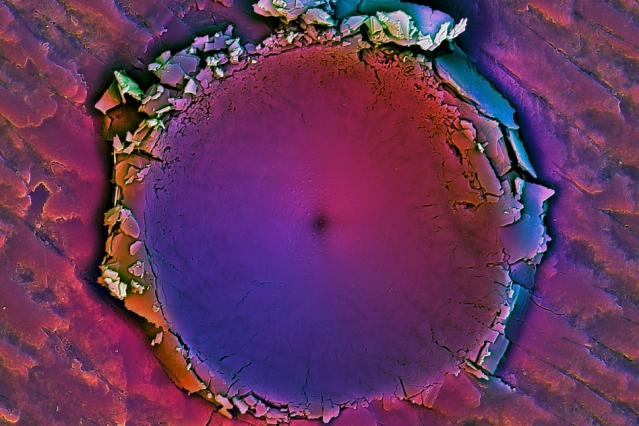
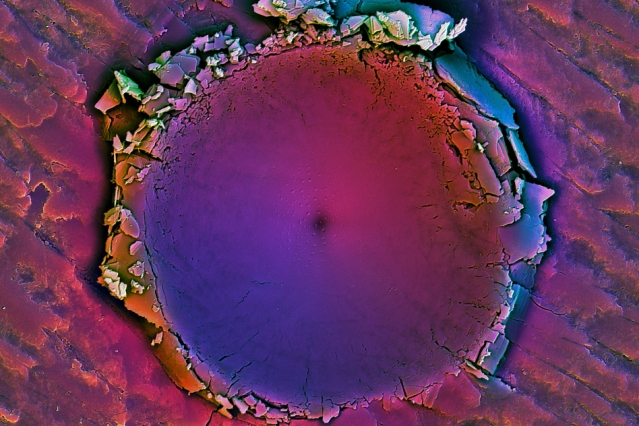
A Scanning Electron Microscope (SEM) image of the region surrounding an indentation the researchers made in a piece of shell from Placuna placenta. The image shows the localization of damage to the area immediately surrounding the stress.
Image: Ling Li and James C. Weaver
The shells’ unique properties emerge from a specialized nanostructure that allows optical clarity, as well as efficient energy dissipation and the ability to localize deformation, the researchers found. The results are published this week in the journal Nature Materials, in a paper co-authored by MIT graduate student Ling Li and professor Christine Ortiz.
Ortiz, the Morris Cohen Professor of Materials Science and Engineering (and MIT’s dean for graduate education), has long analyzed the complex structures and properties of biological materials as possible models for new, even better synthetic analogs.
Engineered ceramic-based armor, while designed to resist penetration, often lacks the ability to withstand multiple blows, due to large-scale deformation and fracture that can compromise its structural integrity, Ortiz says. In transparent armor systems, such deformation can also obscure visibility.
Creatures that have evolved natural exoskeletons — many of them ceramic-based — have developed ingenious designs that can withstand multiple penetrating attacks from predators. The shells of a few species, such as Placuna placenta, are also optically clear.
To test exactly how the shells — which combine calcite with about 1 percent organic material — respond to penetration, the researchers subjected samples to indentation tests, using a sharp diamond tip in an experimental setup that could measure loads precisely. They then used high-resolution analysis methods, such as electron microscopy and diffraction, to examine the resulting damage.
The material initially isolates damage through an atomic-level process called “twinning” within the individual ceramic building blocks: A crystal breaks up into a pair of mirror-image regions that share a common boundary, rather like a butterfly’s wings. This twinning process occurs all around the stressed region, helping to form a kind of boundary that keeps the damage from spreading outward.
The MIT researchers found that twinning then activates “a series of additional energy-dissipation mechanisms … which preserve the mechanical and optical integrity of the surrounding material,” Li says. This produces a material that is 10 times more efficient in dissipating energy than the pure mineral, Li adds.
The properties of this natural armor make it a promising template for the development of bio-inspired synthetic materials for both commercial and military applications — such as eye and face protection for soldiers, windows and windshields, and blast shields, Ortiz says.
Huajian Gao, a professor of engineering at Brown University who was not involved in this research, calls it “an excellent and elegant piece of work.” He says it “successfully demonstrates the effectiveness of nanoscale deformation twins in energy dissipation in bioceramics, and should be able to inspire and guide the development of manmade ceramic materials.” He adds, “As a first-of-its-kind [demonstration of] the effectiveness of deformation twins in natural materials, this work should have huge practical impact.”
The work was supported by the National Science Foundation; the U.S. Army Research Office through the MIT Institute for Soldier Nanotechnologies; the National Security Science and Engineering Faculty Fellowships Program; and the Office of the Assistant Secretary of Defense for Research and Engineering.
Story Source:
The above post is reprinted from materials provided by MIT NEWS