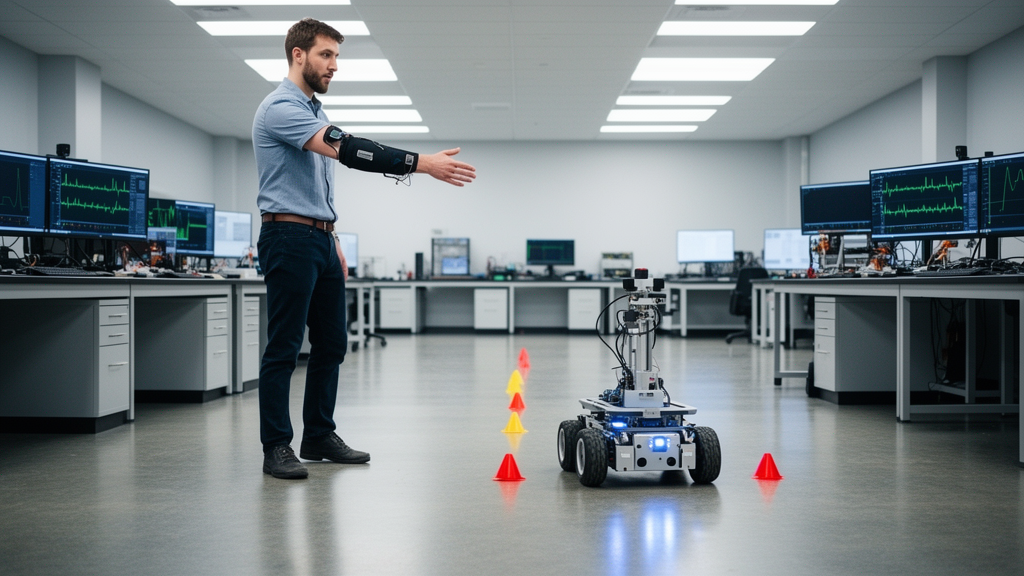
Researchers have developed a lightweight machine learning framework that translates non-invasive surface electromyography signals from a human arm into directional commands for a mobile robot, achieving an average classification accuracy of 92.8 percent across nine distinct gestures. Published in Discover Robotics by Iva Valentinova Valcheva, Vaibhav Gandhi, and Eris Chinellato, the study explores how electrical potentials generated during muscular contractions can provide responsive human-robot interaction without requiring computationally heavy hardware. Operating an eight-sensor Myo Armband, the team constructed an operational pipeline connecting raw biological data acquisition, signal conditioning, feature extraction, and real-time robotic actuation. This research targets longstanding obstacles in myoelectric control, where signal variability, computational overhead, and transmission latency have historically prevented laboratory algorithms from translating into practical robotic systems. In experimental evaluations, the models substantially exceeded the baseline chance accuracy of 11.1 percent expected from random gesture selection, demonstrating that computationally efficient classical algorithms can reliably direct physical devices with negligible latency.
Electromyography functions as an evaluative technique that detects and records electrical signals generated within skeletal muscle tissue during movement. Skeletal muscles attach directly to bones and tendons throughout the human body, facilitating voluntary movement through bundled muscle fibers containing actin and myosin proteins that interact to generate physical contractions. Electromyographic methodology is broadly divided into two primary approaches: intramuscular electromyography and surface electromyography. Intramuscular electromyography is an invasive procedure requiring needle electrodes inserted directly into specific muscles to monitor motor unit action potentials with high precision, yet it necessitates specialized clinical equipment and trained medical operators. In contrast, surface electromyography offers an accessible, non-invasive modality, positioning sensors on the skin over target muscle groups to record aggregate electrical activity. Although practical for consumer interfaces, assistive technology, and rehabilitation robotics, surface electromyography faces operational difficulties, including signal interference from subcutaneous adipose tissue, variable electrode impedance, motion artifacts, and electrical cross-talk arising from adjacent forearm muscles.
To acquire surface electromyographic signals without invasive procedures, the researchers utilized a commercial Myo Armband developed by Thalmic Labs. The wearable device incorporates eight surface electromyographic sensors and an internal inertial measurement unit, capturing muscular electrical activity within an amplitude detection span ranging from 0 to 2000 microvolts. The wireless armband is powered by an onboard rechargeable lithium-ion battery operating continuously for up to eight hours, maintaining a transmission distance of up to ten meters. During experimental trials, the band was positioned around the proximal forearm, with careful calibration ensuring that rectangular sensor pads maintained firm electrical contact with the skin and the manufacturer logo faced upward. This anatomical placement enabled the eight sensors to monitor key posterior and anterior forearm muscles. Specifically, the sensors recorded activity from the flexor carpi radialis, pronator teres, extensor carpi radialis, brachioradialis, and the extensor and flexor digitorum muscles, which jointly control wrist flexion, extension, forearm pronation, and finger articulation.
The data acquisition protocol engaged four participants, composed of an equal distribution of male and female subjects spanning diverse ages and physical body conditions. Every subject performed nine distinct arm and hand gestures, with each movement repeated ten times to construct a structured training dataset. The chosen gestures were designed to activate distinct forearm muscle compartments: a switch gesture involving flicking the middle finger twice off the thumb to produce a snap; a forwards directional command forming a gun shape with the index finger extended; a beckoning backwards motion performed with palm oriented upward; right, left, up, and down directional commands altering wrist orientation; a freeze command executed by twisting the wrist 180 degrees clockwise; and an on-off toggle sequence combining three separate movements: striking a closed fist against the other hand, striking with an open palm, and rotating the wrist 90 degrees to establish reliable robot control.
Because raw biological electrical signals are vulnerable to movement artifacts, powerline interference, and muscular cross-talk, systematic pre-processing was applied to enhance signal quality before feature extraction. A spectral assessment revealed that dominant frequency components across the recorded gesture data were concentrated below 50 Hz, with raw signal amplitudes spanning from approximately negative 80 microvolts to positive 80 microvolts. Consequently, the investigators implemented a fourth-order band-pass filter with cutoff frequencies set between 20 Hz and 50 Hz. Attenuating frequencies below 20 Hz suppressed low-frequency baseline drift and movement artifacts, while filtering frequencies above 50 Hz eliminated sensor noise and high-frequency interference. Forward-backward filtering was employed to achieve zero-phase distortion, effectively doubling the filter order. The signals were then full-wave rectified to convert bipolar fluctuations into unipolar absolute amplitudes, smoothed with a low-pass filter, and normalized relative to the 200 Hz sampling frequency to facilitate consistent filter performance and reliable feature extraction.
Following digital filtering, the researchers investigated ten mathematical feature extraction techniques to evaluate their capacity to differentiate gestures accurately. The examined algorithms included mean absolute value, waveform length, mean absolute value slope, number of crossings of the mean, difference absolute mean value, simple square integral, root mean square, variance of absolute values, absolute differential signal, and zero crossings. Experimental evaluations revealed sharp performance disparities between pre-filtered and post-filtered signals. For instance, zero crossings, number of crossings of the mean, and simple square integral exhibited near-zero accuracy on raw signals, whereas slope and differential metrics showed high discrimination. Conversely, evaluating features after signal filtering established a stable mean classification accuracy of 87.56 percent across five experimental sets, reaching 100 percent and never dropping below 75 percent. Based on stability and computational simplicity, mean absolute value, variance of absolute values, mean absolute value slope, and root mean square proved optimal for classification.
To determine the optimal classification algorithm for robotic operation, the investigators conducted comparative evaluations of multiple machine learning models across individual subject datasets and mixed-subject datasets. The inclusion of mixed-subject datasets allowed researchers to evaluate algorithmic resilience in realistic scenarios where multiple distinct users operate the same physical robot. The comparative assessment revealed that three models achieved superior accuracy: Random Forest delivered the highest average classification accuracy at 92.8 percent, followed by Linear Support Vector Machine at 89.6 percent and Extra Trees at 87.0 percent. However, detailed examination of confusion matrices led the authors to designate Linear Support Vector Machine as the optimal model for real-time deployment due to fewer prediction errors across gesture boundaries. Initialized with a linear kernel and a regularization parameter C of 0.025, the Linear Support Vector Machine achieved subject-specific classification accuracies ranging from 88 to 100 percent, offering superior computational efficiency and robust predictive reliability.
To demonstrate physical feasibility, the gesture classification framework was integrated into a complete robotic control architecture powered by the Robot Operating System. The physical platform consisted of a TurtleBot 4 Lite mobile robot operating alongside the Turtlesim simulation utility. A custom Python script running on the TurtleBot established a local socket server listening for incoming client messages on a designated port. As the client decoded incoming gesture data from bytes to a UTF-8 string, motion commands were queued into a directional buffer. A timer callback function executed every second popped the pending command and published a standard Twist message to the velocity topic, assigning linear and angular velocities to steer the physical base. Benchmarking demonstrated that the classifier generated and transmitted commands to the robot in approximately 0.000956 seconds, exhibiting negligible perceptual delay below 300 milliseconds and validating that lightweight machine learning models eliminate latency bottlenecks.
Physical deployment on the TurtleBot 4 Lite revealed several mechanical and functional boundaries that influenced robotic motion execution. The mobile robot operates across two spatial axes, permitting rotational maneuvering around its vertical Z-axis and linear translation along its longitudinal X-axis, but lacking mechanical degrees of freedom for lateral Y-axis translation. Consequently, executing a lateral command required the robot to execute an in-place rotation about the Z-axis prior to translating forward along the X-axis. Additionally, manufacturer safety protocols programmed into the TurtleBot base restricted negative velocities, preventing direct backward movement. Network limitations further precluded multiple TurtleBot units from sharing identical socket IP addresses during concurrent operations. To overcome these mechanical constraints and demonstrate the complete gesture repertoire, the investigators utilized the Turtlesim simulation platform. Turtlesim served as an effective substitute, successfully executing reverse translations, lateral Y-axis maneuvers, and concurrent multi-robot control schemes that could not be achieved directly on the physical mobile platform.
Despite the successful demonstration of near-real-time control and high classification accuracy, the authors identified several methodological boundaries and highlighted essential directions for subsequent engineering. The TurtleBot validation functioned primarily as an initial proof-of-concept demonstration rather than an exhaustive statistical evaluation, utilizing a fixed two-second processing window at a 200 Hz sampling rate without incorporating an independent testing dataset or multi-session evaluation. Because the system was trained directly on acquired repetitions without testing across separate experimental sessions, long-term generalizability against electrode displacement and skin impedance fluctuations remains unverified. Furthermore, the fixed two-second window captured signal rise and fall variations, occasionally incorporating quiescent muscle states that degraded accuracy. The researchers noted that future iterations must implement dynamic adaptive windowing to isolate active contractions, optimize feature selection using metrics like mean absolute value and root mean square, assess inter-session robustness, evaluate end-to-end hardware latency breakdowns, and explore edge computing processors to ensure dependable control.
Subject of Research: Surface electromyography and machine learning for robotic device control
Article Title: Surface EMG driven gesture recognition using machine learning for robotic applications
Article References: Valcheva, I. V., Gandhi, V., & Chinellato, E. (2026). Surface EMG driven gesture recognition using machine learning for robotic applications. Discover Robotics, 2(1), Article 4. https://doi.org/10.1007/s44430-026-00018-4
Image Credits: AI Generated
DOI: 10.1007/s44430-026-00018-4
Keywords: surface electromyography, robotics, machine learning, gesture recognition, TurtleBot, support vector machines, biomedical engineering, human-robot interaction, Surface, driven, gesture, recognition
News Source: Denise Maddox. (November 10, 2026). Machine Learning Framework Translates Arm Muscle Signals Into Real-Time Robot Navigation. Scienmag.