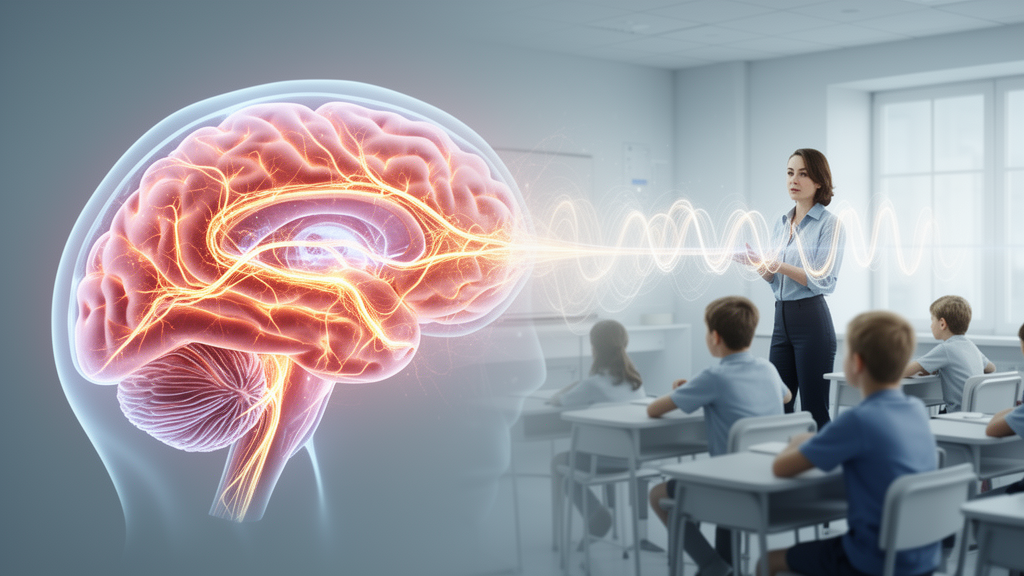
A fundamental reorientation in educational neuroscience proposes using interpersonal neural synchronization as a key biomarker to investigate how human brains interact during authentic classroom learning, according to a perspective review published by researcher Chunming Lu in AI, Brain and Child. The review assesses how tracking the covariation of neural activity between teachers and students over time can bridge the longstanding divide separating laboratory neuroscience from real-world educational practice. Rather than examining isolated individuals performing artificial tasks, the paper argues that educational neuroscience must establish its own independent research paradigms grounded in the inherently social, communicative, and interactive nature of human teaching and learning.
For decades, traditional learning research has heavily conflated human classroom education with general cognitive processes derived from strictly controlled laboratory setups and animal experiments. Classical conditioning and operant conditioning models, largely established through animal research, framed learning primarily as a passive stimulus-response mechanism that overlooks the active social architecture of schooling. Although animal studies have illuminated fundamental neural pathways—such as how perceptual and semantic category associations appear in the early stages of neocortical visual processing, or how the hippocampus encodes initial details before projecting them to the neocortex for abstract knowledge consolidation—these isolated paradigms fail to reflect the unique cognitive realities of students navigating an authentic classroom environment.
The review emphasizes that human school education represents a sophisticated cultural transmission system that fundamentally distinguishes human learning from the social learning observed in other animals. While humans share basic group-living characteristics and social learning behaviors with other higher social animals such as chimpanzees, school education introduces uniquely human cognitive and neural mechanisms. Classroom instruction relies heavily on continuous intent inference, complex linguistic communication, metacognition, and motivation regulation. Because behaviors and cognitive operations correspond directly to specific patterns of brain activity, investigating these human-specific educational processes requires neuroscientific methods capable of observing neural dynamics within natural social environments.
Historically, educational neuroscience has struggled with what educator John Bruer termed in 1997 a bridge too far, describing the persistent conceptual and methodological gap between fundamental neuroscience and practical pedagogy. The perspective argues that educational neuroscience has too often functioned merely as an indirect translator of cognitive neuroscience findings, rather than directly tackling genuine educational challenges. To overcome this limitation, the field must synthesize theories and empirical methodologies across psychology, education, and neuroscience, using non-invasive neuroimaging tools such as functional near-infrared spectroscopy, electroencephalography, and functional magnetic resonance imaging to capture neural processes safely and harmlessly during natural teaching interactions.
At the center of this proposed paradigm shift is interpersonal neural synchronization, defined as the temporal covariation of brain activity time series across two or more interacting individuals. Interpersonal neural synchronization captures both shared neural responses elicited by common sensory inputs and dynamic neural coupling generated through bidirectional information exchange over time. While conventional educational research focused predominantly on individual internal cognitive architectures, such as isolated hippocampal-cortical memory networks, real educational contexts inherently involve multi-party communication and collaboration that register neurally as synchronized brain activity across participants.
Empirical support for this interactive paradigm originated in naturalistic communication studies before expanding into instructional environments. Early research in 2012 demonstrated that face-to-face free dialogue robustly elicits interpersonal neural synchronization, whereas eliminating visual contact or bidirectional interaction significantly diminishes this neural coupling. Subsequent educational applications revealed that teacher-student neural synchrony emerges during Socratic dialogue and correlates positively with student learning outcomes. Researchers later scaled these measurements to entire classroom cohorts, demonstrating that brain-to-brain synchrony across groups of students reliably tracks collective engagement and classroom social dynamics.
Beyond serving as an indicator of student engagement, interpersonal neural synchronization provides a functional window into the sequential architecture of instructional delivery and interpersonal rapport. Neuroimaging investigations have shown that distinct patterns of brain synchrony correspond to different instructional phases, tracing transitions from basic linguistic exchange to active knowledge transmission. Furthermore, teacher-student rapport functions as a critical social-emotional bond that manifests as synchronized neural activity even during resting states, providing an empirical neurobiological basis for the pedagogical importance of strong interpersonal relationships between educators and learners.
Recent classroom investigations have begun decoding implicit cognitive operations that remain invisible through external behavioral observation alone. In an empirical study evaluating knowledge construction, pre-class preparation fundamentally altered brain activation and synchronization during subsequent classroom instruction. When students engaged in prior self-study, subsequent teaching predominantly activated their prefrontal cortex, which governs logical reasoning and working memory, while simultaneously enhancing interpersonal neural synchrony between the teacher’s temporoparietal junction and the students’ prefrontal cortex. In contrast, teaching delivered without pre-class preparation elicited heightened student activation in the temporoparietal junction—reflecting increased social cognitive effort spent inferring the instructor’s intentions in real time—accompanied by reduced prefrontal synchrony.
Representational similarity analyses in that same investigation revealed that students reconstruct overall knowledge structures during independent pre-class preparation, whereas classroom instructional time is dedicated to processing specific, detailed knowledge points. This sequence directly challenges conventional learning models that assume cognitive progression moves strictly from local details to global knowledge frameworks. In addition, classroom neuroimaging has clarified the dynamics of student attention distribution. Rather than tracking the physical acoustic properties of spoken sounds, dynamic shifts in classroom attention correspond significantly to semantic coherence, with interpersonal neural synchronization between speakers and listeners effectively segmenting distinct attentional states based on the logical consistency of an instructor’s speech.
The interpersonal neural synchronization paradigm has also extended to early childhood education, where portable functional near-infrared spectroscopy bypasses the compliance challenges of conventional magnetic resonance scanners during free play and natural interaction. Research in preschool populations demonstrates significant physiological rhythm synchrony and neural coupling between parents and young children, with high-quality interaction supporting cognitive and linguistic development. Shared reading activities specifically enhance language acquisition in children older than two years, indicating a critical developmental window. In observational learning paradigms, children imitate maternal behavior through neural replay mechanisms indexed by inter-brain synchronization, a social learning process that single-brain metrics fail to detect.
In special education, interpersonal neural synchronization provides an objective diagnostic and evaluative biomarker, particularly for hearing-impaired infants and toddlers whose low compliance and subtle behavioral cues limit conventional testing. Recent research indicates that maternal brain activity and parent-child neural synchronization accurately predict the auditory and linguistic abilities of hearing-impaired children, achieving predictive validity that surpasses measurements derived exclusively from the children’s individual brain activity. Crucially, maternal neural activity and dyadic synchrony remained superior predictors of child rehabilitation outcomes following six months of intervention, demonstrating the clinical utility of multi-brain metrics in developmental interventions.
Ultimately, the review emphasizes that the future of educational neuroscience relies on establishing independent methodologies specifically tailored to authentic social learning rather than translating decontextualized findings from animal or single-brain laboratory studies. As portable functional neuroimaging technologies continue to mature alongside advanced machine learning algorithms capable of analyzing complex multi-brain datasets, the field is positioned to integrate deeply into everyday classroom settings. By embracing the social, interactive human brain, educational neuroscience aims to construct a rigorous, empirically grounded science of teaching and learning that directly informs and personalizes instructional practice.
A central conceptual challenge highlighted in the review involves delineating how formal schooling serves as an evolutionary cultural transmission system. Although humans share baseline group-living traits with non-human social species such as chimpanzees, individual students exhibit diverse social preferences, spanning preferences for solitude to strong inclinations toward interpersonal interaction. Yet despite these personal differences, all human learners remain fundamentally reliant on social collectives. Lu outlines two unresolved research questions critical to grounding the field: first, pinpointing which specific components of classroom instruction are strictly unique to the human species, and second, determining how those instructional elements systematically facilitate both the transmission of complex knowledge and the broader evolution of human culture through institutional schooling.
The perspective also underscores the interpretive limitations of relying on isolated laboratory models to explain authentic educational phenomena. While fundamental neuroscience has illuminated how the hippocampus encodes granular information before projecting representations into the neocortex to form abstract knowledge networks, and animal experiments have demonstrated that perceptual and semantic category associations emerge during early neocortical visual processing, it remains unclear how these early sensory representations map onto classroom category acquisition. Traditional frameworks that focus exclusively on internal cognitive networks overlook how educational settings introduce bidirectional information flows between individuals over time. Furthermore, empirical investigations demonstrate that examining an individual child’s brain activity in isolation fails to identify the neural replay mechanisms that underpin observational imitation during social learning.
Methodologically, advancing this multi-brain framework depends on integrating continuous technological and computational innovations directly into natural school environments. Because capturing the simultaneous neural dynamics of interacting teachers and learners generates complex, high-dimensional datasets, researchers increasingly require sophisticated machine learning algorithms and artificial intelligence tools to analyze multi-brain time series. By moving past the historic lack of international consensus regarding its core conceptual connotations and research paradigms, educational neuroscience aims to leverage portable neuroimaging and multi-brain analytics to directly address practical educational questions. This shift opposes functioning merely as an indirect translator of cognitive neuroscience, instead seeking to establish independent methodologies capable of delivering actionable, personalized insights into authentic classroom instruction.
Subject of Research: Interpersonal neural synchronization and research paradigms in educational neuroscience
Article Title: From lab to classroom: the rise of interpersonal neural synchronization in educational neuroscience
Article References: Lu, C. (2025). From lab to classroom: the rise of interpersonal neural synchronization in educational neuroscience. AI, Brain and Child, 1(1), Article 18. https://doi.org/10.1007/s44436-025-00019-x
Image Credits: AI Generated
DOI: 10.1007/s44436-025-00019-x
Keywords: educational neuroscience, interpersonal neural synchronization, classroom learning, fNIRS, teacher-student interaction, social brain, early childhood education, cognitive neuroscience, classroom, rise, interpersonal, neural
News Source: Cassandra Pierce. (November 10, 2026). Brain Synchronization Between Teachers and Students Reveals How Real Classrooms Learn. Scienmag.