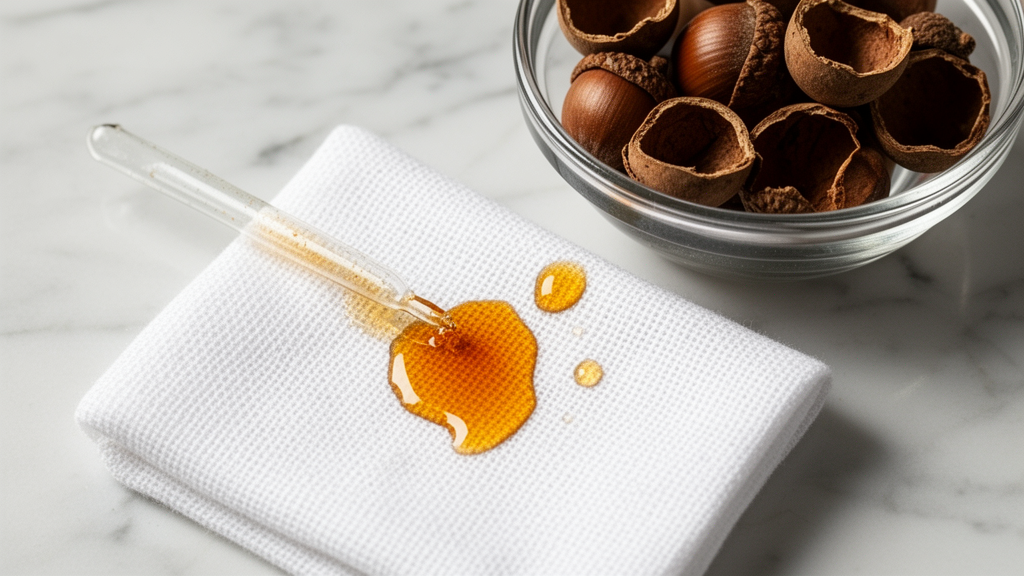
Published in the journal Fashion and Textiles in February 2026, the study presents a method for utilizing agricultural by-products that are typically discarded during food processing. The primary objective of the research was to develop a sustainable approach for textile finishing that reduces reliance on synthetic chemicals while valorizing waste biomass. By applying acorn shell extract to cotton fabrics, the team aimed to create a multifunctional treatment that imparts both biological activity and distinct coloration to the textile substrate.
The study focused on the shells of Quercus variabilis, a species widely distributed across Korea. Acorn shells are rich in bioactive phenolic compounds, including tannins, flavonoids, and phenolic acids, which have been documented for their antioxidant and antimicrobial effects. Although acorns are commonly used in food and livestock feed industries, the shells are often discarded as waste. Previous research has identified the shell as the part of the acorn with the highest concentration of these secondary metabolites, making it a promising candidate for extraction.
To prepare the finishing agent, the researchers subjected 100 grams of dried acorn shells to hot aqueous extraction. The shells were boiled in 1.5 liters of distilled water for two hours to recover the bioactive compounds. The resulting crude extract was filtered to remove solid residues and then freeze-dried to produce a stable powder. This powder was pulverized to achieve a uniform particle size suitable for textile application. Chemical analysis using high-resolution mass spectrometry identified the primary phenolic constituents of the extract as gallic acid, ellagic acid, catechin, and protocatechuic acid. The total phenolic content of the extract was measured at 144.57 mg GAE/g, indicating a high concentration of bioactive molecules.
The application of the extract to cotton fabrics was performed using a pad-dry-cure technique. Cotton was selected as the substrate due to its widespread use in apparel and its chemical structure, which contains abundant hydroxyl groups that readily interact with phenolic compounds. The researchers tested six different extract concentrations, ranging from 0.5 wt% to 10 wt%. Fabric samples were immersed in aqueous solutions of the extract for 30 minutes, followed by padding to achieve a wet pickup rate of approximately 100%. The impregnated fabrics were dried at 85 degrees Celsius and heat-cured at 160 degrees Celsius for three minutes to promote the fixation of the extract onto the fiber surface. This process was designed to ensure that the bioactive agents were effectively bound to the cotton cellulose.
Post-treatment analysis revealed that the extract was successfully deposited onto the cotton surface, resulting in a nearly proportional increase in fabric weight as the extract concentration increased. This add-on percentage indicated a strong binding affinity between the bioactive constituents and the cotton cellulose. Scanning electron microscopy showed distinct morphological changes on the surface of the treated fabrics compared to pristine cotton. The surface of the treated samples appeared coated with the extract, which correlated with the observed weight gain. The researchers noted that the affinity of the acorn shell extract for cotton cellulose appeared greater than that of chestnut shell extract, a comparison based on previous work by the same team. This difference may be attributed to the compositional characteristics of the acorn shells, which are predominantly lignocellulosic, leading to a higher concentration of lower molecular weight bioactive compounds in the aqueous extract.
Colorimetric analysis demonstrated that the acorn shell extract imparted a distinct yellowish-brown coloration to the cotton fabrics. As the extract concentration increased, the fabrics exhibited a reduction in lightness and an increase in redness and yellowness coordinates. The color strength, measured as K/S values, also increased with concentration. The researchers attributed this coloration to the presence of tannins, which undergo oxidation upon exposure to atmospheric oxygen. This process leads to the formation of pigmented tannin-protein complexes, resulting in the observed brown hues. The most pronounced color development was observed at the highest concentration of 10 wt%, suggesting that the extract could serve as a natural dye for textiles seeking earth-toned palettes.
Fourier-transform infrared spectroscopy provided evidence of chemical interactions between the extract and the cotton fibers. The spectra of the treated fabrics displayed characteristic absorption bands of cellulose, along with a distinct band near 1725 cm-1 indicating the presence of carbonyl and carboxyl functionalities from the phenolic constituents. A shift in the peak associated with O-H bending vibration was also observed, which the researchers attributed to the formation of hydrogen bonds between the extract and the cellulose.
The functional performance of the finished fabrics was evaluated for antimicrobial and antioxidant activities. The antimicrobial efficacy was tested against Staphylococcus aureus, a gram-positive bacterium, and Klebsiella pneumoniae, a gram-negative bacterium, using the ISO 20743 standard. Fabrics treated with extract concentrations greater than 5 wt% exhibited over 99.9% antimicrobial efficacy against both bacterial strains. This high level of reduction in bacterial count suggests that the phenolic compounds in the acorn shell extract are effective in inhibiting microbial growth on the textile surface. The results align with previous studies that have reported the bactericidal effects of acorn shell extracts against various bacterial strains, including those that form biofilms.
Antioxidant activity was assessed using the DPPH radical scavenging assay. The treated fabrics demonstrated antioxidant activity exceeding 90% at concentrations as low as 0.5 wt%. The antioxidant performance appeared to plateau at 5 wt%, indicating that lower concentrations may be sufficient to achieve maximum radical scavenging capacity. The researchers noted that the antioxidant performance of the acorn shell-treated fabrics exceeded that of chestnut shell-treated fabrics reported in their previous studies. This superior performance is likely due to the higher total phenolic content of the acorn shell extract, particularly the presence of gallic and ellagic acids, which are potent natural antioxidants. The ability to impart such high antioxidant activity at low concentrations highlights the efficiency of the acorn shell extract as a functional finishing agent.
However, the durability of these functional properties was found to be limited. To evaluate wash fastness, the treated fabrics were subjected to three laundering cycles according to ISO 105-C06. After laundering, the fabric treated with 10 wt% extract retained over 99.9% antibacterial efficacy against S. aureus, but the reduction rate against K. pneumoniae decreased substantially to 26.8%. The DPPH radical-scavenging activity also dropped to 61.4% after three washes. These results indicate that while the initial functional performance is excellent, the retention of these properties over multiple washes is a significant challenge. The researchers emphasize that enhancing the wash fastness of acorn shell extract-treated cotton fabrics will be essential for their practical application in consumer textiles, warranting further methodological optimization in future studies.
The study concludes that acorn shell extract is a promising bio-based agent for textile finishing, offering a dual benefit of antimicrobial and antioxidant functionality along with natural coloration. The findings support the potential of agricultural by-products as valuable resources for sustainable textile production, contributing to the principles of the circular economy. By utilizing a waste stream from the food industry, this approach reduces environmental impact and provides a natural alternative to synthetic finishing agents. The moderate concentration of around 5 wt% appears optimal for functional finishing, while higher concentrations may be preferred for applications where color development is a primary goal.
Despite the promising results, the study acknowledges limitations regarding the long-term durability and skin compatibility of the treated fabrics. Further research is needed to optimize treatment conditions for industrial scale-up and to ensure the safety of the finished textiles for human contact. The current findings provide a foundational understanding of the chemical and functional interactions between acorn shell extract and cotton, paving the way for the development of more environmentally conscious textile treatments. As the textile industry seeks to minimize its ecological footprint, the valorization of such bioactive by-products represents a significant step toward sustainable material innovation.
Subject of Research: Acorn shell extract as a potential functional finishing agent for textile applications
Article Title: Acorn shell extract as a potential functional finishing agent for textile applications
Article References: Hong, K. H. (2026). Acorn shell extract as a potential functional finishing agent for textile applications. Fashion and Textiles, 13(1), Article 5. https://doi.org/10.1186/s40691-026-00455-0
Image Credits: AI Generated
DOI: 10.1186/s40691-026-00455-0
Keywords: Acorn, shell, extract, potential, functional, finishing, agent, textile, applications, scientific research
News Source: Denise Maddox. (November 9, 2026). Acorn Shell Extracts Provide Antimicrobial Finishing for Cotton. Scienmag.