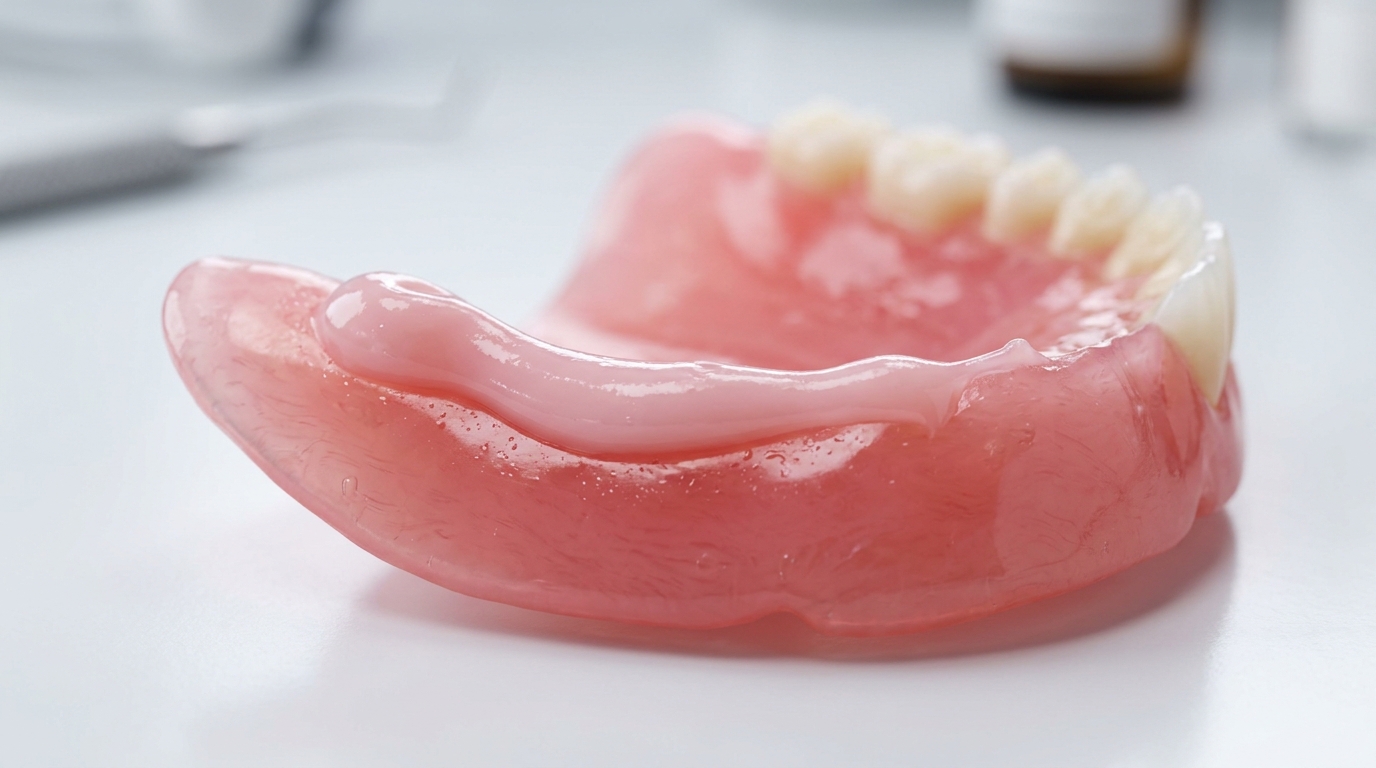
Researchers have developed a multi-parameter viscoelastic material model that predicts the mechanical behavior of denture adhesives under varying oral physiological conditions. Published in BMC Biomedical Engineering in September 2024, the study utilizes time-temperature superposition and multiple linear regression analysis to quantify the influence of temperature, adhesive swelling, and pH on the storage and loss moduli of the material. The primary objective was to statistically determine the significance of these physiological variables and integrate them into a mathematical framework suitable for finite element method simulations. This approach aims to facilitate more accurate numerical investigations of how denture adhesives perform within the dynamic environment of the human oral cavity.
The study focused on a denture adhesive comparable to Corega Comfort, manufactured by GSK Oral Health. The material was primarily composed of Calcium/Sodium PVM/MA Copolymer, Petrolatum, and Cellulose Gum as active ingredients, with Paraffinum Liquidum as an inactive ingredient. Denture adhesives are commonly prescribed to improve masticatory performance and retention for edentulous patients. By enhancing adhesion between the oral mucosa and the denture surface, these adhesives help mitigate displacement during biting and chewing forces. Previous numerical studies using the finite element method have illustrated the potential of these adhesives to stabilize dentures, but such simulations require accurate material laws to characterize the adhesive’s response to various bite loads.
The research team employed steady-state frequency sweep tests using a rotational rheometer with a parallel plate configuration to measure the rheological properties of the adhesive. The tests were conducted at a shear rate of 0.3% over a frequency range of 0.01 Hz to 10 Hz, with 10 measurement points for each decade of the interval. The adhesive was subjected to temperatures ranging from 17 °C to 52 °C in steps of 5 °C. Additionally, the rheological tests were performed at three distinct pH values: 2, 7, and 10, representing acidic, neutral, and alkaline conditions, respectively. The adhesive was also tested at specific levels of swelling until saturation, with measurements taken in steps of 20%.
To assess the impact of these physiological variables, the researchers applied multiple linear regression analysis to the experimentally derived storage and loss modulus values. The analysis was conducted with a confidence level of 98%, where the probability of observing a response was evaluated through p-values. The null hypothesis assumed that the predictor variables—temperature, swelling ratio, and pH—did not influence the response variables. The results indicated that the p-values for temperature and swelling ratio were less than 0.0001 for both storage and loss modulus predictions. The p-values for all three variables were below the significance threshold of 0.02, leading to the rejection of the null hypothesis. This statistical evidence confirmed that the physiological parameters significantly affect the mechanical behavior of the denture adhesive.
The multiple linear regression analysis demonstrated that the predictor variables could estimate the loss and storage modulus with reasonable accuracy. The adjusted R-squared value for the model was 0.85, indicating that approximately 85% of the variation in the rheologically determined continuous relaxation spectrum could be explained by the model. This level of prediction was considered robust given the variability and complexity of the test specimen. When the highest residuals were excluded, the R-squared value increased to approximately 0.95, suggesting a strongly predictive relationship. These findings underscore the utility of the physiological parameters in modeling the viscoelastic properties of the adhesive.
Pearson’s correlation coefficient was used to measure the strength of the linear relationship between the independent physiological variables and the dependent modulus values. The analysis revealed that temperature and swelling ratio had a strong influence on the loss modulus, whereas pH exhibited a weaker correlation. The temperature showed a higher Pearson’s R value for both storage and loss modulus, indicating a significant linear relationship. The swelling ratio also demonstrated a strong correlation, with a direct positive effect on the storage modulus and an inverse negative effect on the loss modulus. The correlation for pH was much lower compared to temperature and swelling, likely due to the limited experimental data, which included only three discrete pH values.
The development of the viscoelastic material model incorporated the time-temperature superposition principle to account for the horizontal shift in the relaxation spectrum with temperature changes. The horizontal shift factors were evaluated using the Arrhenius shift factor, a method previously illustrated in related work. The model utilized Prony series discretization to approximate the continuous relaxation spectrum obtained from rheological measurements. This discretization allows for the numerical implementation of the material behavior in finite element simulations. The choice of the number of terms in the Prony series was based on the accuracy of the fit curve, ensuring a precise representation of the relaxation spectrum.
The final mathematical expression for the shear relaxation modulus included parameters for temperature, swelling ratio, and pH. The model defined the relaxation times and amplitudes for each element of the Prony series as functions of the swelling ratio and pH. Given the weak correlation of pH with the modulus values, the equation was simplified by ignoring the pH parameter in one of the proposed forms. This simplified model, which accounts for temperature and swelling ratio, is hypothesized to capture the effects of the physiological variables satisfactorily. The model can be implemented in standard commercially available finite element software packages, such as ANSYS, using specific tools for viscoelastic material definitions.
The study acknowledges several limitations in its scope and methodology. The model is limited to the influence of temperature, pH, and swelling, neglecting other potential parameters in the oral cavity. The consideration of these specific variables was based on the crucial role of saliva and the inherent viscosity of the adhesive. The experimental data for pH was statistically limited to three discrete values, which may not fully capture the range of pH variations encountered in the oral cavity. Consequently, the impact of pH on the shear moduli requires further experimental investigation to be more confidently integrated into the numerical material model. The study emphasizes the need for additional data to refine the model’s predictive capabilities regarding pH effects.
This multi-parameter viscoelastic material model provides a foundation for future detailed numerical investigations of denture adhesives. By incorporating physiological variables into the material model, researchers can better understand the behavior of denture adhesives under various bite loads and oral conditions. The model can facilitate the optimization of denture adhesive formulations and support oral healthcare providers in improving denture performance. Although denture adhesives are temporary materials, they significantly contribute to contact stresses on soft tissue and dental structures. The proposed model enhances the details regarding the stress state in the denture-soft tissue interfaces, potentially aiding in patient-specific care and the development of holistic finite element based models.
The statistical framework underpinning this model relies on the distinction between energy storage and dissipation within viscoelastic materials. In this context, the storage modulus, denoted as G′, quantifies the magnitude of energy stored in the material during deformation, while the loss modulus, G″, describes the energy lost due to dissipation. This differentiation is critical for characterizing the mechanical response of polymeric substances like denture adhesives, which exhibit time-dependent and rate-dependent behavior. The study utilized these moduli as dependent variables in the regression analysis, allowing the researchers to map how specific oral physiological conditions alter the adhesive’s capacity to store or dissipate energy. By treating these rheological properties as outputs influenced by temperature, pH, and swelling, the model provides a quantitative basis for understanding material performance beyond simple qualitative observations.
The experimental design incorporated a specific range of physiological variables to simulate the dynamic environment of the human oral cavity. The adhesive was tested at temperatures spanning from 17 °C to 52 °C, with increments of 5 °C, to capture the thermal variations experienced during oral function. The pH levels were set at 2, 7, and 10, representing acidic, neutral, and alkaline conditions, respectively. Although these three discrete points provide a broad spectrum, the researchers noted that the statistical power for pH was limited by the small number of data points. The swelling ratio was measured in steps of 20% until saturation, reflecting the interaction between the adhesive and saliva. This comprehensive testing protocol allowed for the isolation of individual variable effects while maintaining the complexity of the oral environment.
The application of time-temperature superposition was essential for consolidating the relaxation spectra obtained at different temperatures. The observed horizontal shifts in the spectra were evaluated using the Arrhenius shift factor, a method that enables the construction of a master curve from data collected at various thermal conditions. This approach simplifies the mathematical representation of the material’s behavior over time by accounting for the temperature-dependent shift in the relaxation spectrum. The resulting shift factor, denoted as a_θ, is integrated into the relaxation modulus equation, allowing the model to predict material response at any given temperature within the tested range. This technique is particularly useful for viscoelastic materials where the relaxation time scales significantly with temperature changes.
The final model equations, specifically Equations 3 and 4, define the shear relaxation modulus as a function of time, temperature, swelling ratio, and pH. Equation 3 includes all three physiological variables, while Equation 4 simplifies the model by excluding pH due to its weaker statistical correlation with the modulus values. The model parameters, including the number of Prony series terms, relaxation times, and amplitudes, are dependent on the specific physiological conditions. This flexibility allows the model to be adapted for different scenarios within the oral cavity. The use of Prony series discretization with three terms was chosen based on the accuracy of the fit curve, ensuring that the discrete approximation closely matches the continuous relaxation spectrum derived from experimental data.
Implementing this model in finite element analysis software, such as ANSYS, requires specific adjustments to account for the viscoelastic properties. The study suggests using the Narayanaswamy shift function, which is a simplification of the Arrhenius shift function, to handle the temperature dependence in the software. This integration enables researchers to simulate the stress state at the denture-soft tissue interface with greater precision. By incorporating the multi-parameter model, numerical simulations can better reflect the actual mechanical behavior of denture adhesives under varying physiological conditions. This advancement supports the development of more accurate patient-specific care models, where the adhesive’s contribution to contact stresses can be evaluated in detail. The model thus serves as a bridge between rheological measurements and clinical applications, enhancing the understanding of how denture adhesives function in the oral cavity.
Subject of Research: Viscoelastic material modeling of denture adhesives under physiological conditions
Article Title: Multi-parameter viscoelastic material model for denture adhesives based on time-temperature superposition and multiple linear regression analysis
Article References: Ramakrishnan, A. N., Reymann, J., Ludtka, C., Kiesow, A., & Schwan, S. (2024). Multi-parameter viscoelastic material model for denture adhesives based on time-temperature superposition and multiple linear regression analysis. BMC Biomedical Engineering, 6(1), Article 8. https://doi.org/10.1186/s42490-024-00083-z
Image Credits: AI Generated
DOI: 10.1186/s42490-024-00083-z
Keywords: denture adhesives, viscoelasticity, finite element method, rheology, oral physiology, material modeling, time-temperature superposition, linear regression, BMC Biomedical Engineering, Multi-parameter, viscoelastic, material
News Source: Denise Maddox. (November 9, 2026). New Model Predicts Denture Adhesive Behavior Under Oral Conditions. Scienmag.