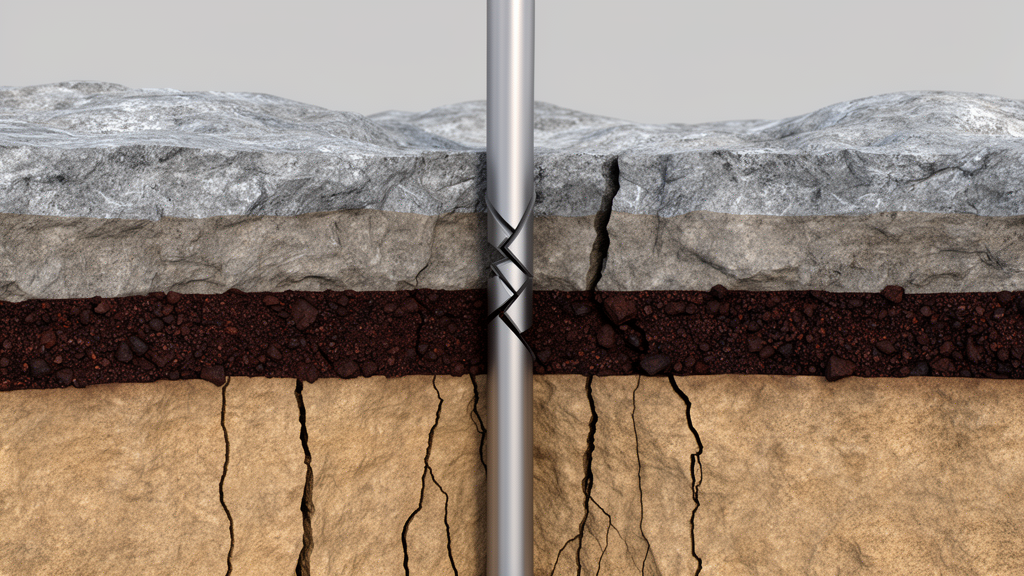
Research published in Geomechanics and Geophysics for Geo-Energy and Geo-Resources presents a geomechanical framework linking surface subsidence from coal mining to shear loading on natural gas wellbores. The study, led by Junqi Lei and colleagues, addresses the integrity challenges faced by gas wells in areas where natural gas and coal are co-exploited. These wells typically penetrate thick unconsolidated aeolian sand, underlying bedrock, and coal-bearing strata disturbed by longwall mining.
The research integrates theoretical analysis, three-dimensional numerical modeling, and field-measured subsidence data to investigate how incompatible deformation and shear slip near the sand-bedrock interface translate into localized transverse shear loading. The study focuses on the specific mechanism where differential movement between the sand and bedrock layers induces active and passive earth pressure asymmetry. This asymmetry concentrates an additional transverse shear force near the critical interface. The authors report that this force can reach up to 71.6 kN, accompanied by a reversal of the lateral bending moment from positive to negative values.
The numerical results indicate peak bending moment values of 26.4 kN m in the positive direction and -24.8 kN m in the negative direction. Under sustained lateral loading, the analysis shows that the cement sheath reaches its shear limit before the steel casing. This sequence suggests that local cracking in the cement sheath may compromise zonal isolation, thereby increasing the risk of gas leakage. The study uses an upper-bound shear-capacity model that considers in-situ strength reduction to estimate the ultimate cross-sectional shear capacity of the cement sheath at 107 kN.
To connect surface observations with subsurface mechanical effects, the researchers calibrated a linear relationship between surface subsidence and transverse shear force. The numerical simulations yielded a transmission coefficient of 1.087 kN per millimeter, with an R-squared value of 0.982, indicating a strong linear correlation. Based on this relationship, the study identifies a critical surface subsidence threshold of 98.4 mm.
The study applies conservative limit-state assumptions with an empirical safety margin to determine practical engineering controls. By combining these assumptions with field-measured dip-direction subsidence functions, the authors recommend a risk-control offset of 404 m from the subsidence-basin centerline. The resulting risk zoning framework supports wellbore integrity assessment, gas leakage risk control, and optimization of mining boundaries in co-exploitation areas.
The study highlights the importance of structural boundaries in wellbore integrity. Mining-induced strata deformation is not uniformly distributed but concentrates transverse shear forces at specific locations, such as the sand-bedrock interface.
The study focuses on gas-coal co-exploitation areas with specific stratigraphic configurations, including thick aeolian sand and bedrock.
The findings offer an engineering basis for wellbore offset design during co-exploitation. The framework serves as a tool for assessing wellbore integrity and optimizing mining boundaries in complex geological environments.
Subject of Research: Geomechanical analysis of natural gas wellbore integrity in gas-coal co-exploitation areas
Article Title: A subsidence-to-shear geomechanical framework for natural gas wellbore integrity in gas–coal co-exploitation areas
Article References: Lei, J., Wang, W., Yang, Y., Ren, J., Wu, L., Li, L., Yang, W., Zhai, Y., Peng, L., Sun, Z., Liu, S., & Yan, F. (2026). A subsidence-to-shear geomechanical framework for natural gas wellbore integrity in gas–coal co-exploitation areas. Geomechanics and Geophysics for Geo-Energy and Geo-Resources. https://doi.org/10.1007/s40948-026-01215-6
Image Credits: AI Generated
DOI: 10.1007/s40948-026-01215-6
Keywords: geomechanics, wellbore integrity, coal mining, natural gas, subsidence, shear loading, cement sheath, risk assessment, numerical modeling, co-exploitation, subsidence-to-shear, geomechanical
News Source: Denise Maddox. (November 9, 2026). Study Links Coal Mining Subsidence to Gas Wellbore Shear Risk. Scienmag.