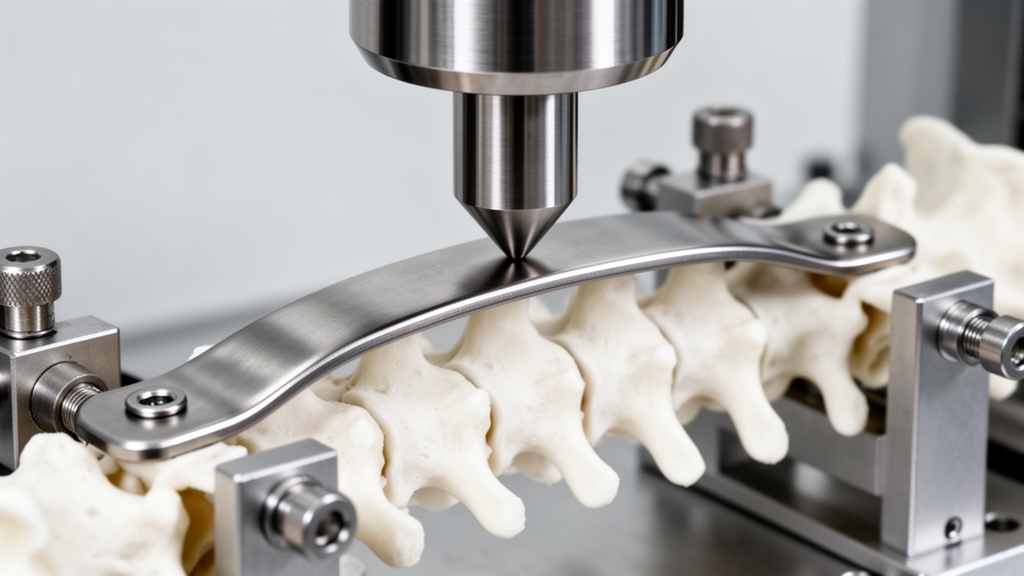
Biomedical engineers at Pusan National University have developed and demonstrated a risk-informed verification, validation, and uncertainty quantification framework for evaluating finite element simulations of titanium rib bone plates under standardized four-point bending tests. Published in Frontiers in Bioengineering and Biotechnology, the case study applied the ASME V&V 40 standard to assess the credibility of computational modeling and simulation for orthopedic trauma implants classified as Class III medical devices. The research evaluated how computational evidence can fulfill differentiated regulatory roles across two distinct Contexts of Use, comparing a high-influence standalone scenario with a moderate-influence supplementary verification scenario while holding decision consequence constant at a medium level.
Rib fractures represent critical trauma indicators whose surgical management increasingly relies on pre-contoured plates rather than manual intraoperative bending, which can prolong surgical procedures and introduce residual stresses or microscopic cracks that threaten mechanical stability. Regulatory bodies, including the United States Food and Drug Administration and the Korean Ministry of Food and Drug Safety, classify these permanent internal fixators as Class III medical devices requiring comprehensive mechanical performance data before market introduction. Standard characterization is typically performed using ASTM F382 static four-point bending testing to determine fundamental mechanical properties. To reduce reliance on extensive physical testing while maintaining regulatory rigor, computational models must be evaluated through formal credibility assessment frameworks that systematically scale verification and validation activities relative to underlying model risk.
The research team established two distinct Contexts of Use to investigate how varying regulatory roles alter credibility demands for the same underlying computational model. Context of Use 1 designated computational modeling and simulation as standalone evidence to evaluate a design change involving an increased number of plate holes without conducting additional physical tests, corresponding to high model influence and an overall High-Medium model risk. In contrast, Context of Use 2 utilized the computational model as supplementary evidence alongside concurrent physical bench testing to evaluate product line expansion across new pre-contoured geometries, reflecting medium model influence and an overall Medium-Medium model risk. Rather than constructing separate validation pipelines, the researchers implemented a single conservative credibility framework calibrated to the stricter High-Medium risk level, which inherently satisfied the requirements of the lower-risk scenario.
Model risk within the ASME V&V 40 framework combines decision consequence and model influence to determine the required rigor of credibility factors across code verification, calculation verification, model form, input uncertainties, and validation comparators. Because rib plate deformation or mechanical failure could lead to reoperation or patient injury, decision consequence was set to medium for both contexts of use based on regulatory risk categorization. The investigators evaluated 23 individual credibility factors using a standardized gradation system ranging from two to four levels. Target goals for three-gradation factors were established at intermediate or high levels, while factors with four gradations were targeted at the highest two levels, establishing rigorous technical benchmarks for software quality assurance, mesh convergence, sensitivity analyses, and output comparison metrics.
Code verification activities confirmed numerical stability through software quality assurance and numerical code verification, achieving a normal stress error of 0.704 percent relative to an exact benchmark solution. Discretization error verification evaluated five quadratic tetrahedral element sizes ranging from 1.0 millimeter down to 0.25 millimeter under four-point static bending conditions at a 50-newton load. An element size of 0.3 millimeter was selected as the operational baseline, balancing computational resource requirements and numerical precision. Refining the mesh from 0.4 millimeter to 0.3 millimeter produced a 0.57 percent shift in maximum equivalent stress and identical reaction forces, while further refinement to 0.25 millimeter altered maximum stress by only 0.71 percent and reaction force by 0.33 percent, demonstrating stable asymptotic mesh convergence.
Physical bench testing was conducted on commercial flat eight-hole titanium grade 4 bone plates in strict adherence to ASTM F382 specifications using a displacement-controlled rate of 3 millimeters per minute up to 10 millimeters of deflection. Caliper measurements of specimen dimensions established nominal center span values of 19 millimeters and loading span values of 16 millimeters, with standard deviations of 0.05 millimeter. Five specimens were tested, with one excluded due to fixture slip, yielding an effective experimental sample size of four. The three-dimensional finite element model was created from optical surface scans of the plate geometry, simplifying threaded screw holes into cylindrical passages to maintain mesh quality while assigning bilinear isotropic hardening properties with a 98,500-megapascal Young modulus and a 581-megapascal yield stress.
Validation sensitivity analyses examined modeling choices and physical input variability to identify primary drivers of mechanical response across ASTM F382 parameters, including bending stiffness, yield force, bending structural stiffness, and bending strength. Comparing element formulations showed that linear tetrahedral elements substantially overestimated structural stiffness and strength by up to 17 percent compared to experimental benchmarks, whereas quadratic tetrahedral and quadratic hexahedral elements aligned within 2 to 5 percent of measured values. Contact sensitivity tests varying the coefficient of friction between support rollers and plate surfaces from 0.05 to 0.30 demonstrated that higher friction progressively increased predicted yield forces, identifying a friction coefficient of 0.10 as the optimal representation. Input sensitivity evaluations applying 0.1 percent perturbations revealed that loading span geometric tolerance exerted the strongest influence, displaying sensitivity roughly 2.5 times greater than material modulus and 3.6 times greater than center span.
Uncertainty quantification was conducted using Latin Hypercube Sampling across 30 design iterations that simultaneously propagated uniform distributions of elastic modulus, center span, and loading span tolerances. In Level I validation comparisons using nominal parameters, the computational model predicted average experimental quantities of interest with relative differences under 5 percent across all primary metrics. Bending stiffness showed a 2.19 percent deviation, yield force differed by 2.84 percent, bending structural stiffness differed by 2.18 percent, and bending strength deviated by 2.84 percent, while the supplementary force at 10 millimeters displacement showed a negative 4.74 percent error. In Level II comparisons, validation uncertainty and expanded 95 percent confidence intervals were quantified, yielding validation ratios below one for bending stiffness, yield force, and structural stiffness, confirming that numerical prediction errors fell fully within experimental and input parameter uncertainty bounds.
Applying the validated simulation framework to Context of Use 1, the researchers modeled 10-hole and 12-hole plate variants under identical ASTM F382 boundary and span conditions. Because the test standard specifies fixed center and loading spans based on the internal spans between loading rollers rather than overall implant length, the simulated performance showed minimal variation. Normalized comparisons against the baseline eight-hole geometry demonstrated shifts in bending stiffness, structural stiffness, and maximum displacement force of less than 0.05 percent, alongside minor increases in yield force and bending strength under 0.2 percent. The model predicted that lengthening rib bone plates by adding exterior screw holes does not degrade bending stiffness or yield capacity under standardized spans, supporting regulatory principles that treat uniform-cross-section variants as unified families while noting that physical testing remains complementary confirmation for standalone submissions.
For Context of Use 2, the computational framework was extended to evaluate pre-contoured eight-hole plates tested in both concave and convex orientations across ten total physical bench specimens. Relative errors between computational predictions and measured values remained within the pre-established 10 percent acceptance threshold for all evaluated parameters in both mounting orientations. Concave configurations exhibited measured bending stiffness of 66.59 newtons per millimeter compared to a simulated 71.15 newtons per millimeter, while convex configurations exhibited measured stiffness of 45.71 newtons per millimeter compared to a simulated 46.27 newtons per millimeter. The consistent alignment below the 10 percent error margin demonstrated that the model reliably captured the biomechanical consequences of pre-contouring geometry, confirming its suitability as supplementary regulatory evidence under moderate model risk.
The investigators detailed several technical boundaries and methodological constraints associated with their findings. In post-yield plastic regions beyond 2 millimeters of deflection, simulation errors expanded to negative 7 percent and validation ratios exceeded unity for final displacement force, reflecting the known limitations of simplified bilinear hardening formulations in capturing full non-linear plastic progression. Numerical uncertainty was not independently quantified through formal grid convergence indices, meaning overall validation uncertainty may be moderately underestimated. Furthermore, experimental benchmarking was restricted to a single testing center with an effective sample of four specimens per condition, which cannot assess inter-laboratory reproducibility. The researchers emphasized that their demonstrated credibility applies specifically to titanium plates under ASTM F382 loading, providing an operational roadmap for risk-informed computational evidence in medical device evaluation.
Subject of Research: Risk-informed finite element simulation credibility for titanium rib bone plates under ASTM F382 bending
Article Title: Risk-informed credibility goals for finite element simulation of rib bone plates: a case study in applying ASME V&V 40 to ASTM F382 testing
Article References: Park, J. S., & Lee, C. (2026). Risk-informed credibility goals for finite element simulation of rib bone plates: a case study in applying ASME V&V 40 to ASTM F382 testing. Frontiers in Bioengineering and Biotechnology, 14, Article 1875854. https://doi.org/10.3389/fbioe.2026.1875854
Image Credits: AI Generated
DOI: 10.3389/fbioe.2026.1875854
Keywords: biomechanics, computational modeling, orthopedic implants, rib bone plates, finite element analysis, ASME V&V 40, ASTM F382, medical devices, verification and validation, trauma devices, Risk-informed, credibility
News Source: Gregory Coleman. (November 9, 2026). Simulation Framework Evaluates Rib Bone Plate Credibility Under Standardized Bending Tests. Scienmag.