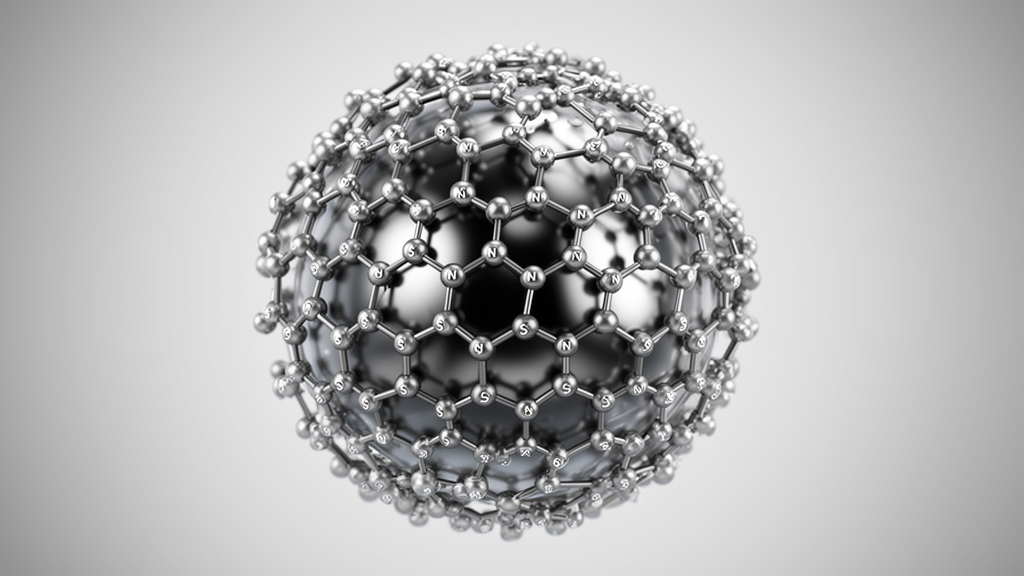
Researchers have synthesized and characterized a magnetically recoverable hybrid nanocatalyst that uses saccharin as a structural linker to anchor palladium nanoparticles onto a reduced graphene oxide and iron oxide scaffold for Heck cross-coupling reactions. The investigated system, designated as rGO@Fe₃O₄@Sac@Pd, integrates four functional components designed to operate cooperatively during chemical synthesis: a conductive reduced graphene oxide sheet serving as a high-surface-area platform, magnetite nanoparticles providing magnetic responsiveness for rapid physical recovery, saccharin serving as a non-covalent interfacial linker that coordinates metal centers, and zero-valent palladium nanoparticles that supply the active catalytic sites. In comparative evaluations under standardized reaction conditions, the saccharin-functionalized composite demonstrated narrower metallic particle-size distributions, superior catalytic retention, and markedly higher coupling yields relative to a saccharin-free control material with matching bulk palladium content.
The multi-stage chemical synthesis protocol was designed to assemble the functional architecture in a sequential manner, beginning with the formation of the underlying magnetic carbon substrate. Magnetite nanoparticles were first deposited onto reduced graphene oxide sheets through the in situ chemical co-precipitation of iron(III) chloride hexahydrate and iron(II) chloride tetrahydrate in the presence of concentrated aqueous ammonia, producing the intermediate rGO@Fe₃O₄ composite. To introduce the organic coordination interface, this intermediate was stirred in deionized water with sodium saccharin, allowing saccharinate anions to anchor onto the surface via non-covalent, electrostatic, and hydrogen-bonding interactions without disrupting the magnetic core. The final catalyst assembly was completed by introducing palladium(II) acetate in dimethyl sulfoxide into the aqueous dispersion, followed by chemical reduction with hydrazine hydrate under alkaline conditions at 80 degrees Celsius to generate zero-valent palladium nanoparticles directly across the functionalized support.
Comprehensive physical and spectroscopic characterization tracked the structural evolution of the material at every phase of preparation. Fourier transform infrared spectroscopy verified the removal of oxygen-containing functional groups from graphite oxide during its conversion to reduced graphene oxide, followed by the appearance of a characteristic absorption band near 570 reciprocal centimeters corresponding to iron-oxygen bond vibrations in the immobilized magnetite phase. In the saccharin-modified intermediate, distinct infrared features emerged at 1739, 1568, and 1392 reciprocal centimeters, reflecting carbonyl stretching, aromatic carbon-carbon skeletal vibrations, and sulfonamide group contributions from the anchored organic linker. The introduction of palladium produced an aromatic vibrational perturbation at 1458 reciprocal centimeters and an additional absorption band at 667 reciprocal centimeters, consistent with localized coordination perturbations occurring between the palladium phase and the surrounding oxygen and nitrogen heteroatoms.
Surface composition and metal coordination states were established through high-resolution X-ray photoelectron spectroscopy calibrated against the graphitic carbon reference at 284.5 electron volts. The survey spectrum revealed an elemental composition of 68.1 atomic percent carbon, 15.2 atomic percent oxygen, 8.4 atomic percent iron, 4.6 atomic percent nitrogen, 2.1 atomic percent palladium, and 1.6 atomic percent sulfur, without detectable external impurities. High-resolution deconvolution of the nitrogen 1s spectrum identified three distinct chemical environments: uncoordinated imide nitrogen at 398.3 electron volts, imide nitrogen coordinated directly to palladium at 399.5 electron volts, and imide nitrogen participating in support interactions through hydrogen bonding at 401.0 electron volts. Analysis of the palladium 3d doublet identified the 3d five-halves peak at 335.3 electron volts and the 3d three-halves peak at 340.5 electron volts with a spin-orbit splitting of 5.2 electron volts, demonstrating that immobilized palladium resides predominantly in the metallic zero-valent oxidation state. Furthermore, the sulfur 2p spectrum exhibited an intact sulfonyl signal at 168.3 electron volts, confirming that the saccharin framework remained chemically intact without undergoing oxidative decomposition during nanocomposite assembly.
Crystalline structure, magnetic properties, and textural properties were evaluated using diffraction, magnetometry, and gas physisorption techniques. Powder X-ray diffraction patterns of the composite displayed sharp reflections corresponding to the cubic spinel structure of magnetite alongside distinct reflections at 40, 46, and 68 degrees two-theta, matching the (111), (200), and (220) planes of face-centered cubic metallic palladium without detectable crystalline palladium oxide peaks. Application of the Scherrer equation to the prominent palladium (111) reflection indicated an average crystalline domain size of 14.2 nanometers. Nitrogen adsorption-desorption measurements revealed a Type IV isotherm with an H3 hysteresis loop, showing that pristine reduced graphene oxide with a surface area of 245.8 square meters per gram decreased to 142.3 square meters per gram upon magnetite and saccharin functionalization, and finalized at 118.6 square meters per gram with a total pore volume of 0.24 cubic centimeters per gram and an average BJH pore diameter of 8.4 nanometers. Vibrating sample magnetometry demonstrated soft magnetic behavior with sufficient saturation magnetization to facilitate rapid external magnetic separation from liquid reaction media.
Electron microscopy and surface topography imaging provided quantitative spatial validation of the multi-component nanostructure. Scanning electron microscopy showed sheet-like graphene oxide evolving into wrinkled, aggregated reduced graphene oxide surfaces that became progressively populated by dispersed spherical magnetite nanoparticles ranging from 20 to 50 nanometers in diameter. Transmission electron microscopy confirmed the hierarchical layout, exhibiting well-defined cuboid magnetite crystallites measuring between 30 and 45 nanometers alongside a population of smaller spherical metallic particles. Measurement of 120 individual palladium-associated nanoparticles in the transmission electron micrographs yielded a mean diameter of 16.0 plus or minus 1.5 nanometers within a narrow size range of 12 to 18 nanometers. Energy-dispersive X-ray spectroscopy confirmed the presence of 6.2 weight percent palladium in the final composite, while high-angle annular dark-field scanning transmission electron microscopy coupled with elemental mapping corroborated the local distribution of iron, oxygen, carbon, nitrogen, sulfur, and palladium throughout the composite architecture. Atomic force microscopy over a 1.2 by 1.2 micrometer area revealed surface height variations of 0 to 1.366 nanometers, confirming that probe measurements traversed flat, exfoliated graphene basal planes situated between the larger nanoparticle aggregates.
A critical technical focus of the investigation was assessing the specific stabilizing role played by the saccharin linker through direct comparison with an independently synthesized saccharin-free control catalyst, designated as rGO@Fe₃O₄@Pd. Bulk inductively coupled plasma optical emission spectrometry established closely matched bulk palladium contents between the two fresh systems, measuring 5.61 weight percent in the saccharin-containing material and 5.42 weight percent in the saccharin-free control. Despite nearly identical total metal loadings, the absence of the saccharin linker resulted in substantial structural and operational differences. Transmission electron microscopy of the control material revealed a broader particle-size distribution ranging from 12 to 26 nanometers, with a calculated weighted mean diameter of 19.9 plus or minus 3.4 nanometers. In a benchmark cross-coupling reaction between bromobenzene and styrene carried out in dimethylformamide and water at 70 degrees Celsius under nitrogen, the saccharin-containing catalyst delivered a 95 percent isolated yield with 98.8 percent palladium retention, whereas the saccharin-free control afforded only 74 percent isolated yield and experienced severe metal leaching, retaining just 82.4 percent of its palladium after a single cycle.
Reaction conditions were systematically optimized using the mono-coupling of bromobenzene with N,N-prime-methylenebisacrylamide as a model system. Parameter screenings demonstrated that performing the transformation under an inert nitrogen atmosphere was vital, as operating under ambient air caused conversion to plunge from 100 percent to 20 percent, an effect attributed to rapid surface oxidation of active zero-valent palladium to inactive oxidized species. Among the tested bases and solvent mixtures, potassium carbonate combined with an ethanol and water solvent mixture in a two-to-one volume ratio at 70 degrees Celsius provided optimal efficiency, achieving full conversion within 45 minutes using 30 milligrams of catalyst. Blank control runs using the palladium-free rGO@Fe₃O₄ and rGO@Fe₃O₄@Sac materials yielded no detectable coupled products after 120 minutes, confirming that the underlying magnetic iron oxide and carbon supports possess no measurable independent catalytic activity and that cross-coupling is driven exclusively by the supported palladium centers.
The catalytic scope was explored across a series of structurally diverse aryl, aroyl, and phenacyl halides coupled with both N,N-prime-methylenebisacrylamide and styrene. By adjusting the stoichiometry of the coupling partners, the reaction selectivity could be directed toward either mono-coupled or bis-coupled products: a one-to-one molar ratio of aryl halide to N,N-prime-methylenebisacrylamide selectively generated mono-coupled derivatives, whereas increasing the ratio to two-to-one promoted bis-coupling across both acrylamide arms with less than 3.5 percent of alternative coupling isomers observed in crude nuclear magnetic resonance spectra. Aryl and phenacyl bromides reacted rapidly, yielding coupled products in 85 to 95 percent isolated yields within 35 to 60 minutes, while aryl and phenacyl chlorides reacted more sluggishly, requiring 120 to 700 minutes to afford moderate isolated yields between 55 and 68 percent. High-resolution mass spectrometry and melting-point determinations confirmed that most of the synthesized bis-acrylamide derivatives represented previously unreported compounds, with all experimental mass values matching theoretical formulas within a five parts-per-million error threshold.
Catalyst reusability was evaluated through five consecutive recycling runs using the model cross-coupling of bromobenzene and styrene. The catalyst was magnetically recovered after each run, washed with ethanol, dried, and reintroduced into subsequent cycles, yielding isolated product quantities of 94.3 plus or minus 2.1 percent in the first cycle, 92.3 plus or minus 1.5 percent in the second, 89.0 plus or minus 3.0 percent in the third, 86.3 plus or minus 1.5 percent in the fourth, and 83.0 plus or minus 2.0 percent in the fifth cycle. Analysis of the liquid reaction phase by inductively coupled plasma optical emission spectrometry revealed cycle-by-cycle palladium losses of 0.02104, 0.01872, 0.01690, 0.01466, and 0.01210 milligrams, representing a cumulative dissolved metal loss of 0.08342 milligrams across five cycles. Parallel physical measurements tracked the solid catalyst mass decreasing progressively from 30.00 milligrams to 24.10 milligrams due to mechanical handling and recovery losses. An equal-mass control test using 24.10 milligrams of fresh catalyst alongside 24.10 milligrams of recycled catalyst demonstrated that physical mass loss accounted for the majority of the activity drop, with intrinsic catalyst deactivation playing a secondary role. A hot-filtration test confirmed that coupling halted upon magnetic separation of the solid composite, establishing that the catalytic transformation operates primarily via the heterogeneous supported phase rather than through leached homogeneous species.
Subject of Research: Synthesis and catalytic evaluation of a saccharin-modified magnetic nanocomposite for Heck cross-coupling
Article Title: Synthesis and characterization of rGO@Fe₃O₄@Sac@Pd hybrid magnetic nanocatalyst for Heck coupling reactions
Article References: Saleim Hussein, M., Zeynizadeh, B., & Poursattar Marjani, A. (2026). Synthesis and characterization of rGO@Fe₃O₄@Sac@Pd hybrid magnetic nanocatalyst for Heck coupling reactions. Results in Chemistry, 32, Article 104027. https://doi.org/10.1016/j.rechem.2026.104027
Image Credits: AI Generated
DOI: 10.1016/j.rechem.2026.104027
Keywords: nanocatalysis, Heck coupling, heterogeneous catalysis, palladium nanoparticles, reduced graphene oxide, magnetite, saccharin linker, magnetic recovery, cross-coupling, green chemistry, Synthesis, characterization
News Source: Bethany Barker. (November 9, 2026). Magnetic Nanocatalyst Stabilized by Saccharin Enhances Heck Cross Coupling Efficiency. Scienmag.