• HOME
  • NEWS
  • EXPLORE
    • CAREER
      • Companies
      • Jobs
    • EVENTS
    • iGEM
      • News
      • Team
    • PHOTOS
    • VIDEO
    • WIKI
  • BLOG
  • COMMUNITY
    • FACEBOOK
    • INSTAGRAM
    • TWITTER
Monday, June 29, 2026
BIOENGINEER.ORG
No Result
View All Result
  • Login
  • HOME
  • NEWS
  • EXPLORE
    • CAREER
      • Companies
      • Jobs
        • Lecturer
        • PhD Studentship
        • Postdoc
        • Research Assistant
    • EVENTS
    • iGEM
      • News
      • Team
    • PHOTOS
    • VIDEO
    • WIKI
  • BLOG
  • COMMUNITY
    • FACEBOOK
    • INSTAGRAM
    • TWITTER
  • HOME
  • NEWS
  • EXPLORE
    • CAREER
      • Companies
      • Jobs
        • Lecturer
        • PhD Studentship
        • Postdoc
        • Research Assistant
    • EVENTS
    • iGEM
      • News
      • Team
    • PHOTOS
    • VIDEO
    • WIKI
  • BLOG
  • COMMUNITY
    • FACEBOOK
    • INSTAGRAM
    • TWITTER
No Result
View All Result
Bioengineer.org
No Result
View All Result
Home Headlines

Risk of international spread of yellow fever re-assessed in light of the ongoing outbreaks

Bioengineer.org by Bioengineer.org
January 19, 2018
in Headlines, Health, Science News
Reading Time: 2 mins read
0
Share on FacebookShare on TwitterShare on LinkedinShare on RedditShare on Telegram
IMAGE

ECDC has updated its rapid risk assessment on the outbreak of yellow fever with the latest developments, more comprehensive information on the current situation in Angola, Democratic Republic of Congo (DRC) and Uganda and an extended threat assessment for the EU.

Some of the data used in the assessment were collected during a mission to Angola in May 2016.

Current situation

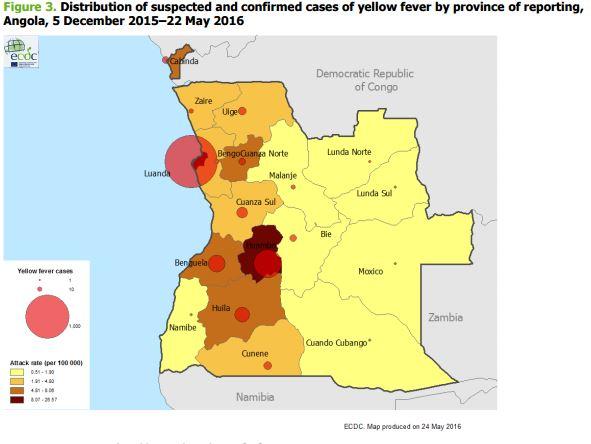
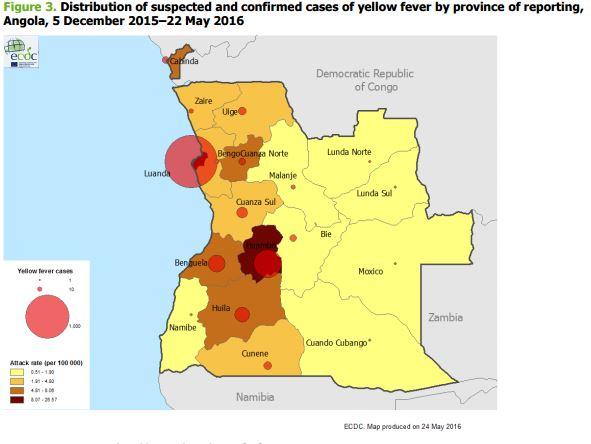
From 21 January to 22 May 2016, the Angolan Ministry of Health notified 2 536 yellow fever cases, of which 747 were confirmed and 301 fatal. The number of new suspected and confirmed cases in Angola has been decreasing and a mass vaccination campaign has already reached about half of the targeted population. However, the outbreak in Angola is not yet under control and is currently expanding to additional provinces, further challenging the ongoing mass vaccination campaign. Currently, all regions in Angola should be considered as areas at high risk of transmission of yellow fever.

The yellow fever outbreak in Uganda is unrelated to the outbreak in Angola. Between 26 March and 19 May 2016, health authorities reported 60 yellow fever cases, including seven deaths in six different districts.

As of 23 May, DRC has reported 590 cases of yellow fever, 41 of these had a recent travel history to Angola.

Viraemic patients travelling to areas where suitable vectors and susceptible human populations are present pose a risk for local transmission. Such areas exist in most of the inter-tropical zones of Africa, and the Americas and Asia.

Therefore, the risk of international spread within Africa and beyond is currently high.

ECDC threat assessment for the EU

In the EU/EEA, the risk of yellow fever virus being introduced is limited to unvaccinated viraemic travellers coming from areas with active local transmission. Given that outbreaks of yellow fever in urban settings have the potential for rapid spread and that significant yellow fever epidemics are ongoing in Angola, DRC and Uganda, a range of options for response by EU/EEA Member States are presented in the updated rapid risk assessment. These options emphasize the importance of vaccination of travellers and those leaving Angola, preventive measures against mosquito bites in affected areas, as well as awareness raising among clinicians to consider this diagnosis in returning travellers.

###

Read the rapid risk assessment: Outbreaks of yellow fever in Angola, Democratic Republic of Congo and Uganda, first update

ECDC yellow fever health topic

Media Contact

ECDC Press
[email protected]
@ECDC_EU

http://ecdc.europa.eu

Share12Tweet8Share2ShareShareShare2

Related Posts

Tracking Lanthanide-Labeled Microplastics in Plants

June 25, 2026

POSTECH Researchers Slash Cost of Reconstituted Cell-Free Systems by 95%

June 25, 2026

AI and Physics Collaborate to Design Advanced Hydrogen Storage Materials

June 25, 2026

Natural Hallucinogens: Evolution’s Ecological Tools, Not Mere Chemical Byproducts

June 25, 2026
Please login to join discussion

POPULAR NEWS

  • Saying Goodbye to PGY-6: Pediatric Fellowship Realities

    103 shares
    Share 41 Tweet 26
  • Multi-Hospital Study Reveals Long Covid Burden Is Twice as High as Current Estimates

    92 shares
    Share 36 Tweet 23
  • Detection of EDCs in Breast Milk and Infant Urine Up to Six Months Highlights Early Exposure Risks

    77 shares
    Share 31 Tweet 19
  • New Drug Candidate Developed at McMaster Shows Potential for Treating Brain Cancer

    58 shares
    Share 23 Tweet 15

About

We bring you the latest biotechnology news from best research centers and universities around the world. Check our website.

Follow us

Recent News

Tracking Lanthanide-Labeled Microplastics in Plants

POSTECH Researchers Slash Cost of Reconstituted Cell-Free Systems by 95%

AI and Physics Collaborate to Design Advanced Hydrogen Storage Materials

Subscribe to Blog via Email

Success! An email was just sent to confirm your subscription. Please find the email now and click 'Confirm' to start subscribing.

Join 82 other subscribers
  • Contact Us

Bioengineer.org © Copyright 2023 All Rights Reserved.

Welcome Back!

Login to your account below

Forgotten Password?

Retrieve your password

Please enter your username or email address to reset your password.

Log In
No Result
View All Result
  • Homepages
    • Home Page 1
    • Home Page 2
  • News
  • National
  • Business
  • Health
  • Lifestyle
  • Science

Bioengineer.org © Copyright 2023 All Rights Reserved.