• HOME
  • NEWS
  • EXPLORE
    • CAREER
      • Companies
      • Jobs
    • EVENTS
    • iGEM
      • News
      • Team
    • PHOTOS
    • VIDEO
    • WIKI
  • BLOG
  • COMMUNITY
    • FACEBOOK
    • INSTAGRAM
    • TWITTER
Monday, November 9, 2026
BIOENGINEER.ORG
No Result
View All Result
  • Login
  • HOME
  • NEWS
  • EXPLORE
    • CAREER
      • Companies
      • Jobs
        • Lecturer
        • PhD Studentship
        • Postdoc
        • Research Assistant
    • EVENTS
    • iGEM
      • News
      • Team
    • PHOTOS
    • VIDEO
    • WIKI
  • BLOG
  • COMMUNITY
    • FACEBOOK
    • INSTAGRAM
    • TWITTER
No Result
View All Result
Bioengineer.org
No Result
View All Result
Home NEWS Science News Technology

Delay-Aligned Network Boosts Decoding in Hybrid Brain–Computer Interfaces

by
November 9, 2026
in Technology
Reading Time: 2 mins read
0
Delay-Aligned Network Boosts Decoding in Hybrid Brain–Computer Interfaces

Delay-Aligned Network Boosts Decoding in Hybrid Brain–Computer Interfaces

Share on FacebookShare on TwitterShare on LinkedinShare on RedditShare on Telegram

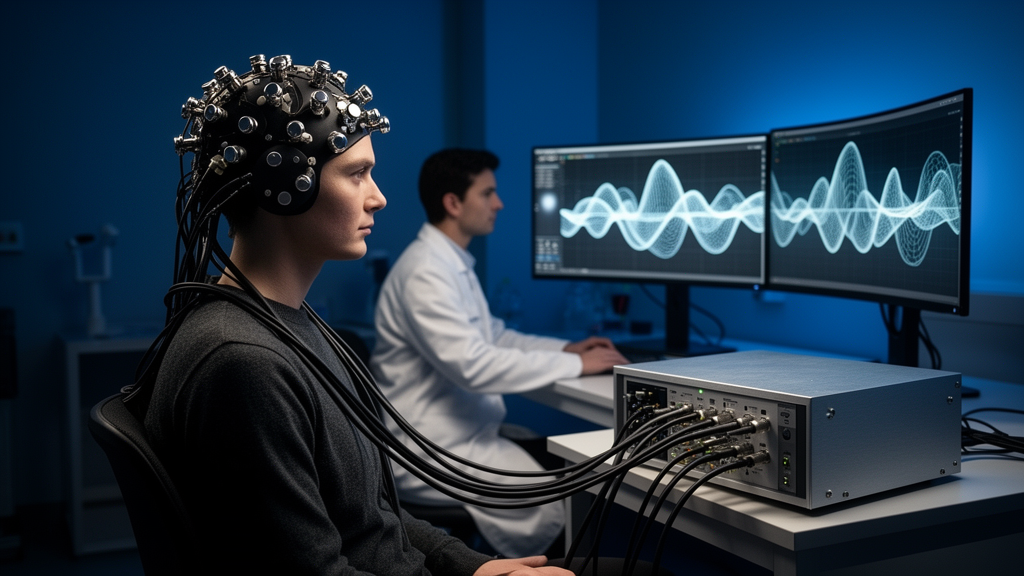
A newly developed framework known as the Neurovascular Coupling-Aware Delay Alignment and Subspace Disentanglement Network (NVC-DSDNet) improves multimodal neural decoding in hybrid brain–computer interfaces while maintaining neurophysiological interpretability. Hybrid brain–computer interfaces unite the rapid electrophysiological activity recorded through electroencephalography (EEG) with hemodynamic responses captured by functional near-infrared spectroscopy (fNIRS). However, effective fusion across these two modalities has faced significant obstacles due to neurovascular latency differences and entangled multimodal feature spaces.

To resolve these integration challenges, NVC-DSDNet couples delay-aware attention mechanisms with shared and private neural subspaces. Within this framework, EEG responses operate as temporal anchors that dynamically retrieve task-relevant fNIRS features across candidate delay intervals. Concurrently, a Neural Feature Subspace Decomposition process separates shared neural intent from modality-specific information, isolating cross-modal features during representation learning.

The network incorporates an adaptive multi-head decision module that calculates sample-level weights for unimodal and fused predictions. When evaluated under subject-independent five-fold cross-validation, NVC-DSDNet achieved decoding accuracies of 72.67 percent on motor imagery tasks, 82.79 percent on mental arithmetic tasks, and 76.17 percent on word generation tasks.

The model’s learned delay weights exhibited distinct temporal dynamics corresponding to hemodynamic response profiles across cognitive conditions. These learned delay weights peaked at 4.5 to 5.5 seconds during motor imagery tasks and shifted to between 6.0 and 9.0 seconds for mental arithmetic tasks, matching task-dependent hemodynamic time courses. The findings demonstrate that coupling-aware temporal alignment and feature subspace disentanglement effectively enhance multimodal decoding performance while preserving interpretability grounded in neurovascular physiology.

Subject of Research: Multimodal neural decoding in hybrid EEG–fNIRS brain–computer interfaces

Article Title: NVC-DSDNet: neurovascular coupling-aware delay alignment and subspace disentanglement network for hybrid EEG–fNIRS brain–computer interfaces

Article References: Wang, S., Gao, Y., Zhang, Z., Shao, X., & Qin, Y. (2026). NVC-DSDNet: neurovascular coupling-aware delay alignment and subspace disentanglement network for hybrid EEG–fNIRS brain–computer interfaces. Complex & Intelligent Systems. https://doi.org/10.1007/s40747-026-02580-1

Image Credits: AI Generated

DOI: 10.1007/s40747-026-02580-1

Keywords: brain–computer interfaces, EEG, fNIRS, neurovascular coupling, delay alignment, subspace disentanglement, multimodal decoding, neural decoding, NVC-DSDNet, neurovascular, coupling-aware, delay

News Source: Cassandra Pierce. (November 9, 2026). Delay-Aligned Network Boosts Decoding in Hybrid Brain–Computer Interfaces. Scienmag.


Tags: brain-computer interfacescoupling-awaredelaydelay alignmentEEGfNIRSmultimodal decodingNeural DecodingneurovascularNeurovascular couplingNVC-DSDNetsubspace disentanglement
Share12Tweet7Share2ShareShareShare1

Related Posts

New 2D Spectral Framework Reveals Wake Turbulence Structure

New 2D Spectral Framework Reveals Wake Turbulence Structure

November 9, 2026
AI System Dynamically Adapts Video Game Weather to Player Facial Affect

AI System Dynamically Adapts Video Game Weather to Player Facial Affect

November 9, 2026

Robotic Framework Translates Historic Song Dynasty Dougong Carpentry into Bimanual Assembly

November 9, 2026

Research report: Performance evaluation of emerging block copolymer membranes for oil-water separation

November 9, 2026

POPULAR NEWS

  • Perceptually Guided Optimization Cuts Computational Costs for Personalized Spatial Audio Models

    Perceptually Guided Optimization Cuts Computational Costs for Personalized Spatial Audio Models

    29 shares
    Share 12 Tweet 7
  • Combined Aerobic and Strength Exercise Reduces Geriatric Depression in Controlled Trial

    29 shares
    Share 12 Tweet 7
  • Miniature Pig Kidney Atlas Reveals Developmental Dynamics and Key Regulator

    29 shares
    Share 12 Tweet 7
  • Genetic study reveals multiple invasion paths for invasive snail in Brazil

    29 shares
    Share 12 Tweet 7

About

We bring you the latest biotechnology news from best research centers and universities around the world. Check our website.

Follow us

Recent News

Omega-3 Trials Show No Preventive Benefit for Childhood Atopic Dermatitis

Research report: Recurrent cholesterol-enriched cartilage signature and SREBF1-sensitive lipid and catabolic responses in osteoarthritis

New 2D Spectral Framework Reveals Wake Turbulence Structure

Subscribe to Blog via Email

Enter your email address to subscribe to this blog and receive notifications of new posts by email.

Join 87 other subscribers
  • Contact Us

Bioengineer.org © Copyright 2023 All Rights Reserved.

Welcome Back!

Login to your account below

Forgotten Password?

Retrieve your password

Please enter your username or email address to reset your password.

Log In
No Result
View All Result
  • Homepages
    • Home Page 1
    • Home Page 2
  • News
  • National
  • Business
  • Health
  • Lifestyle
  • Science

Bioengineer.org © Copyright 2023 All Rights Reserved.