A multidisciplinary team of medical educators and technical researchers has demonstrated that clinicians can design and implement a functional mechanical ventilation simulator by directing generative artificial intelligence tools through natural language prompts. Reported as an innovation development study conducted across two Italian simulation centers at the University of Eastern Piedmont and the University of Trieste, the initiative produced Open Vent Sim, an open-source web application designed to support medical training where specialized physical equipment is scarce. The project addressed a recognized clinician-developer gap, wherein healthcare instructors understand clinical learning objectives but lack the software programming skills required to build or adapt digital training tools, leaving institutions dependent on costly, closed-architecture commercial platforms.
The study sought to evaluate the feasibility, physiological fidelity, and usability of an educational simulator developed through natural language-driven development, a paradigm where software is built via conversational prompting rather than traditional manual coding. Conducted between February and June 2025, the effort focused specifically on overcoming local institutional bottlenecks, notably the absence of physical anesthesia workstations and the restriction of having access to only a single-unit commercial ventilation program. Rather than assessing learner knowledge gains or serving as a clinical trial of educational efficacy, the study was structured as a proof-of-concept innovation evaluation wherein the primary unit of assessment was the software itself, its underlying physiological algorithms, its interface, and its operational usability.
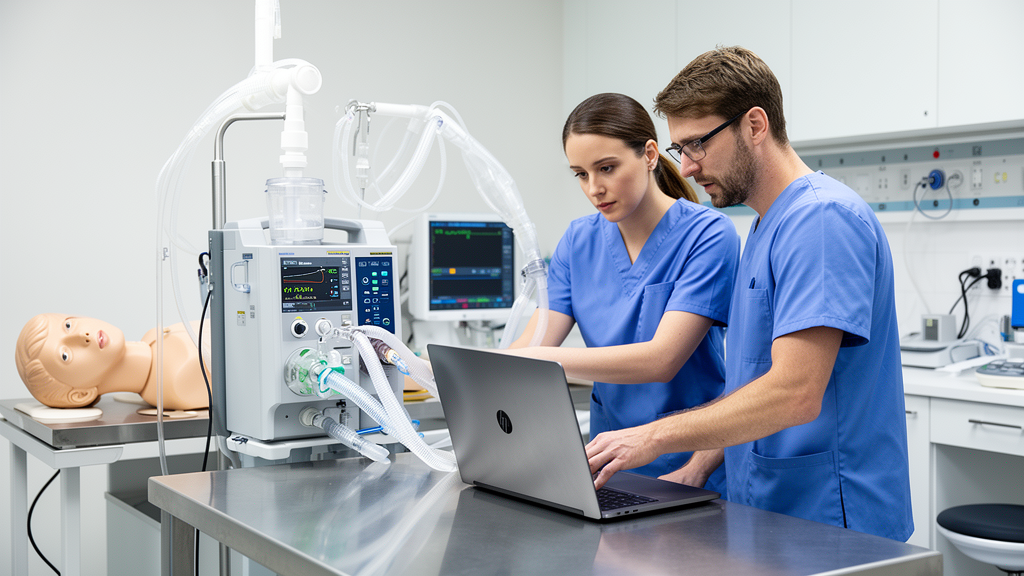
The primary development platform utilized for initial prototyping was Google AI Studio, which offered a synchronized three-panel interface comprising a conversational natural-language chat console, a live code editor, and an immediate application preview display. The core development group included a lead anesthesiology and intensive care physician, three anesthesiologists, ten anesthesiology and intensive care residents who provided iterative feedback, one intensive care research nurse, and one biomedical engineer. Software engineering collaborators at Masaryk University in the Czech Republic subsequently joined the team to conduct code reviews, architectural analyses, and code optimization using standard TypeScript environments and repository management tools.
During the initial development phase, the clinical lead utilized Google AI Studio along with the Gemini 2.5 Pro model to generate React TypeScript code exclusively through natural language prompts, tracking changes via an integrated version-control plugin. The process initiated with a baseline instruction asking the model to generate a new web application for a ventilator simulator with fundamental controls and waveform displays. Development then proceeded through structured cycles consisting of clinical requirement articulation, artificial intelligence interpretation, code generation, immediate browser previewing, and clinical review. Multimodal inputs, such as uploaded graphical traces and display screenshots from real hospital equipment, were provided to assist the model in replicating real-world diagnostic patterns.
Iterative clinical feedback played a vital role in refining physiological accuracy beyond the initial code generations. In one detailed development sequence involving Pressure Support Ventilation, resident reviewers observed that the AI-generated tracings lacked the subtle negative flow deflection that clinicians expect to see when a patient makes an inspiratory effort to trigger a mechanical breath. The clinical team provided specific quantitative feedback, instructing the model that the triggering deflection needed to drop approximately negative two to negative five centimeters of water below baseline and persist for one hundred to two hundred milliseconds before positive pressure delivery commenced. Following three successive conversational refinement cycles within a single ninety-minute session, two attending intensivists verified that the waveform matched clinical standards.
As the simulator expanded to incorporate three dedicated clinical configurations—an anesthesia workstation, an intensive care ventilator supporting invasive and non-invasive ventilation, and high-flow oxygen delivery systems—additional physiological modeling was integrated. Pre-configured profiles were created for normal lungs, acute respiratory distress syndrome, and chronic obstructive pulmonary disease, allowing educators to adjust lung compliance and airway resistance dynamically. The team also incorporated algorithms to calculate fresh gas flow dynamics, breathing circuit volumes, metabolic carbon dioxide production, and soda lime absorbent degradation based on dynamic canister capacity and minute ventilation curves, reflecting the practical resource management needs of clinical anesthesia.
The initial functional prototype of Open Vent Sim was constructed in approximately twenty hours across two weeks of iterative evening sessions, followed by twenty additional hours of clinical refinement and feature expansion, totaling forty hours of clinical specialist engagement. For clinical evaluation across the two simulation centers, prototypes were deployed via Google Cloud Run, generating accessible web links that allowed faculty and residents to interact with the software directly inside standard web browsers without requiring local software installations. Reviewers systematically tracked identified anomalies, feature adjustments, and resolution milestones across iterative cycles using structured online intake forms and collaborative spreadsheets.
Despite the rapid generation of functional features, the development process highlighted clear limitations inherent to artificial intelligence-assisted coding. The primary challenge was not catastrophic software failure but the pronounced verbosity and structural disorganization of the output, which accumulated into a monolithic file approaching two thousand three hundred lines of code. This code structure violated fundamental software engineering principles, notably the requirement to avoid code duplication across components. The resulting codebase exhibited poor modularity, which made long-term maintenance difficult without dedicated technical intervention.
To convert the working prototype into a robust application, technical specialists at Masaryk University dedicated approximately fifteen hours to systematic refactoring and structural optimization. The engineers decomposed the monolithic structure into reusable React components conforming to the Don’t Repeat Yourself principle, extracted complex respiratory mechanics formulas and data parsers into isolated helper functions, and established a type-safe architecture. This separation of concerns ensured that interface elements and underlying physiological models could be maintained, updated, or tested independently without risking unintended disruptions to other application modules.
The finalized application was deployed into formal educational environments across two established simulation tiers. In SimZone 1, the software served as an interactive skill trainer where learners manipulated ventilation settings and observed immediate physiological waveform responses following theoretical lectures. In SimZone 2, educators integrated the simulator into team-based clinical scenarios for small-group problem-solving, collaborative decision-making, and specialized procedural rehearsals, including simulated tracheostomy care where actual mechanical ventilators were unavailable. Faculty noted that multi-user accessibility expanded instructional throughput and allowed the teaching of advanced ventilation concepts that were previously constrained by equipment shortages.
At the conclusion of the iterative development cycle, usability and user experience were formally evaluated using the validated Italian version of the User Experience Questionnaire, completed by a cohort of seven residents and three attending physicians. All six measured domains exceeded the conventional positive threshold of positive zero point eight on a scale ranging from negative three to positive three: Attractiveness scored one point six eight with a standard deviation of zero point seven three, Perspicuity reached two point two seven with a standard deviation of zero point five five, Efficiency measured one point seven three with a standard deviation of zero point five two, Dependability scored one point five zero with a standard deviation of zero point nine one, Stimulation achieved one point five zero with a standard deviation of zero point seven six, and Novelty measured one point zero five with a standard deviation of zero point nine seven.
Synthesizing these domain metrics, the questionnaire revealed an overall Pragmatic Quality mean score of one point eight three and a Hedonic Quality mean score of one point two seven, placing user clarity and operational efficiency in the highest benchmark tiers. The authors noted that the comparatively lower rating for novelty was expected for an educational platform engineered primarily to mirror existing, standardized clinical instruments rather than deliver novel digital entertainment. They also acknowledged that the wider dispersion observed in dependability and novelty was driven in part by a single critical evaluator within the small convenience cohort.
The authors emphasized important limitations regarding the interpretation of their findings, noting that the study was conducted across two centers with a single collaborative team focused on mechanical ventilation. While the study established technical feasibility, interface usability, and physiological plausibility, it did not include objective pre- and post-instruction knowledge testing, standardized clinical competency evaluations, or direct comparative trials against traditional training modalities. The researchers concluded that demonstrating true educational efficacy will require formal multicenter studies, while broader adoption of natural language development in medical education will depend on clear institutional support, technical facilitation, and ongoing code governance.
Subject of Research: Clinician-led medical simulator development using natural language artificial intelligence interfaces
Article Title: Simulator development using natural language: clinician-led innovation through artificial intelligence
Article References: Barra, F. L., Ricci, S., Moro, E., Travěnec, J., Costa, A., Carenzo, L., Rodella, G., & Vaschetto, R. (2026). Simulator development using natural language: clinician-led innovation through artificial intelligence. Advances in Simulation, 11(1), Article 73. https://doi.org/10.1186/s41077-026-00467-2
Image Credits: AI Generated
DOI: 10.1186/s41077-026-00467-2
Keywords: artificial intelligence, medical simulation, natural language processing, mechanical ventilation, healthcare education, software engineering, clinical innovation, anesthesiology, Simulator, development, natural, language
News Source: Blake Davidson. (November 9, 2026). Clinicians Use Natural Language Artificial Intelligence to Develop Mechanical Ventilation Simulator. Scienmag.