Credit: Kent State University
It could be argued that no science is more valuable to us than that which helps to ensure the survival of our species by solving the problems that challenge it.
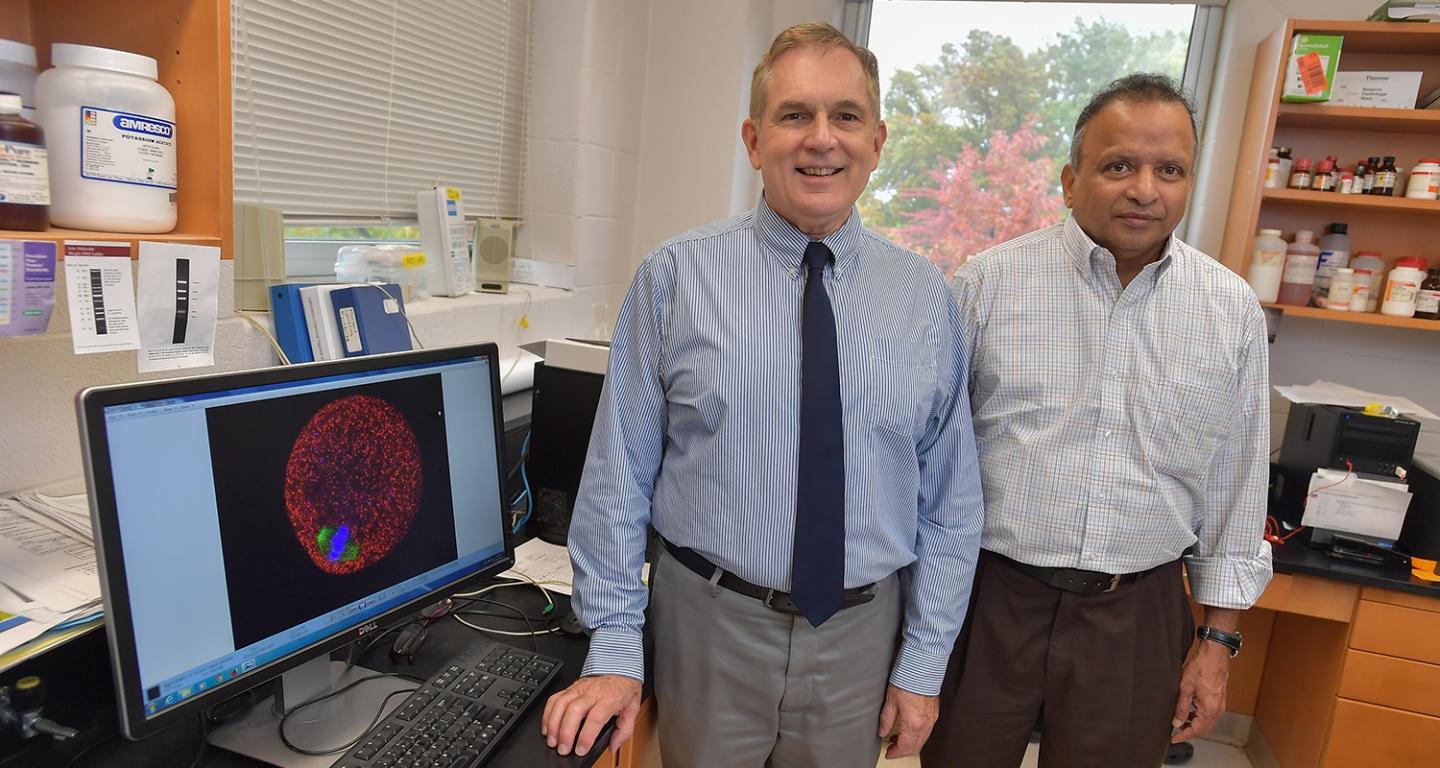
For many years, two Kent State University researchers in the College of Arts and Sciences have been toiling over this matter, and each has recently received new grants from the Eunice Kennedy Shriver Institute of Child Health and Human Development at the National Institutes of Health – collectively totaling more than $857,990 – to study reproductive biology, focusing on the cellular mechanisms that regulate the formation and function of gametes (sperm and eggs).
Kent State Biological Sciences Professor Srinivasan Vijayaraghavan, Ph.D., received $424,484, for a two-year study called "Identification of Phosphoproteins Regulating Sperm Function," while Biological Sciences Professor Doug Kline, Ph.D., was awarded $433,503 over three years for research into "The Role of 14-3-3 Proteins in Oogenesis and Early Development."
The grants are just the latest in a 30-year legacy of continuous funding between the two Kent State scientists.
Kline and Vijayaraghavan say roughly 15 percent of the U.S. population suffers from infertility problems, split roughly down the middle between men and women.
"Females have a variety of options available to them, both for infertility treatment and for contraception, while males are presented with more limited opportunities," Vijayaraghavan said.
Fundamentally, gametes (a sperm or egg) combine – with the sperm fertilizing the egg – to create an embryo. Vijayaraghavan and Kline study the protein interactions and cellular mechanisms that make this happen in the individual gametes and in the fertilization process, as well as what can cause failure.
Kline will continue his studies into the transformation of immature oocytes – eggs – into mature ones that can be successfully fertilized. An immature egg will not develop normally.
"We want to understand this process at the cellular level, with applications that may someday lead to better outcomes for fertility treatments in assisted reproductive programs, as well as expand our knowledge of the basic reproductive biology of all mammals," Kline said.
Vijayaraghavan will delve deeper into the study of sperm function, studying the proteins involved in sperm motility. Because the female egg is idle, the hard work falls to the sperm to initiate fertilization.
"We want to know how sperm develop the ability to move and reach the egg and do what they need to do," he said. "An immobile sperm means an infertile sperm."
The work involves cutting-edge genetic technology that allows Vijayaraghavan to take a novel approach in identifying the phosphorylation – addition of a phosphate group to a molecule – of proteins that regulate sperm motility.
"If this works, we will have identified important proteins that we can target for treatment," he said.
###
For more information about Kent State's Department of Biological Sciences, visit http://www.kent.edu/biology.
Photo Caption:
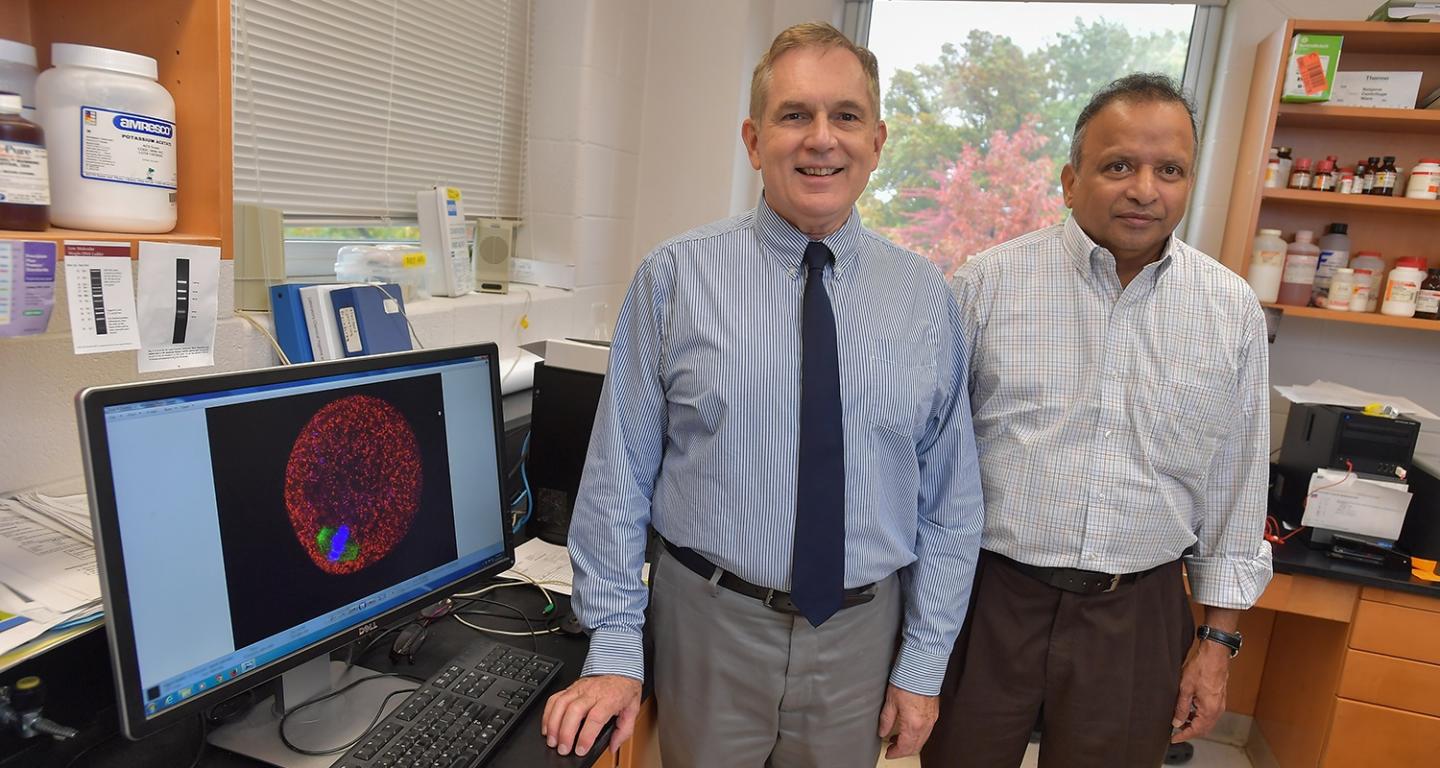
Doug Kline (left) and Srinivasan Vijayaraghavan (right), both professors in Kent State University's Department of Biological Sciences, have received NIH grants to study reproductive challenges.
Media Contacts:
Doug Kline, [email protected], 330-672-3810
Srinivasan Vijayaraghavan, [email protected], 330-672-9598
Dan Pompili, [email protected], 330-672-2070
Media Contact
Dan Pompili
[email protected]
330-672-2070
@ksunews
http://www.kent.edu/