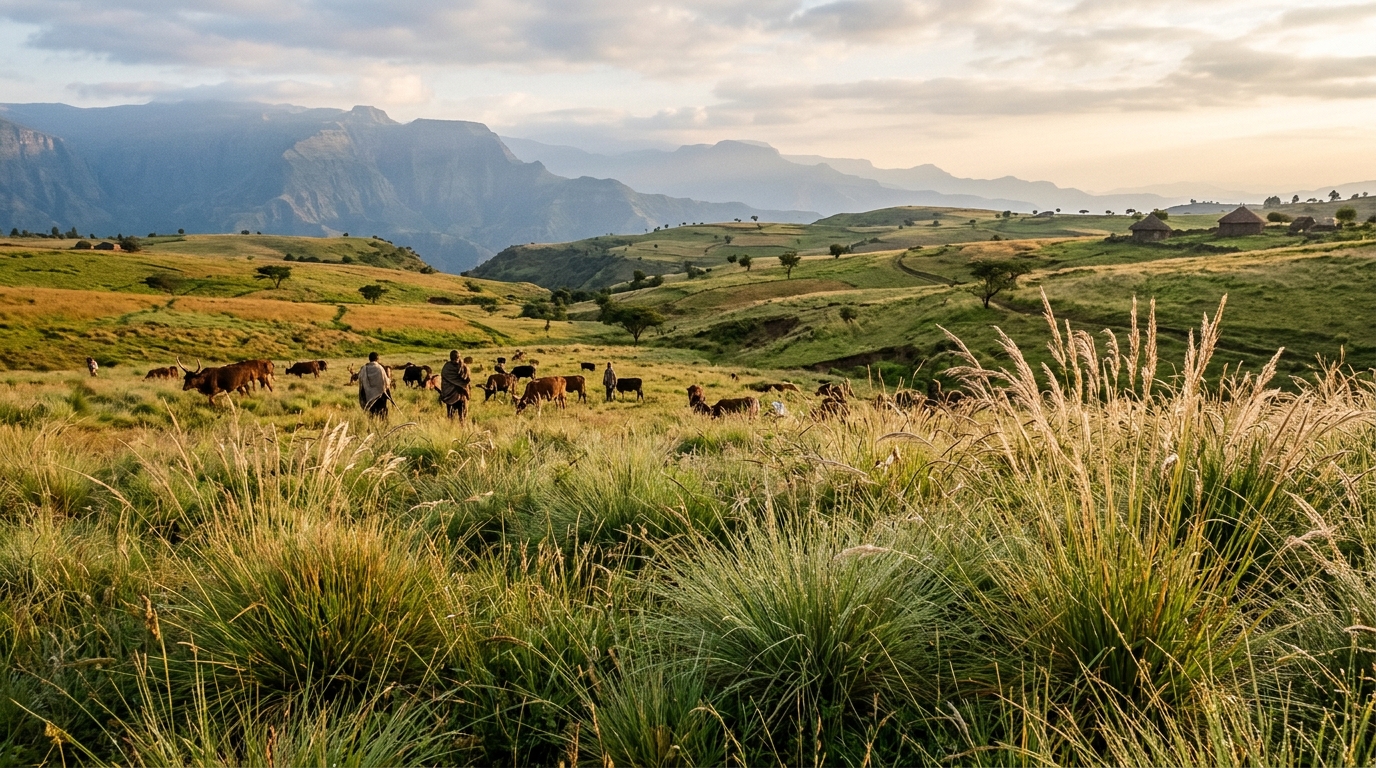
Natural pastures in South Ari District, Southern Ethiopia, are predominantly composed of grass species, with 23 herbaceous plant species identified across different agro-ecological zones and land-use systems. A study published in Discover Life in May 2026 by Yilkal Tadele, Kuratu Kuke, and Tekle Olbamo quantified the biomass yield and nutritive value of these forage resources, highlighting significant differences between communal and private grazing lands. The research provides a detailed baseline assessment of pasture productivity in a region where livestock production is a vital component of the local economy and rural livelihoods. The findings indicate that while grasses dominate the vegetation, the nutritional quality of the forage varies considerably, with private grazing lands generally outperforming communal areas in terms of dry matter yield.
The study was conducted in the South Ari District of Ari Zone, which is characterized by diverse agro-ecological conditions ranging from highland to lowland areas. The district spans altitudes from 500 to 3,418 meters above sea level, with a bimodal rainfall pattern that influences pasture growth. The researchers stratified the study area into highland, midland, and lowland agro-ecologies to capture the ecological variability inherent in the region. This stratification allowed for a comparative analysis of how altitude and land-use type affect herbaceous species composition and biomass production. The district supports a substantial livestock population, including over 269,000 cattle, which relies heavily on natural pastures for feed.
To assess the herbaceous vegetation, the team employed a stratified sampling design that included both communal and private grazing lands. They established 1 m² quadrats to record species composition and estimate biomass yield through destructive sampling. A total of 36 quadrats were used, with 18 located in communal grazing lands and 18 in private grazing lands. This methodological approach enabled the researchers to compare the productivity of different management systems while accounting for agro-ecological differences. The sampling was conducted during the main growing season, a limitation the authors acknowledge as potentially affecting the capture of seasonal variability in forage availability.
The identification of 23 herbaceous species revealed a composition dominated by grasses from the Poaceae family, which accounted for 45.5% of the total species. Legumes from the Fabaceae family made up 25% of the species, while forbs from the Asteraceae family comprised 29.5%. This grass-dominated structure is typical of natural pastures in southern Ethiopia, where continuous grazing pressure often reduces the abundance of legumes. The relative scarcity of legumes is significant because these plants are crucial for providing crude protein to livestock. The presence of less desirable species, such as Ageratum conyzoides and Bidens tripartita, suggests that some areas may require management intervention to improve forage quality.
Key preferred forage species identified in the study included Cynodon dactylon, Sporobolus indicus, and Hyparrhenia rufa, which were consistently abundant across both communal and private grazing lands. These grasses are highly desirable to livestock, indicating that the pastures continue to provide valuable feed resources. However, the frequency of these species varied between agro-ecological zones, with site-specific differences likely influenced by microclimate, soil fertility, and grazing intensity. For instance, Cynodon dactylon showed higher frequency in midland private grazing sites compared to highland areas. The prevalence of these preferred species underscores the importance of maintaining pasture health to support livestock productivity.
Biomass yield analysis revealed that dry matter production varied significantly across land-use types and agro-ecologies. In communal grazing lands, dry matter yield ranged from 1.11 to 1.27 tons per hectare per year, while in private grazing lands, it ranged from 1.73 to 2.12 tons per hectare per year. Private grazing lands consistently produced higher biomass than communal areas, a finding attributed to reduced grazing pressure and improved management practices. Lowland areas recorded significantly higher yields than midland and highland zones, with grasses in lowland communal lands producing 1.90 tons of dry matter per hectare. This spatial variation highlights the impact of environmental factors on pasture productivity.
The nutritive value of selected dominant forage species was evaluated through laboratory analysis of chemical composition. Crude protein content varied widely, ranging from 5.95% in Cymbopogon citratus to 14.35% in Calopogonium mucunoides. This variability indicates that the protein availability in natural pastures is inconsistent, which can affect livestock performance. Neutral detergent fiber values, which are indicators of forage digestibility, ranged from 37.67% to 74.42%. The mean neutral detergent fiber content of 52.17% suggests that the pastures provide moderate-quality forage, although the scarcity of legumes may limit overall nutritional value. The chemical analysis was conducted on samples collected during a single season, so seasonal variations in nutrient content were not captured.
The study’s findings align with previous research in other regions of Ethiopia, which has documented similar patterns of grass dominance and variability in biomass yield. For example, studies in Bale Zone and West Shewa have reported that natural pastures are predominantly grass-based, with legume abundance varying based on agro-ecological conditions. The higher biomass yields in private grazing lands observed in this study are consistent with findings from other Ethiopian rangelands, where protected or privately managed lands tend to maintain better species composition and productivity. These comparisons reinforce the importance of land-use management in determining pasture outcomes.
Limitations of the study include the use of a limited number of quadrats and sampling during a single growing season. The authors acknowledge that 36 quadrats may not fully capture the species diversity across ecologically heterogeneous zones. Additionally, the lack of multi-season sampling means that temporal variability in species composition and nutrient content is not fully represented. The hierarchical nature of the data was not modeled using mixed-effects approaches due to resource constraints, which may affect the statistical robustness of the findings. These limitations suggest that future studies should incorporate more extensive sampling and multi-season data to better understand pasture dynamics.
The implications of the study point to the need for improved grazing management strategies to enhance pasture productivity and nutritional quality. Protecting communal pastures through temporary enclosures or rotational grazing could help maintain the abundance of palatable species and increase biomass yield. The strategic introduction of forage legumes is recommended to improve protein availability and overall forage quality. These measures could support sustainable livestock production and enhance forage availability in South Ari District. The study provides a valuable baseline for local grazing management strategies and highlights the potential for improving pasture systems through targeted interventions.
In conclusion, the research demonstrates that natural pastures in South Ari District are dominated by grass species with moderate biomass yield and variable nutritive value. Private grazing lands and lowland areas produce higher dry matter yields than communal and highland sites, respectively. The variability in crude protein content indicates potential protein deficiencies in grass-dominated pastures, which may impact livestock performance. The study underscores the importance of integrated assessments of herbaceous species composition, biomass productivity, and forage quality across different agro-ecologies and land-use systems. By combining ecological field data with laboratory analysis, the study offers a comprehensive understanding of pasture dynamics in Southern Ethiopia.
The study integrated ecological field data with laboratory analysis and indigenous knowledge from livestock keepers to provide a comprehensive understanding of pasture dynamics. This approach allowed the researchers to combine objective measurements of species composition and biomass with practical herding experience. By engaging local herders and development agents in the selection of grazing sites, the team ensured that the sampled areas were ecologically relevant and accessible. The household surveys specifically targeted individuals with extensive livestock herding experience and detailed knowledge of the local plant flora. This participatory method helped categorize plant species into preference levels, ranging from highly desirable to undesirable, based on actual livestock consumption patterns. The integration of these data sources offers a more nuanced view of pasture utility than ecological surveys alone might provide.
Statistical analysis of the collected data employed a two-factor fixed-effects model to evaluate the effects of agro-ecology and land-use type on the measured variables. The model accounted for location and grazing system as fixed factors, while treating random error as a residual component. Post-hoc comparisons using Tukey’s test were conducted to separate means when significant differences were observed in the data. Descriptive statistics, including means, standard errors, and confidence intervals, were calculated to summarize the species composition and biomass yields. The use of SPSS version 21 and Microsoft Excel facilitated the organization and management of the extensive dataset. This statistical framework supported the identification of significant variations in dry matter production across different altitude categories and management regimes.
The chemical analysis of the selected forage species followed standardized laboratory procedures to ensure accuracy and reproducibility. Samples were air-dried and then oven-dried at 65 degrees Celsius for 72 hours to standardize moisture content before being milled to pass through a 1 mm sieve. The analysis was performed in triplicate for dry matter, ash, and crude protein, following AOAC procedures. Neutral detergent fiber was determined according to Van Soest et al., while acid detergent fiber and lignin were analyzed using methods by Van Soest and Robertson. Crude protein was calculated by multiplying the nitrogen content by 6.25. These rigorous protocols allowed for a precise assessment of the nutritive value of the dominant herbaceous species in the region.
The study area is characterized by a bimodal rainfall pattern, with a short rainy season from March to May and a main rainy season from July to September. The mean annual rainfall in the district ranges from 601 to 1,600 mm, while the mean annual temperature varies between 10.1 and 27.5 degrees Celsius. These climatic factors significantly influence pasture growth and quality, with marked declines in forage availability during the dry season. The district’s diverse agro-ecological zones, comprising highland, midland, and lowland areas, create distinct environmental conditions that affect herbaceous species composition. The highland zone covers 20% of the total area, the midland zone covers 70%, and the lowland zone covers 10%. This spatial distribution of agro-ecologies provides a natural laboratory for studying the impact of altitude on pasture productivity and species diversity.
The livestock population in South Ari District is substantial, with 269,613 cattle, 124,249 sheep, 33,331 goats, 23,596 equines, 180,084 chickens, and 16,964 bee colonies. This diverse herd relies heavily on natural pastures and crop residues, which together account for more than 85% of the national livestock feed supply in Ethiopia. The predominance of natural pastures in the local diet underscores the importance of maintaining their productivity and nutritional quality. The high cattle population in the district was a key factor in its selection for the study, as it reflects the region’s reliance on livestock for household income and food security. The availability of natural pasture resources and the prevalence of free-grazing practices further justified the focus on this specific area for the assessment of herbaceous species composition and biomass yield.
Subject of Research: Herbaceous species composition, biomass yield, and forage value of natural pastures in South Ari District, Southern Ethiopia
Article Title: Herbaceous species composition, biomass yield, and forage value of natural pastures in South Ari District, Southern Ethiopia
Article References: Tadele, Y., Kuke, K., & Olbamo, T. (2026). Herbaceous species composition, biomass yield, and forage value of natural pastures in South Ari District, Southern Ethiopia. Discover Life, 56(1), Article 12. https://doi.org/10.1007/s11084-026-09734-8
Image Credits: AI Generated
DOI: 10.1007/s11084-026-09734-8
Keywords: Herbaceous, species, composition, biomass, yield, forage, value, natural, pastures, South, District, Southern
News Source: Drew Townsend. (November 9, 2026). Ethiopian Pasture Study Reveals Grass Dominance and Yield Variations. Scienmag.