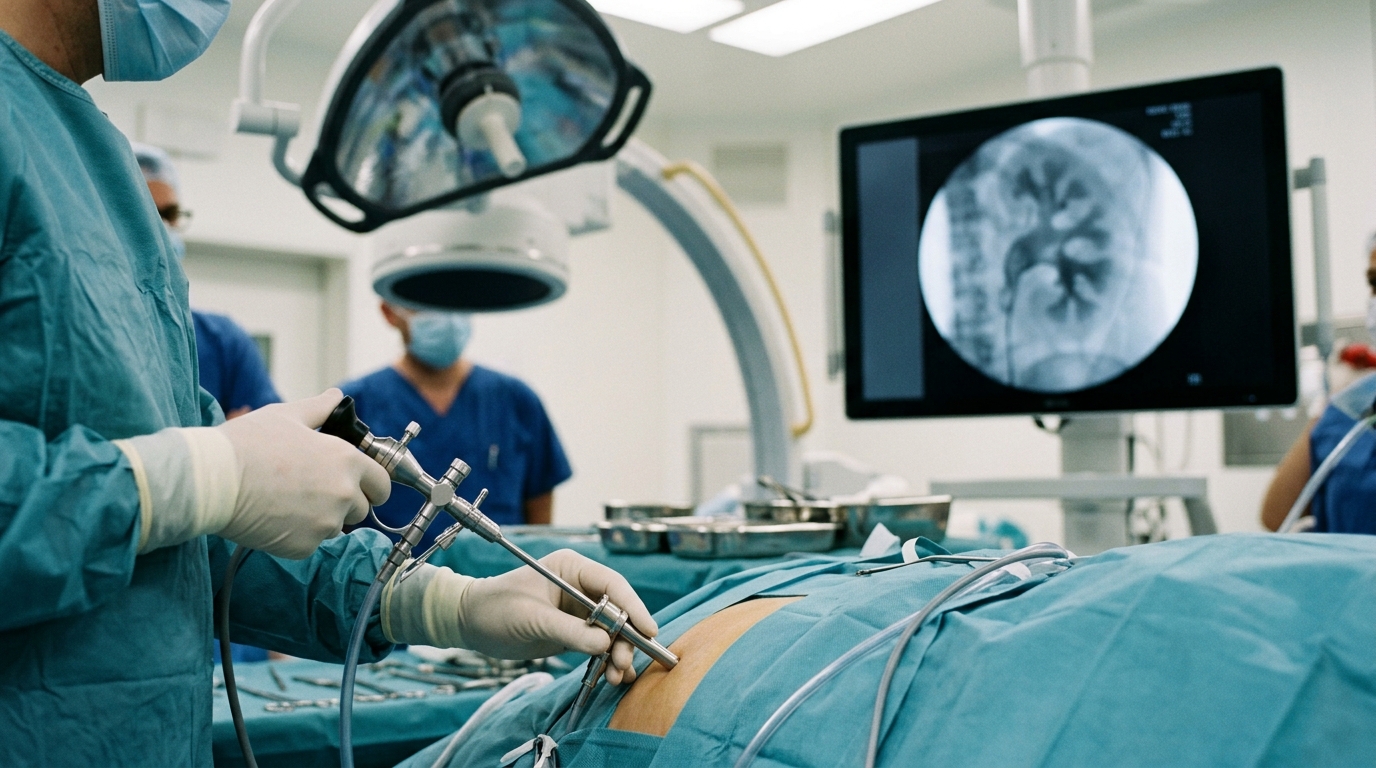
A prospective observational investigation assessing percutaneous nephrolithotomy access has established that a standardized low-volume air pyelogram protocol delivers high technical success and strong stone-clearance rates without demonstrable risk of venous air embolism. Conducted across 350 consecutive surgical patients, the clinical study showed that retrograde instillation of room air capped at 10 mL provided sufficient pelvicalyceal visualization to guide initial percutaneous puncture in 90.9 percent of cases, eliminating the procedural necessity for conventional iodinated contrast in 318 individuals. Published in the African Journal of Urology, the research evaluated procedural efficacy, fluoroscopic exposure durations, anatomical visualization patterns, and intraoperative safety parameters in patients undergoing surgical treatment for renal calculi. Throughout the entire surgical cohort, zero clinical episodes of venous air embolism were detected, demonstrating that strict procedural controls overcome historic concerns regarding vascular air migration while safeguarding patients against contrast-induced adverse events.
Percutaneous nephrolithotomy serves as the clinical standard of care for addressing renal calculi measuring greater than 2 centimeters as well as complex stone burdens, yet procedural efficacy relies on achieving precise access into the renal collecting system. Traditional access protocols rely on fluoroscopy accompanied by retrograde instillation of iodinated contrast media to visualize the internal renal architecture. Although iodinated agents establish dense pelvicalyceal opacification, they introduce non-trivial clinical vulnerabilities, notably life-threatening allergic hypersensitivity and contrast-induced acute kidney injury among individuals presenting with baseline renal impairment. Historically conceptualized in the 1980s, retrograde air pyelogram utilizes room air instilled through a ureteral catheter as a negative-contrast agent that naturally rises into dependent posterior calyces in prone surgical positions. Despite benefits including universal availability, negligible cost, absent nephrotoxicity, and reduced radiation exposure, air pyelogram adoption has remained restricted due to clinical apprehensions regarding venous air embolism.
To evaluate these safety and efficacy dynamics, researchers implemented a standardized prospective protocol enrolling consecutive patients scheduled for percutaneous nephrolithotomy between July 15, 2025, and December 15, 2025. Eligibility criteria incorporated patients presenting with renal stones exceeding 2 centimeters in the pelvicalyceal system or smaller calculi where percutaneous surgery represented the optimal intervention. Exclusion parameters ruled out individuals with uncorrected coagulopathy, active anticoagulant regimens, untreated urinary tract infections, systemic urosepsis, active pregnancy, incomplete follow-up records, or absent preoperative computed tomography imaging. Sample size determinations targeted statistical power for stone-free clearance and major complication incidence, establishing a minimum enrollment requirement of 210 patients before expanding to 350 participants to accommodate potential attrition. The resulting cohort exhibited a median age of 40 years across an age range spanning 2 to 87 years, with a sex distribution comprising 183 male and 167 female patients.
The procedural method followed a uniform procedural pathway designed to minimize vascular entry risks and optimize calyceal targeting. Following spinal or general anesthesia, patients underwent cystoscopic placement of a 6 French ureteral catheter in the lithotomy position before being repositioned prone. Under fluoroscopic monitoring, clinicians slowly instilled room air manually under low pressure up to a strict maximum volume of 10 mL in adult participants, immediately halting injection upon sensing resistance. Post-injection saline flushing was omitted to eliminate elevated pyelovenous pressures capable of inducing backflow. Percutaneous access was executed with an 18-gauge puncture needle using the standard bull’s-eye fluoroscopic alignment, followed by tract dilation up to 16, 18, or 22 French using serial metallic dilators. Pediatric patients received size-adjusted management, utilizing a 4 French ureteral catheter, tract dilation limited to 16 French, and air instillation capped at 6 mL guided by anatomical habitus.
Analysis of anatomical visualization revealed that negative air contrast delineated posterior renal calyces while avoiding visualization overlap. The upper calyx was successfully visualized in 98.6 percent of cases, the middle posterior calyx in 66.0 percent, and the lower posterior calyx in 41.1 percent of patients. Conversely, anterior calyces were visualized in fewer than 5.0 percent of cases, reflecting the physical buoyancy of air within dependent calyces when patients are positioned prone. Posterior calyces presented on fluoroscopy as circular lucencies with sharp contrasting margins, permitting clear calyx identification even among complex staghorn stone configurations. Puncture site selection prioritized the upper compound calyx in 56.0 percent of cases, the middle posterior calyx in 32.0 percent, the lower posterior calyx in 6.9 percent, the lower compound calyx in 4.0 percent, and the middle anterior calyx in 1.1 percent.
Technical execution parameters demonstrated that air alone provided definitive targeting visualization in 318 patients, while 32 patients required intraoperative conversion to meglumine diatrizoate contrast due to questionable needle trajectory, air extravasation, complex anatomy, or multiple tract requirements. Across the entire 350-patient study cohort, successful guidewire negotiation into the ureter was achieved in 86.3 percent of procedures. Intraoperative operational measurements documented a median access attempt frequency of 1 attempt across a range of 1 to 5 attempts. Fluoroscopic exposure registered an overall median duration of 311.5 seconds, spanning an observed range between 101 and 885 seconds. Total operative time required to complete the procedure demonstrated a median duration of 35 minutes across a range extending from 10 to 120 minutes, indicating procedural efficiency across diverse baseline stone complexities.
Clinical stone clearance evaluations performed 4 weeks postoperatively using ultrasound imaging documented an overall stone-free rate of 91.7 percent, with residual stone fragments greater than 4 millimeters detected in 8.3 percent of the patient cohort. Postoperative complications assessed according to the Clavien-Dindo grading system showed that major complications of Grade 2 or higher occurred in 6.0 percent of participants. Specific recorded complications included transient postoperative pyrexia exceeding 100 degrees Fahrenheit in 7.7 percent of patients, transient serum creatinine elevations in 0.9 percent, and hemorrhagic complications requiring blood transfusion in 3.1 percent. Renal pseudoaneurysm formation necessitating secondary therapeutic angioembolization developed in 1.1 percent of cases. Rigorous continuous hemodynamic tracking, capnography, and pulse oximetry recorded no clinical signs of venous air embolism, such as unexplained arterial hypotension, desaturation, or acute cardiovascular collapse.
Comparative assessment between patients managed exclusively with air pyelogram and those converted to iodinated contrast highlighted statistically significant performance advantages for successful air navigation. The air-only cohort attained a significantly higher stone-free rate of 92.8 percent compared to 81.3 percent in the conversion group. Furthermore, patients managed exclusively with air required significantly fewer access puncture attempts, averaging 1.15 attempts versus 2.19 attempts among contrast-converted patients. Fluoroscopy time was reduced in the air-only group, recording a mean of 308.1 seconds compared to 481.5 seconds when contrast was required. Mean operative duration was likewise shorter at 35.8 minutes compared to 45.9 minutes. Major complication rates between groups showed no statistically significant disparity at 6.9 percent versus 12.5 percent, and overall hospital stays were comparable, averaging 3.27 days versus 3.59 days.
Cross-tabulation of baseline clinical characteristics identified preoperative anatomical complexity as the primary determinant governing air pyelogram conversion. Variables including patient age, sex, systemic hypertension, diabetes mellitus, prior percutaneous or open renal surgery, stone area, skin-to-stone distance, hydronephrosis severity, stone density, and composite STONE score exhibited no statistically significant correlation with procedural conversion. In contrast, baseline Guy’s Stone Score demonstrated a statistically significant association with air pyelogram failure, with patients presenting Grade 3 and Grade 4 configurations experiencing the highest conversion frequencies. The authors noted that this correlation indicates that patients with severe anatomical branching or extensive staghorn stone burdens may benefit from upfront iodinated contrast administration to avoid procedural delays, whereas straightforward and moderate pelvicalyceal anatomies remain suited for initial low-volume air navigation.
The study authors acknowledged important methodological boundaries governing the interpretation of these prospective findings. The protocol was implemented at a single institution without an internal randomized control arm receiving conventional contrast pyelography, relying instead on subgroup comparisons and published literature. In addition, hemodynamic monitoring and capnography were utilized to identify clinically manifest venous air embolism rather than transesophageal echocardiography or precordial Doppler ultrasound, meaning asymptomatic subclinical microemboli could not be definitively quantified. The post-procedure assessment of stone-free status utilized renal ultrasonography at 4 weeks rather than non-contrast computed tomography, which may have led to overestimation of stone clearance. Ultimately, maintaining volume caps of 10 mL, slow manual delivery, and immediate contrast conversion provides a reliable, radiation-sparing alternative for percutaneous renal access.
Subject of Research: Clinical efficacy and safety profile of low-volume air pyelogram for percutaneous nephrolithotomy access
Article Title: Clinical outcomes and safety profile of air pyelogram to guide percutaneous access in percutaneous nephrolithotomy – a prospective study
Article References: Mishra, K., Shah, R. S., & Paudel, A. (2026). Clinical outcomes and safety profile of air pyelogram to guide percutaneous access in percutaneous nephrolithotomy – a prospective study. African Journal of Urology, 32(1), Article 46. https://doi.org/10.1186/s12301-026-00595-1
Image Credits: AI Generated
DOI: 10.1186/s12301-026-00595-1
Keywords: percutaneous nephrolithotomy, air pyelogram, urology, kidney stones, venous air embolism, fluoroscopy, radiology, surgical safety, Clinical, outcomes, safety, profile
News Source: Ophelia Keating. (November 8, 2026). Prospective Study Validates Low Volume Air Pyelogram Safety for Kidney Stone Surgery. Scienmag.