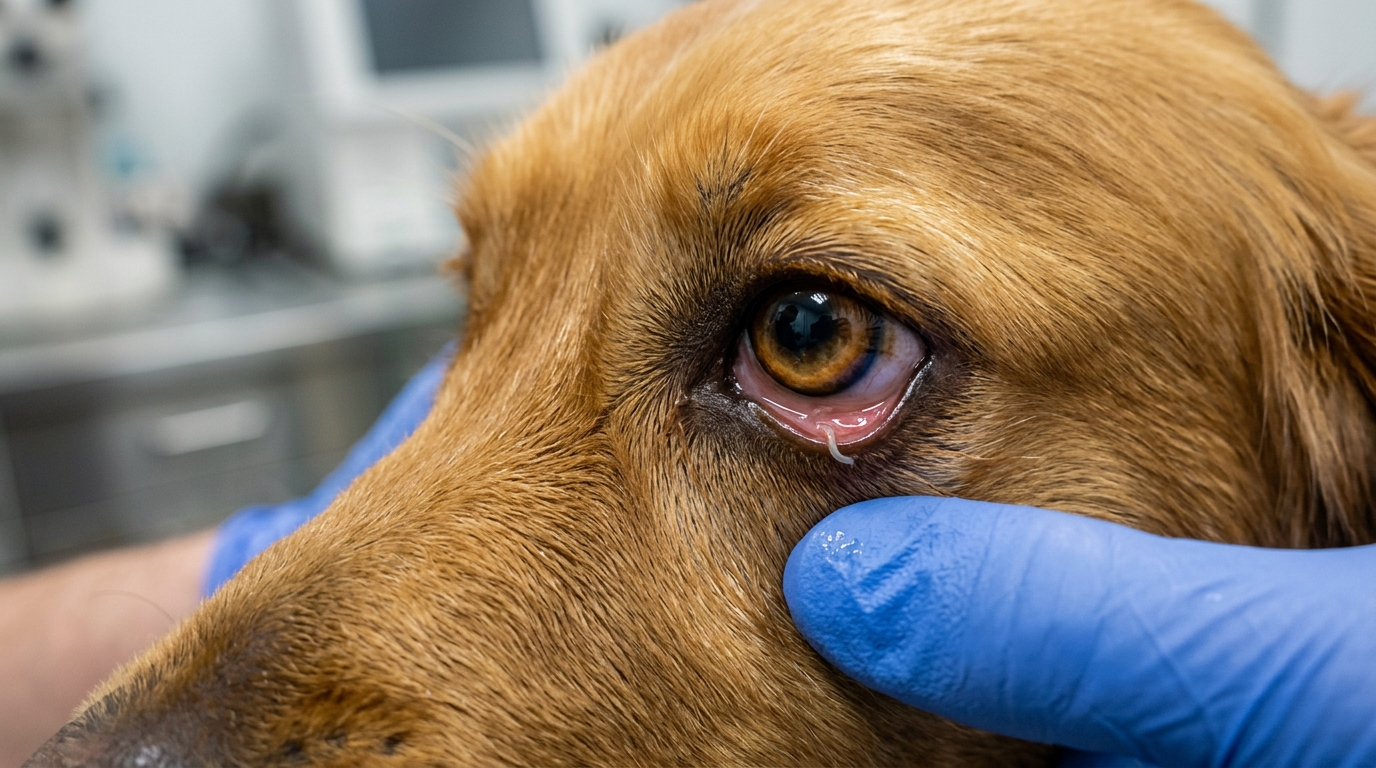
A 6-year-old spayed female Swiss White Shepherd presented to the Small Animal Clinic at the Estonian University of Life Sciences in late November 2024 with unilateral ocular discharge and conjunctival hyperaemia. The dog had recently traveled through several European countries, including the Baltic states, Poland, the Czech Republic, Austria, Italy, Switzerland, Liechtenstein, Germany, and Sweden. Prior treatment with fusidic acid eye drops administered twice daily for one week had not led to clinical improvement. Otherwise, the dog was healthy, but the persistent ocular signs prompted a detailed ophthalmological examination that revealed the presence of multiple motile, thread-like parasites on the inferior conjunctival fornix and under the third eyelid of the left eye.
During the examination, a total of eight worms were removed under local anaesthesia using cotton swabs. The specimens were preserved in 80% ethanol and 0.9% sodium chloride solution for subsequent molecular identification. The right eye showed no pathological changes, and no nematodes were detected in that eye. A clinical examination was otherwise unremarkable, though blood samples collected for serum biochemical and haematology analysis revealed mild hypernatremia at 164 mmol/L. Haematology parameters were within the reference interval, and a peripheral blood smear examined microscopically to screen for concurrent filarial infections showed no such infections.
The dog was treated with two oral doses of milbemycin oxime/praziquantel, administered one week apart. Ocular management consisted of regular cleaning with 0.9% sodium chloride solution and lubrication using a hyaluronate-enriched, carbomer-based ophthalmic gel administered three to four times daily. This regimen was continued until the next visit. A follow-up ophthalmic examination in early December revealed a slight decrease in aqueous tear production on the Schirmer tear test in both eyes, with the left eye measuring 12 mm/min and the right eye 10 mm/min. Mild conjunctival hyperaemia and follicular conjunctivitis were noted on the left eye, but no parasites were observed. Ocular cleaning and lubrication continued twice daily until the next follow-up visit.
A final examination in January 2025 showed normal Schirmer tear test values in both eyes, and the conjunctivitis had resolved. Two worm samples were subjected to species identification using molecular genetic analysis. DNA was extracted using the High Pure PCR Template Preparation Kit from Roche Diagnostics, following the manufacturer’s protocols. For PCR and sequencing, new primers were designed that amplified a 697 bp fragment of the mitochondrial DNA cytochrome oxidase I gene. The analysis yielded two identical sequences of 637 bp. Species identification was conducted by similarity search with nBLAST, which retrieved 21 sequences of Thelazia callipaeda from various countries, exhibiting 100% sequence coverage and similarity with the sequences from Estonia. Thus, the species was unequivocally identified as T. callipaeda, and the cox1 sequences were submitted to GenBank with accession numbers PX498064 and PX498065.
Thelazia callipaeda, commonly known as the oriental eyeworm, is a zoonotic vector-borne nematode first described in Asia in the early 20th century. In recent decades, T. callipaeda has been increasingly reported across Europe, including in Turkey, Romania, Bulgaria, Greece, Serbia, Hungary, Slovakia, Poland, the Czech Republic, Austria, Croatia, Bosnia and Herzegovina, Germany, Switzerland, Italy, France, Belgium, Spain, Portugal, and the United Kingdom. The parasite infects a range of domestic and wild carnivores, such as dogs, cats, red foxes, wolves, and beech martens, as well as lagomorphs and humans. The primary vector for the eyeworm in Europe is the male fruitfly Phortica variegata, which feeds on lacrimal secretions. Adult female worms release first-stage larvae into the host’s lacrimal secretions, which are ingested by the vector when it feeds. The larvae undergo two moults in the fly’s digestive tract before becoming infective third-stage larvae, a process that is temperature-dependent and typically takes 14 to 21 days.
The male fly transmits the infective larvae to a new host during a subsequent feeding, and the larvae complete their development into adult worms within the conjunctival sac. Vector activity peaks from spring to late autumn, with optimal conditions at 20 to 25 degrees Celsius and 50 to 70% relative humidity. Clinical signs of T. callipaeda infection can vary from mild to severe. In canine thelaziosis, conjunctivitis, epiphora, purulent discharge, blepharospasm, keratitis, blepharitis, chemosis, follicular conjunctivitis, and corneal ulceration have been reported. Management typically involves mechanical removal of adult nematodes and pharmacological intervention.
Human thelaziosis presents mild to severe symptoms, including foreign body sensation, photophobia, lacrimation, epiphora, exudative conjunctivitis, keratitis, and corneal ulcers. The primary treatment method involves mechanical removal of the nematodes under local anaesthesia. Topical and systemic antimicrobials and anti-inflammatory agents are sometimes administered to manage secondary infection and inflammation. In the present case, the clinical signs observed – unilateral conjunctivitis, mucopurulent discharge, and follicular conjunctivitis – are consistent with previous descriptions in both natural and experimental infections. Awareness of the parasitic aetiology is especially important in non-endemic regions, where T. callipaeda may not be considered among differential diagnoses of conjunctivitis. Obtaining a thorough travel history remains crucial for early diagnosis and appropriate management, as the infection was almost certainly acquired abroad given the patient’s travel history through multiple endemic and emerging-risk countries.
Several antiparasitic agents have been evaluated for their efficacy against T. callipaeda. In Europe, licensed treatments for canine thelaziosis include a topical spot-on formulation containing moxidectin 2.5% combined with imidacloprid 10%, as well as an oral formulation of milbemycin oxime. Moxidectin-based products have shown high efficacy in treating and preventing T. callipaeda infection. However, adverse weather conditions, such as wet weather causing a damp haircoat, may reduce the effectiveness of topical applications. In such cases, oral milbemycin oxime administered at a minimum dose of 0.5 mg/kg offers a practical alternative, particularly for dogs that are difficult to handle for ocular or topical treatments.
Prevention plays a critical role in managing the risk of infection during travel from non-endemic regions to endemic areas. Several studies have been assessing the efficacy of various formulations for prevention. Monthly administration of combined treatments, such as sarolaner/moxidectin/pyrantel or milbemycin oxime/afoxolaner, has demonstrated 100% efficacy in preventing T. callipaeda infection. These formulations also offer broad-spectrum control against other parasitic diseases as they are licensed for the treatment and/or prevention of multiple canine parasitoses. Preventive antiparasitic treatment should be routinely recommended for pets traveling abroad. The growing concern of T. callipaeda spread is further supported by previous ecological niche model predictions, suggesting the potential for the vector’s geographic expansion across Europe. These models suggest that large areas in Europe are suitable for the vector, highlighting the potential for the spread of T. callipaeda into non-endemic regions.
Although the vector typically inhabits warmer, oak-rich woodlands in Southern and Central Europe, rising temperatures and vector adaptability may allow its expansion further north. Poland is currently the northeastern limit of reported T. callipaeda infection in Europe, suggesting that Estonia could be at risk should favourable environmental conditions arise. This case underscores the potential for introduction and establishment of T. callipaeda in Estonia, particularly if competent vectors such as P. variegata are present or become established due to climate change or anthropogenic factors. Further research is warranted to determine the possible distribution of P. variegata in Estonia, as well as the potential for autochthonous transmission of T. callipaeda. Enhanced surveillance and One Health collaboration among veterinarians, entomologists, wildlife biologists, and the public health sectors will be critical to address this emerging parasitic threat. The findings highlight the urgent need for increased awareness of T. callipaeda among veterinarians, human medical professionals, and pet owners, as this parasite poses an important public health concern.
Subject of Research: First molecularly confirmed case of canine thelaziosis due to Thelazia callipaeda infection in Estonia
Article Title: First molecularly confirmed case of canine thelaziosis due to Thelazia callipaeda infection in Estonia
Article References: Sisask, K., Mõtsküla, M., & Saarma, U. (2026). First molecularly confirmed case of canine thelaziosis due to Thelazia callipaeda infection in Estonia. Acta Veterinaria Scandinavica, 68(1), Article 23. https://doi.org/10.1186/s13028-026-00864-7
Image Credits: AI Generated
DOI: 10.1186/s13028-026-00864-7
Keywords: Thelazia callipaeda, canine thelaziosis, Estonia, zoonotic parasite, ocular nematode, veterinary ophthalmology, molecular identification, Phortica variegata, travel history, public health, First, molecularly
News Source: William Thompson. (November 8, 2026). First Molecularly Confirmed Dog Eyeworm Case in Estonia. Scienmag.