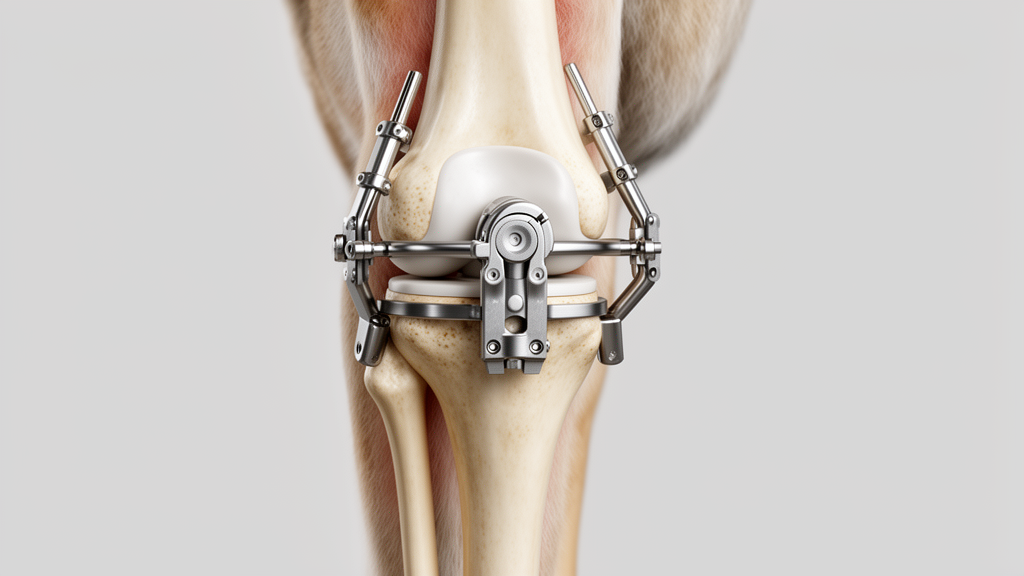
A new biomechanical study suggests that placing the hinge of a hinged transarticular external skeletal fixator (htaESF) over the center of the femoral condyles may not allow for normal femoro-tibial positioning during range of motion in canine stifles. The research was conducted at North Carolina State University.
The study was an original research article published in Frontiers in Veterinary Science, specifically within the Veterinary Surgery section. The authors, Mary Alicia Baldeon, Simon Roe, and David Knazovicky, investigated the hypothesis that a hinge centered over the femoral condyles would fail to maintain normal femoro-tibial alignment throughout the range of motion. In clinical practice, hinged transarticular external skeletal fixation is frequently used to immobilize stifle injuries. Range of motion in htaESF can protect cartilage. However, the study posits that the geometric center of the stifle joint is not static; it changes as the joint flexes and extends.
To test this hypothesis, the researchers harvested eight canine pelvic limbs. The experimental setup involved immobilizing the femurs and pinning the tibias to control rotation during the range of motion tests. The team marked the femoral condylar center at a flexion angle of 135 degrees. From this point, lines were drawn to specific points on the tibia and femur, which were marked on a radio-opaque grid. Radiographs were taken at five-degree intervals throughout the range of motion.
The intersect point (IP) was defined as the intersection of the femoral and tibial lines. The x-y coordinates of this intersect point were normalized and plotted. The researchers calculated the convex hull area for these IP coordinates. Additionally, the coefficient variation of the Euclidean distance was calculated.
The results revealed that the path of the intersect point was non-linear and lacked a consistent pattern both between individual legs and within each dog. The convex hull area was found to be large and bilaterally asymmetrical. A linear mixed model analysis was used to model the relationship between the intersect point shift and the stifle angle. The analysis revealed a significant inverse relationship between the IP shift and the stifle angle, with a p-value of less than 0.001.
These findings imply that the intersect point of stifle joints during range of motion is likely not similar enough across different joints to safely execute range of motion while in a hinged transarticular external skeletal fixator.
The authors acknowledge several limitations in their study. The limbs used were previously frozen. Furthermore, the evaluation focused on only one point in the stifle. The authors conclude that further investigation is necessary to determine the ideal construct for allowing range of motion without placing abnormal forces on the joint.
Subject of Research: Will a trans-articular external fixator placed across the canine stifle allow normal motion if the hinge is centered over the femoral condyle?
Article Title: Will a trans-articular external fixator placed across the canine stifle allow normal motion if the hinge is centered over the femoral condyle?
Article References: Baldeon, M. A., Roe, S., & Knazovicky, D. (2026). Will a trans-articular external fixator placed across the canine stifle allow normal motion if the hinge is centered over the femoral condyle?. Frontiers in Veterinary Science, 13, Article 1892017. https://doi.org/10.3389/fvets.2026.1892017
Image Credits: AI Generated
DOI: 10.3389/fvets.2026.1892017
Keywords: Will, trans-articular, external, fixator, placed, across, canine, stifle, allow, normal, motion, hinge
News Source: William Thompson. (November 8, 2026). Canine Stifle Fixator Hinge Placement May Disrupt Normal Motion. Scienmag.