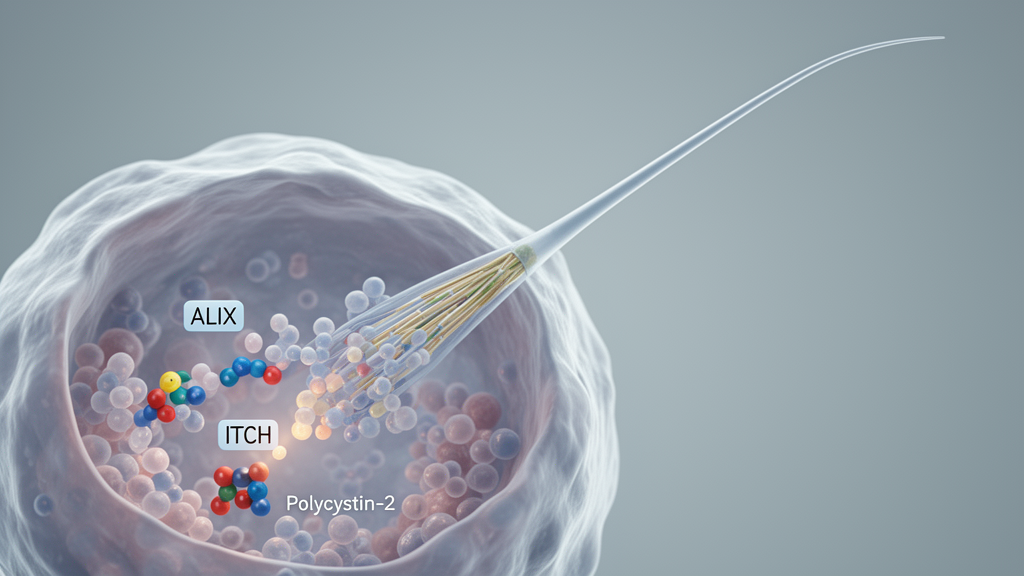
Researchers have identified two proteins, ALIX and ITCH, as critical regulators of ciliary membrane protein homeostasis in mammalian cells. Published in BMC Molecular and Cell Biology, the study demonstrates that these proteins localize to the base of primary cilia and negatively regulate the levels of Polycystin-2, a key component of the cation channel complex implicated in autosomal dominant polycystic kidney disease.
Primary cilia are antenna-like organelles that function as cellular hubs for signaling pathways, including the Sonic hedgehog pathway and signaling mediated by the Polycystin-1/Polycystin-2 cation channel complex. Proper regulation of signaling output depends on the dynamic control of ciliary protein composition, which involves intraflagellar transport-mediated trafficking, protein retrieval, and the shedding of extracellular vesicles from cilia. Mutations that perturb ciliary structure or composition can result in a broad spectrum of disorders known as ciliopathies, which include over 35 severe diseases such as autosomal dominant polycystic kidney disease and Bardet-Biedl Syndrome.
The study focused on ALIX, a protein previously linked to the biogenesis of small extracellular vesicles, and ITCH, an E3 ubiquitin ligase. While ALIX had been detected in the ciliary transition zone of Chlamydomonas cells and in the ciliary proteome of mouse kidney epithelial cells, its specific localization and function at the primary cilium in vertebrates remained unclear. Similarly, although ITCH was identified in the ciliary proteome of several cell types, its specific ciliary functions had not been defined. The researchers sought to determine whether these proteins localize to primary cilia and how they influence ciliary protein levels.
Using immunofluorescence microscopy, the team found that ALIX localizes to the base of primary cilia in multiple mammalian cell types, including mouse cortical collecting duct cells, human retinal pigment epithelial cells, and mouse inner medullary collecting duct cells. The protein was primarily localized at the basal body, below the ciliary transition zone marked by RPGRIP1L. This localization pattern is consistent with previous reports identifying ALIX in the centrosomes of Drosophila and mammalian cells, suggesting a conserved role in ciliary or centrosomal functions.
The retention of ALIX at the ciliary base was found to depend on the ciliary kinesin-3 motor protein KIF13B. In cells lacking KIF13B, ALIX was depleted from the ciliary base over time, although overall cellular levels of ALIX remained unaffected. This suggests that KIF13B is not required for the initial recruitment of ALIX to the ciliary base but is essential for its retention at this site. The study further revealed that KIF13B physically interacts with both ALIX and ITCH, with the forkhead-associated domain of KIF13B playing a critical role in these interactions.
ITCH was also found to be enriched at the ciliary base, and its levels at this site were dependent on KIF13B. In KIF13B-deficient cells, ITCH levels at the ciliary base were significantly reduced, while in rescue lines expressing KIF13B, ITCH was enriched at this site. The study demonstrated that ITCH is essential for ALIX stability, as loss of ITCH led to a significant depletion of ALIX from the ciliary base and a reduction in overall cellular ALIX levels by approximately 30%. This indicates that ITCH regulates ALIX stability, possibly through ubiquitination, although the specific mechanism remains to be fully elucidated.
Functionally, the depletion of either ALIX or ITCH resulted in elevated ciliary levels of Polycystin-2. Partial depletion of ALIX using siRNA led to a significant accumulation of PC2 within cilia after 72 hours of serum starvation, while loss of ITCH caused PC2 accumulation at both 24 and 72 hours. The effect of ITCH loss on ciliary PC2 levels appeared more pronounced than that of ALIX depletion, suggesting that ITCH negatively regulates ciliary PC2 levels not only via ALIX but also through other mechanisms. These findings establish ALIX and ITCH as critical regulators of ciliary membrane protein homeostasis.
Additionally, the study investigated the impact of ITCH loss on Sonic hedgehog signaling. In the absence of ITCH, cells displayed constitutive accumulation of Smoothened, a key Sonic hedgehog effector, within the cilium. Under control conditions, Smoothened levels in cilia were significantly elevated in ITCH-deficient cells compared to wild-type cells, and treatment with purmorphamine, a Sonic hedgehog pathway activator, did not lead to further ciliary accumulation of Smoothened in these cells. This indicates that ITCH plays a role in regulating Sonic hedgehog signaling at the primary cilium, expanding its established role in this pathway.
The study utilized a combination of immunofluorescence microscopy, western blot analysis, and immunoprecipitation to investigate the localization and interactions of ALIX, ITCH, and KIF13B. The researchers employed wild-type and mutant cell lines, including KIF13B-deficient and ITCH-deficient cells, to assess the functional roles of these proteins. The use of siRNA for partial depletion of ALIX allowed for the assessment of its role in ciliary PC2 levels without the potential confounding effects of complete gene knockout.
The findings suggest a model whereby KIF13B initially recruits or retains ITCH at the ciliary base, which in turn is required for regulating ALIX stability or retention at this site. This coordinated action of KIF13B, ITCH, and ALIX helps maintain proper ciliary function by regulating the levels of key signaling proteins such as Polycystin-2 and Smoothened. The study highlights the importance of these proteins in ciliary homeostasis and provides a foundation for further research into the molecular mechanisms underlying ciliopathies.
The research was conducted using cultured mammalian cells, including mouse cortical collecting duct cells, human retinal pigment epithelial cells, and mouse inner medullary collecting duct cells. The use of multiple cell types helped confirm the generalizability of the findings across different cellular contexts. The study also utilized CRISPR/Cas9 methodology to generate ITCH knockout cell lines, allowing for a more precise assessment of ITCH’s role in ciliary protein regulation.
While the study provides significant insights into the roles of ALIX and ITCH in ciliary homeostasis, further research is needed to define the specific mechanisms by which these proteins regulate ciliary protein levels. The complex and context-dependent effects of ITCH ubiquitination on substrate stability and function suggest that additional studies are necessary to fully understand the regulatory pathways involved.
The study contributes to the growing body of knowledge on the regulation of primary cilia and their role in cellular signaling. By identifying ALIX and ITCH as novel regulators of ciliary membrane protein homeostasis, the researchers have provided new insights into the molecular mechanisms that underlie ciliary function and dysfunction.
Subject of Research: Regulation of ciliary Polycystin-2 levels by ALIX and ITCH in mammalian cells
Article Title: ALIX and ITCH localize to the base of primary cilia and negatively regulate ciliary Polycystin-2 levels
Article References: Berggreen, C. R., Laplace, J., Campestre, F., Petersen, A.-L. W., Fixdahl, A. M., Mary, B., Ghazanfar, S., Li, G., Wagner, L. E., Rezi, C. K., Chamlali, M., Anvarian, Z., Christensen, S. T., May-Simera, H. L., & Pedersen, L. B. (2026). ALIX and ITCH localize to the base of primary cilia and negatively regulate ciliary Polycystin-2 levels. BMC Molecular and Cell Biology, 27(1), Article 17. https://doi.org/10.1186/s12860-026-00571-1
Image Credits: AI Generated
DOI: 10.1186/s12860-026-00571-1
Keywords: primary cilia, ALIX, ITCH, Polycystin-2, KIF13B, ciliopathies, Sonic hedgehog signaling, ciliary homeostasis, molecular biology, cell signaling, localize, base
News Source: Drew Townsend. (November 8, 2026). Proteins ALIX and ITCH Regulate Ciliary Polycystin-2 Levels. Scienmag.