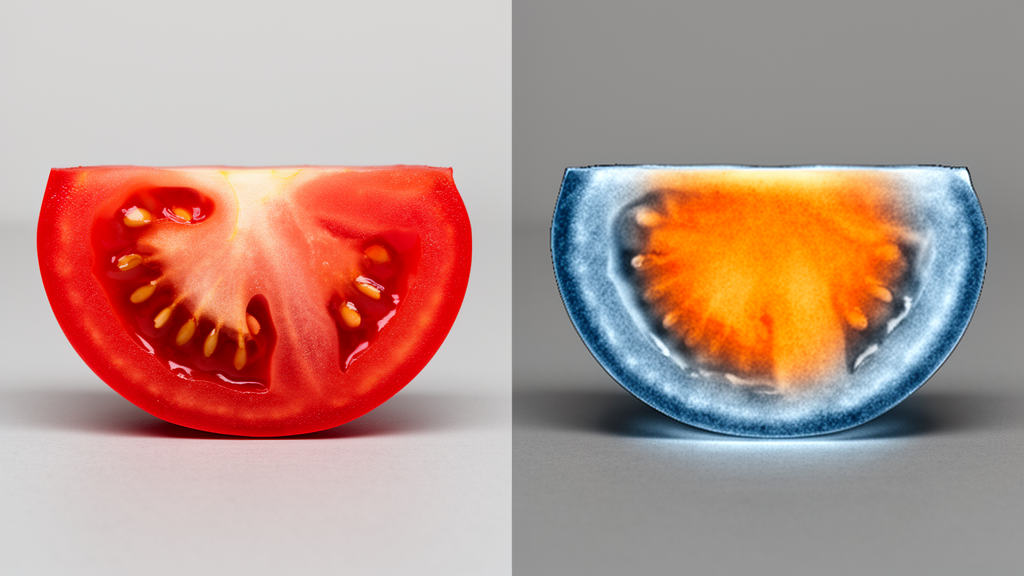
Researchers have developed and validated a three-dimensional computational fluid dynamics model coupled with radiometric infrared thermography to track heat and mass transfer during the convective drying of tomato wedges across multiple air temperatures. Published in Food Production, Processing and Nutrition, the investigation evaluated drying kinetics alongside key physicochemical quality attributes at sixty, seventy, and eighty degrees Celsius. The experimental trials demonstrated that elevating the drying air temperature reduced processing times from twenty-one hours at sixty degrees down to eleven hours at eighty degrees, while computational predictions achieved close correspondence with measured moisture content and surface temperatures across all tested thermal regimes.
Agricultural processing of tomatoes represents a critical post-harvest challenge due to the crop\’s high moisture content, which typically ranges from ninety to ninety-five percent on a wet basis. Fresh tomatoes provide a substantial dietary source of bioactive compounds, including ascorbic acid, polyphenols, and carotenoids such as lycopene, but their elevated water content renders them highly susceptible to post-harvest decay during handling and transport. Convective drying offers an established preservation route by evaporating internal water, decreasing overall weight and bulk volume, and extending shelf life. However, prolonged exposure to elevated temperatures can cause tissue shrinkage, browning reactions, and the degradation of heat-sensitive nutrients, making precise thermodynamic process control necessary to balance dehydration efficiency against product quality preservation.
To capture the transport phenomena specific to tomato wedges, the study investigated a geometry that differs substantially from conventional flat-rounded disc slices or idealized spheres. In typical sun and solar drying practices across several agricultural regions, tomatoes are halved or quartered into wedges, creating complex three-dimensional boundaries that influence surrounding airflow patterns and evaporative flux. While prior research characterized disc-shaped slices, predictive computational fluid dynamics models specifically targeting the convective drying behavior and coupled transport mechanisms of wedged geometries remained undeveloped. The authors addressed this gap by configuring a geometric domain based on a quartered sixty-millimeter sphere suspended within a controlled convective air channel.
The experimental setup utilized fresh, intact tomatoes of uniform maturity, color, and size purchased from a local market, displaying an average initial moisture content of ninety-four percent, equivalent to 15.67 kilograms of water per kilogram of dry matter. Samples were quartered into wedges and placed into stainless steel mesh boxes measuring fifteen by ten by five centimeters, with four wedges per container. Drying experiments were conducted in a convective air dryer maintaining an average air velocity of 0.7 meters per second under controlled operating temperatures of sixty, seventy, and eighty degrees Celsius. Hourly weight measurements tracked moisture reduction until the wedges reached a terminal moisture content of approximately 0.17 kilograms of water per kilogram of dry matter.
Continuous temperature tracking throughout the dehydration process incorporated two complementary detection systems. Thermocouples linked to an AZ Instrument data logger recorded localized temperatures directly within tomato wedges distributed throughout the drying chamber. Concurrently, an Optris Xi 400 radiometric thermal camera mounted fifteen centimeters above the sample trays continuously captured spatiotemporal surface temperature distributions. Color imaging was captured simultaneously at two-hour intervals. The thermographic data provided high-resolution spatial maps of transient thermal phenomena, such as edge heating and boundary gradients, supplying the empirical baseline required to rigorously validate the numerical simulation results.
The computational framework was implemented in COMSOL Multiphysics using finite element discretization across coupled transport modules for laminar flow, heat transfer, and diluted species transport. Mesh generation applied triangular elements ranging from 0.006 to 0.1 millimeters, reinforced with dedicated boundary layers along the interface between the drying air and the tomato tissue to guarantee numerical stability. The model assumed convective heat exchange at the outer interface, internal conductive heat transfer, diffusion-controlled moisture transport, and differing moisture diffusivity between the pulp and outer peel. Volume shrinkage and structural deformation were omitted from the computational equations to simplify calculations and preserve numerical convergence.
Airflow modeling revealed that incoming air at 0.7 meters per second maintained a laminar profile, with velocity decelerating adjacent to the wedge surfaces due to skin friction and boundary layer formation. Air accelerated over the upper curved surfaces while reaching minimum velocities beneath the samples. The experimental drying curves demonstrated that tomato wedges bypassed a constant-rate drying phase entirely, proceeding exclusively through a falling-rate mechanism governed by internal molecular diffusion. Drying rates peaked sharply during the initial hours when abundant free water was present, reaching 3.25 and 3.19 dry basis units per hour at eighty and seventy degrees Celsius, compared to 2.49 dry basis units per hour at sixty degrees.
Thermal progression followed a non-linear efficiency curve with diminishing kinetic returns at elevated temperatures. Increasing the drying air temperature from sixty to seventy degrees Celsius shortened the total drying duration by eight hours, reducing processing time from twenty-one hours to thirteen hours. However, raising the temperature further from seventy to eighty degrees Celsius produced only an additional two-hour reduction, completing the process in eleven hours. Numerical predictions demonstrated strong alignment with experimental moisture trajectories, recording an overall root-mean-square error of 0.812 and a chi-square value of 0.313, with predictive accuracy proving highest at eighty degrees Celsius.
Spatial analysis across distinct wedge coordinates highlighted substantial moisture gradients between the geometric center, the exposed upper boundary, and the lower peel region. Direct contact with hot airflow caused rapid initial dehydration at outer surfaces and leading edges, whereas the core maintained high moisture levels during early drying phases before establishing internal diffusion gradients. Surface thermography showed evaporative cooling kept product temperatures significantly below drying chamber conditions during active dehydration, stabilizing between forty-five and forty-seven degrees Celsius during sixty-degree drying and between sixty and sixty-five degrees during eighty-degree drying, before rising toward the air setpoint as moisture was depleted.
Nutritional and chromatic evaluations revealed that temperature selection strongly affected product preservation. Fresh samples exhibited 83.83 milligrams of lycopene per hundred grams dry weight, an antioxidant radical-scavenging activity of 45.2 percent, and total phenolics of 739.18 milligrams gallic acid equivalents per hundred grams dry weight. While all metrics declined during drying, prolonged processing at sixty degrees resulted in the greatest degradation due to extended oxidative exposure. Drying at seventy degrees yielded the best chromatic retention, showing superior brightness and red-green balance with minimal total color change, whereas eighty-degree drying caused surface crusting and lower chromatic values. The authors concluded that seventy degrees provides an optimal operating condition, while noting that future models should incorporate dynamic shrinkage and heterogeneous tissue properties.
Subject of Research: Computational fluid dynamics modeling and thermal imaging of convective tomato drying
Article Title: Integrated CFD simulation and thermal imaging for monitoring convective drying of tomato wedges
Article References: Hamed, O. A., ElMasry, G., Radwan, S., & ElGamal, R. (2026). Integrated CFD simulation and thermal imaging for monitoring convective drying of tomato wedges. Food Production, Processing and Nutrition, 8(1), Article 60. https://doi.org/10.1186/s43014-026-00409-5
Image Credits: AI Generated
DOI: 10.1186/s43014-026-00409-5
Keywords: computational fluid dynamics, food engineering, tomato drying, thermal imaging, drying kinetics, heat and mass transfer, convective drying, food quality, lycopene retention, moisture diffusivity, Integrated, simulation
News Source: Audrey Campbell. (November 8, 2026). Computer Simulations and Thermal Imaging Track Convective Drying in Tomato Wedges. Scienmag.