Credit: Karen Hardy
Bits of wood recovered from a 1.2-million-year-old tooth found at an excavation site in northern Spain indicate that the ancient relatives of man may have use a kind of toothpick. Toothbrushes were not around yet, if the amount of hardened tartar build-up is anything to go by. An analysis of the tartar has now yielded the oldest known information about what our human ancestors ate and the quality of their diet. According to study leader Karen Hardy of the Catalan Institute for Research and Advanced Studies (ICREA) and the Universtat Autònoma de Barcelona, what they ate was consumed raw, and shows that 1.2 million years ago hominins did not yet know how to use fire to prepare food. The findings are published in Springer's journal The Science of Nature.
The teeth investigated by Hardy's team come from one of the two oldest hominin remains yet to be found in Europe. The piece of jawbone found in 2007 at the Sima del Elefante excavation site in Spain's Atapeurca Mountains is between 1.1 million and 1.2 million years old. Sima del Elefante is part of several archaeological and palaeontological sites that together represent a history that is between 300,000 years and 1.2 million years old.
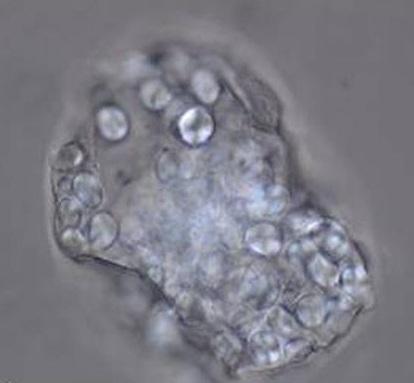
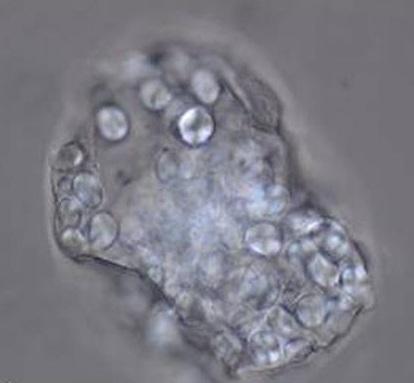
Dental calculus or tartar, a form of hardened plaque, was found on all but one of the teeth examined. A minute sample of tartar from one of the teeth was removed using an ultrasonic scalar, and then analyzed to recover the microfossils trapped in it. These included several types of fibres, including tiny pieces of non-edible wood, plants and animal tissue. A scale from a butterfly's wing and a fragment of an insect leg was also detected. One of the two types of fungal spores recovered is similar to the modern day plant pathogen Alternaria, which is associated with asthma and hay fever.
The wood fibres come from a groove at the bottom of the tooth, called the interproximal groove, which is thought to be caused by regular tooth picking. Previously, the oldest known example of this type of dental hygiene came from the remains of a much younger 49,000 year old Neanderthal. Some of the starch granules trapped in the tartar suggest the hominins may have eaten grass seeds. From the conifer pollen grains present, Hardy's team deducts that the hominin lived close to a forest.
"It is plausible that these ancient grasses were ingested as food," says Hardy. "Grasses produce abundant seeds in a compact head, which may be conveniently chewed, especially before the seeds mature fully, dry out and scatter."
According to Hardy, the intact nature of the starch granules and the uncharred fibres found show that the hominins did not yet know how to use fire with which to cook raw food. The teeth examined had been worn down and showed signs of heavy use that suggest the teeth were used to grip and chew raw materials.
Hardy concludes, "Our evidence for the consumption of at least two different starchy plants, in addition to the direct evidence for consumption of meat and of plant-based raw materials suggests that this very early European hominin population had a detailed understanding of its surroundings and a broad diet."
###
Reference: Hardy, K. et al. (2016). Diet and environment 1.2 million years ago revealed through analysis of dental calculus from Europe's oldest hominin at Sima del Elefante, Spain. The Science of Nature. DOI 10.1007/s00114-016-1420-x
Media Contact
Lea Brix
[email protected]
49-622-148-78414
@SpringerNature
http://www.springer.com