• HOME
  • NEWS
  • EXPLORE
    • CAREER
      • Companies
      • Jobs
    • EVENTS
    • iGEM
      • News
      • Team
    • PHOTOS
    • VIDEO
    • WIKI
  • BLOG
  • COMMUNITY
    • FACEBOOK
    • INSTAGRAM
    • TWITTER
Friday, May 15, 2026
BIOENGINEER.ORG
No Result
View All Result
  • Login
  • HOME
  • NEWS
  • EXPLORE
    • CAREER
      • Companies
      • Jobs
        • Lecturer
        • PhD Studentship
        • Postdoc
        • Research Assistant
    • EVENTS
    • iGEM
      • News
      • Team
    • PHOTOS
    • VIDEO
    • WIKI
  • BLOG
  • COMMUNITY
    • FACEBOOK
    • INSTAGRAM
    • TWITTER
  • HOME
  • NEWS
  • EXPLORE
    • CAREER
      • Companies
      • Jobs
        • Lecturer
        • PhD Studentship
        • Postdoc
        • Research Assistant
    • EVENTS
    • iGEM
      • News
      • Team
    • PHOTOS
    • VIDEO
    • WIKI
  • BLOG
  • COMMUNITY
    • FACEBOOK
    • INSTAGRAM
    • TWITTER
No Result
View All Result
Bioengineer.org
No Result
View All Result
Home Headlines

New insights into cause of phantom limb pain may have therapeutic…

Bioengineer.org by Bioengineer.org
January 19, 2018
in Headlines, Health, Science News
Reading Time: 2 mins read
0
Share on FacebookShare on TwitterShare on LinkedinShare on RedditShare on Telegram
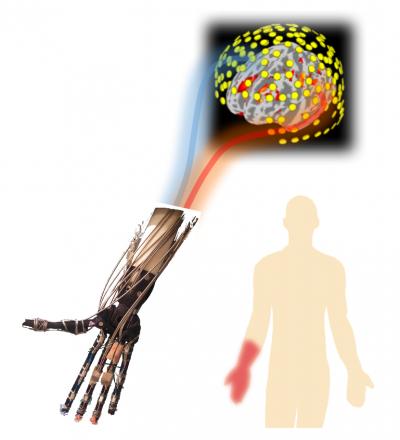
IMAGE

Credit: Osaka University

Osaka, Japan – Phantom limb pain is the pain experienced following loss of a limb, either from injury or amputation. This sensation of pain was previously thought to be caused by abnormal plasticity in the sensorimotor cortex of the brain, and rehabilitative therapies have focused on restoring normal motor function to relieve the pain. However, conflicting results left the question of whether and how phantom pain is caused by changes in sensorimotor activity unanswered.

In a new study, researchers based at Osaka University reported on their use of brain-machine interface (BMI) training with a robotic hand on 10 phantom limb patients to investigate the association between changes in symptomatic pain and cortical currents during phantom hand movements. The BMI decodes the cortical signals that instruct the affected hand to move. It then converts this decoded phantom hand movement into movement of the robotic neuroprosthesis. Previous research has shown that BMIs can precisely decode hand movements in real time.

Patients were asked to either open the robotic hand or grasp with it. The cortical currents activated by hand movements were measured using magnetoencephalography (MEG) signals. Results were compared with movement of the intact hand to check that motor information obtained from the sensorimotor cortex was specific. As expected, training with the prosthesis partially restored functioning of the affected hand and increased motor activity in the cortex. However, unexpectedly, participants reported a significant increase in the sensation of pain.

This approach provided a method for inducing localized changes in cortical activity and directly and reversibly studying the relationship with pain.

Indeed, when the patients were asked to move the phantom hand based on MEG signals decoded from movement of the intact hand, cortical sensorimotor activity was disrupted, reducing pain. In contrast with what was previously thought, these findings showed that pain is not reduced by reconstruction of motor function but by changes in cortical plasticity.

Five study participants found that BMI training reduced pain more than previous therapies, suggesting that this is a promising approach for treating phantom limb pain. The training also reduced pain from residual surgery in some patients, therefore may be used to treat other chronic pain conditions.

###

Media Contact

Saori Obayashi
[email protected]
81-661-055-886
@osaka_univ_e

http://www.osaka-u.ac.jp/en
Share12Tweet8Share2ShareShareShare2

Related Posts

Personalized beverages offer vital nutrients for space missions, new study reveals — Chemistry

Personalized beverages offer vital nutrients for space missions, new study reveals

May 15, 2026
Innovative Ultrasonic Framework Enhances Real-Time Measurement of Oil Film Thickness in Rolling Bearings — Technology and Engineering

Innovative Ultrasonic Framework Enhances Real-Time Measurement of Oil Film Thickness in Rolling Bearings

May 15, 2026

HESpotEx: Deep Learning Predicts Gene Expression from Histology

May 15, 2026

Agricultural Soil Microbiomes Resist Warming Better Than Naturals

May 15, 2026
Please login to join discussion

POPULAR NEWS

  • Research Indicates Potential Connection Between Prenatal Medication Exposure and Elevated Autism Risk

    843 shares
    Share 337 Tweet 211
  • New Study Reveals Plants Can Detect the Sound of Rain

    729 shares
    Share 291 Tweet 182
  • Salmonella Haem Blocks Macrophages, Boosts Infection

    62 shares
    Share 25 Tweet 16
  • Breastmilk Balances E. coli and Beneficial Bacteria in Infant Gut Microbiomes

    58 shares
    Share 23 Tweet 15

About

We bring you the latest biotechnology news from best research centers and universities around the world. Check our website.

Follow us

Recent News

Personalized beverages offer vital nutrients for space missions, new study reveals

Innovative Ultrasonic Framework Enhances Real-Time Measurement of Oil Film Thickness in Rolling Bearings

HESpotEx: Deep Learning Predicts Gene Expression from Histology

Subscribe to Blog via Email

Enter your email address to subscribe to this blog and receive notifications of new posts by email.

Join 82 other subscribers
  • Contact Us

Bioengineer.org © Copyright 2023 All Rights Reserved.

Welcome Back!

Login to your account below

Forgotten Password?

Retrieve your password

Please enter your username or email address to reset your password.

Log In
No Result
View All Result
  • Homepages
    • Home Page 1
    • Home Page 2
  • News
  • National
  • Business
  • Health
  • Lifestyle
  • Science

Bioengineer.org © Copyright 2023 All Rights Reserved.