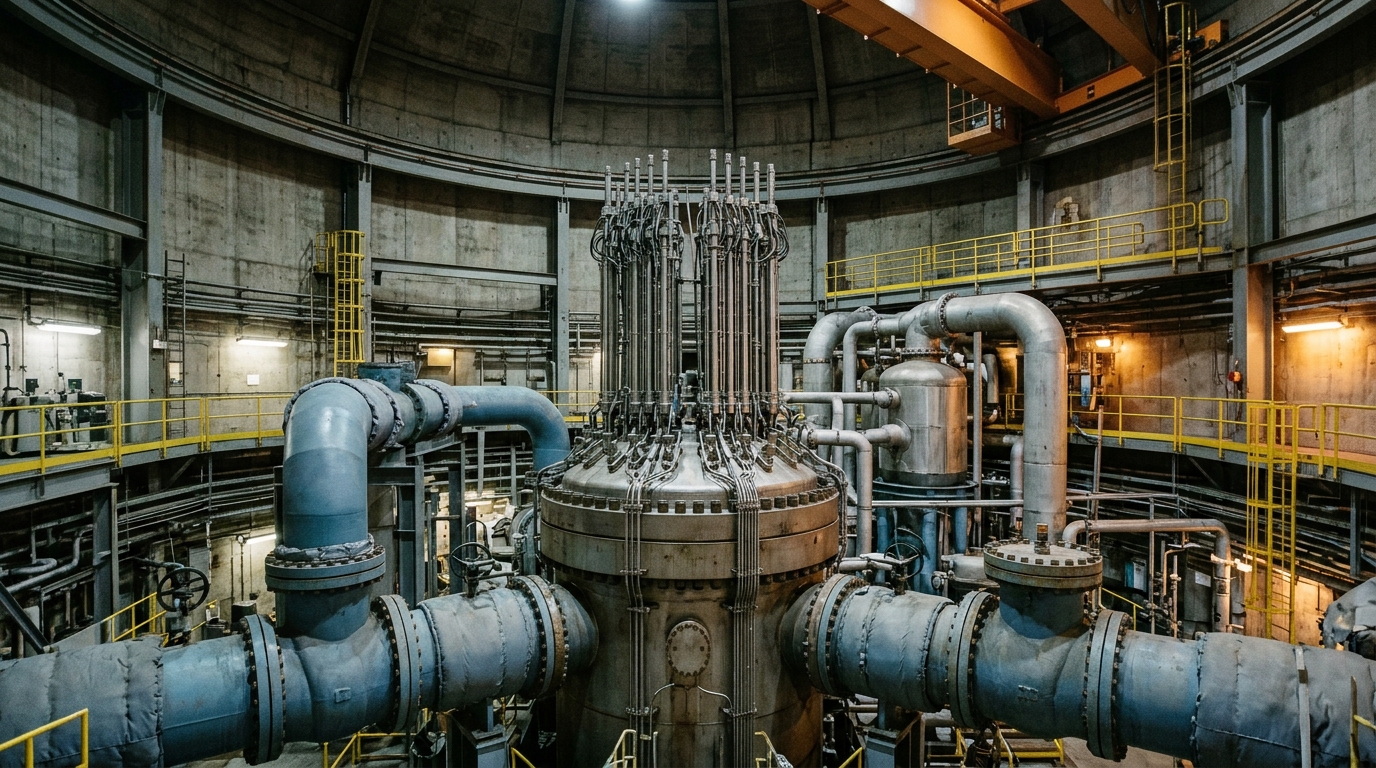
When a nuclear power plant loses its connection to the electrical grid, operators have seconds to understand what is happening inside the reactor. A new study shows that artificial intelligence models trained on simulated loss of offsite power events can predict the key thermal-hydraulic responses of a pressurized water reactor far faster than traditional simulation codes, and that embedding the governing physics equations directly into the neural network’s training process improves both accuracy and robustness. The work, published in Frontiers in Energy Research, compares data-driven deep neural networks with physics-informed neural networks for predicting primary system pressure, fuel temperature and coolant temperature in a triple-loop pressurized water reactor under loss of offsite power conditions.
Loss of offsite power, or LOOP, is one of the most frequent and risk-significant transients in nuclear power plants according to the United States Nuclear Regulatory Commission. Between 2009 and 2023, roughly 33 percent of reported LOOP events were switchyard-related and 34 percent were weather-related. These events simultaneously challenge multiple safety systems and reduce the plant’s ability to remove decay heat, which makes rapid and accurate prediction of the resulting transient crucial for safety analysis, operator training and emergency preparedness. Traditional benchmarked codes such as RELAP and MELCOR have long been used to understand reactor dynamics during such events, but they are computationally expensive, which prohibits their direct use in fast safety assessments.
The research team, led by Fabiano Thulu and Zeyun Wu of Virginia Commonwealth University together with Yunfei Zhao of the University of Maryland, simulated 36 distinct LOOP event cases using the RELAP5 code through Virginia Commonwealth University’s reactor simulator. The scenarios spanned three types of initiating events: loss of 6900 V auxiliary buses, loss of 120 V AC and DC instrument buses, and station blackout. Each event type was combined with four postulated reactor conditions depending on whether the Reactor Protection System and the Auxiliary Feed-Water System functioned, and with three initial reactor power levels of 100, 75 and 50 percent. Every scenario produced time-series data covering 300 seconds of steady-state operation followed by a transient lasting up to 10,000 seconds.
The researchers trained four data-driven deep neural network architectures and three physics-informed neural network variants on this dataset. The data was partitioned into 26 scenarios for training, five for validation and five for testing, with test scenarios drawn from the same combinatorial grid of accident types, power levels and safety system states as the training data. The evaluation therefore assessed interpolation performance on held-out transient trajectories within the training envelope, meaning the models never encountered any time-step data from the test trajectories during training. The test set primarily targeted interpolation within the operational envelope of 50 to 100 percent initial power while assessing generalization across combinations of safety system failures.
Among the data-driven models, an improved multi-layer perceptron with hidden layers of 512, 256 and 128 neurons performed best. On held-out test scenarios it achieved an R-squared of 0.7015 for primary coolant temperature, 0.6701 for fuel temperature and 0.8364 for primary system pressure. The multi-layer perceptron reached the lowest root mean squared error and mean absolute error among the four architectures tested, which also included a temporal convolutional network and a residual network multi-layer perceptron. However, the data-driven model showed localized errors in magnitude and phase lag during abrupt changes in the transient, such as rapid pressure reversals and temperature inflection points, and its uncertainty bands widened during rapid transient phases, indicating sensitivity to random initialization.
The physics-informed approach embedded three lumped-parameter ordinary differential equations governing the macroscopic energy and pressure evolution of the primary system directly into the neural network’s loss function. These equations describe the fuel energy balance, the coolant energy balance and a simplified pressure evolution that ties pressure change rate to coolant temperature change rate. The fuel, coolant and primary system were each treated as spatially uniform control volumes with homogeneous temperature and pressure, constant thermophysical properties, and a single effective fuel-to-coolant heat transfer coefficient. The required derivatives were computed using automatic differentiation, a core feature of the PyTorch framework used for training.
A central challenge was the extreme numerical disparity between the coupled physical variables, where thermal power magnitudes in watts dwarf primary system pressure scales in megapascals. The team introduced a fixed-weight normalization strategy that nondimensionalized the physical residuals by dividing each by its characteristic scale before computing the physics loss. This prevented gradient pathology, in which high-magnitude residuals dominate the training process at the expense of subtle but safety-critical parameters. The gradient norm ratio between the physics loss and the data loss remained at a mean of 0.005 throughout training, confirming that the physics loss contributed meaningfully without dominating optimization.
The best-performing physics-informed architecture, a shared-encoder multi-head design with three dedicated output heads, improved the held-out test R-squared to 0.7449 for coolant temperature, 0.6987 for fuel temperature and 0.8519 for primary system pressure. These represent improvements of 4.3, 6.2 and 1.9 percent respectively over the multi-layer perceptron. The shared-encoder design forces the intermediate network layers to learn a single unified latent representation of the reactor state, allowing temperature and pressure predictions to share a feature space before final predictions are made. The model also reduced root mean squared error for fuel temperature from 43.31 to 25.90 kelvin, for coolant temperature from 27.71 to 18.03 kelvin, and for primary system pressure from 0.54 to 0.51 megapascals, with all improvements statistically significant under a Wilcoxon signed-rank test across five independent training seeds.
An ablation study isolated the contribution of the physics loss term by training the same shared-encoder architecture with the physics constraint completely disabled. The physics constraint reduced coolant temperature root mean squared error by 45.5 percent, from 38.58 to 21.03 kelvin, and pressure root mean squared error by 59.7 percent, from 0.77 to 0.31 megapascals, while fuel temperature showed negligible improvement of 0.93 percent. The mean normalized mean squared error reduction of 44.8 percent confirmed that the embedded constraint, rather than the architecture alone, was the primary driver of the performance gains. The physics-informed model also demonstrated better robustness to sensor measurement uncertainty: when Gaussian noise with a standard deviation of 3 percent of the normalized input range was added to all five input features, the mean absolute percentage error increased by only 0.1274 percent for the physics-informed model, compared with 0.2954 percent for the data-driven model.
Both surrogates achieved single-sample inference latencies below 2 milliseconds on an NVIDIA Tesla T4 GPU, with the data-driven model averaging 1.286 milliseconds and the physics-informed model 0.614 milliseconds, representing speedup factors of approximately 233,000 and 488,000 respectively relative to a primary reference simulation time of roughly 300,000 seconds per LOOP transient. The researchers caution that the models were evaluated on interpolation within the training envelope and that extrapolation to power levels outside the 50 to 100 percent range remains future work, as does incorporating a six-equation two-fluid model to capture non-equilibrium two-phase boiling regimes. They also note that the fidelity of the underlying governing equations is paramount: the simplified lumped-parameter equations did not represent time-varying steam generator heat removal, reactor protection system trip logic or pressurizer actions, and the physics-informed model’s uncertainty calibration for fuel temperature remained below theoretical ideals. The study nonetheless demonstrates that hybridizing data-driven learning with embedded physical laws offers a promising path toward trustworthy, physically consistent surrogate models for nuclear power plant safety assessment.
Subject of Research: Physics-informed neural network surrogate models for predicting thermal-hydraulic transients in pressurized water reactors during loss of offsite power events
Article Title: A physics-informed neural network approach for surrogate modeling for PWRs LOOP events
Article References: Thulu, F., Wu, Z., & Zhao, Y. (2026). A physics-informed neural network approach for surrogate modeling for PWRs LOOP events. Frontiers in Energy Research, 14, Article 1955705. https://doi.org/10.3389/fenrg.2026.1955705
Image Credits: AI Generated
DOI: 10.3389/fenrg.2026.1955705
Keywords: physics-informed neural networks, pressurized water reactor, loss of offsite power, surrogate modeling, thermal-hydraulics, nuclear safety, deep learning, RELAP5, station blackout, reactor transient prediction, physics-informed, neural
News Source: Cassandra Pierce. (November 8, 2026). Neural networks learn reactor physics to predict PWR blackout transients. Scienmag.