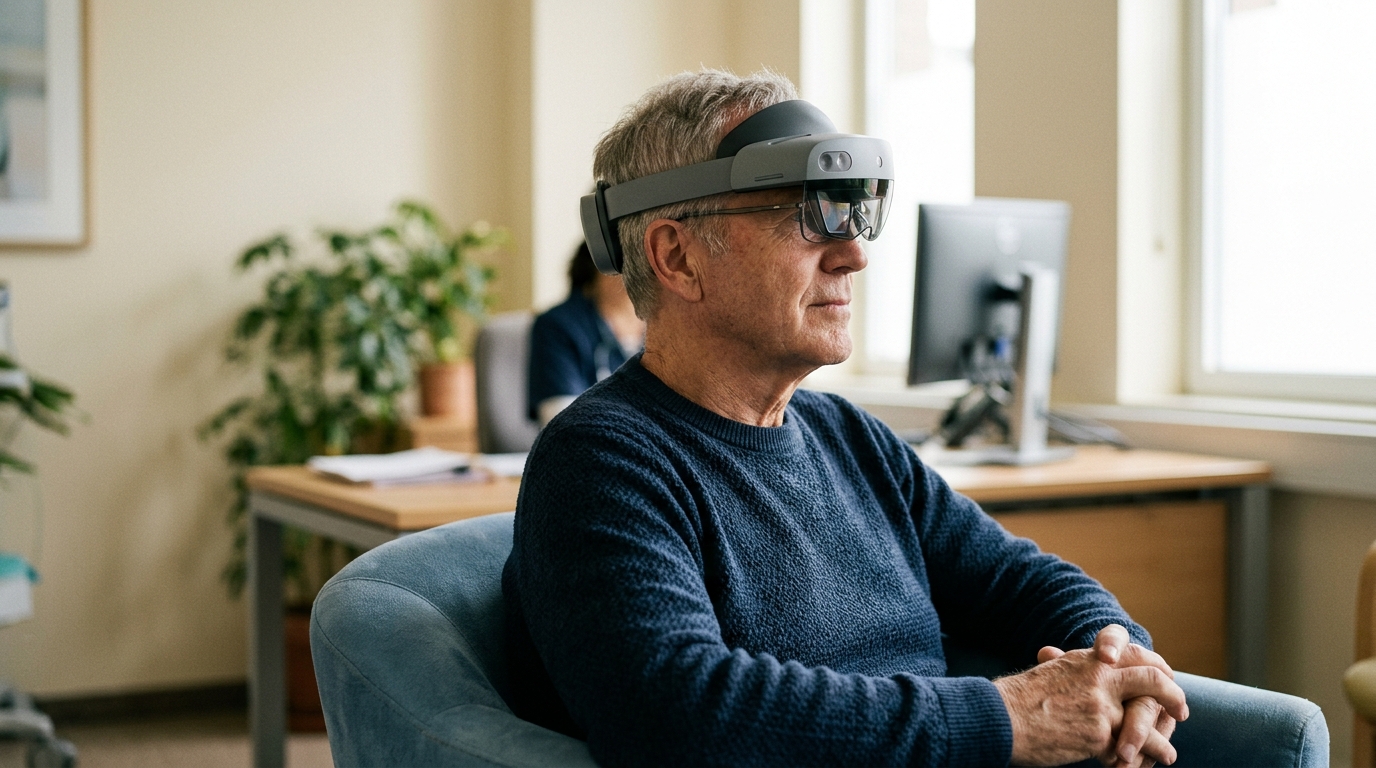
In an initial case–control evaluation, a head-gaze adaptation of the Trail Making Test administered through immersive virtual reality demonstrated feasibility, tolerability, and known-groups validity for distinguishing older adults with mild cognitive impairment from healthy comparison participants. Researchers evaluated the Trail Making Test in Virtual Reality, designated as TMT-VR, across 84 adults aged 60 to 89 years, comprising 42 individuals with clinically diagnosed mild cognitive impairment and 42 healthy comparison participants. Unlike conventional paper-and-pencil assessments, the head-gaze virtual reality system automatically records task completion times and wrong-target selections during test execution. Immersive virtual reality adaptations of neuropsychological instruments alter how individuals respond, necessitating systematic validation within specific clinical populations.
All 84 study participants completed the TMT-VR alongside the traditional paper-and-pencil Trail Making Test and the Mini-Addenbrooke’s Cognitive Examination. The investigation involved planned analyses to determine feasibility, convergence across testing formats, group differences between diagnosed individuals and controls, and diagnostic accuracy for all 26 recorded TMT-VR scores compared directly with their paper-and-pencil counterparts and the Mini-Addenbrooke’s Cognitive Examination. These comparative evaluations incorporated formal demographic adjustment, statistical multiplicity correction using the Holm procedure, and sensitivity analyses.
Feasibility metrics indicated that all 84 participants successfully completed both Part A and Part B of the TMT-VR protocol. Participant ratings of cybersickness systematically decreased over the course of the testing session, demonstrating that the immersive virtual reality environment was well tolerated by older adults with and without cognitive impairment. When evaluating convergence between the virtual reality and traditional formats, Part B completion times correlated moderately across the two modalities. This correlational convergence between the digital and paper-and-pencil tests was observed more clearly within the healthy comparison cohort than among participants with clinically diagnosed mild cognitive impairment.
In group comparisons, participants diagnosed with mild cognitive impairment exhibited significant behavioral differences on Part B of the TMT-VR, demonstrating slower completion times and making a greater number of wrong-target selections relative to healthy comparison participants. Conversely, these group performance differences in completion speed and target selection errors did not appear during Part A of the virtual reality task. When evaluating diagnostic discrimination based strictly on Part B completion times, researchers found no detectable difference in diagnostic accuracy between the immersive virtual reality platform and the traditional paper-and-pencil format.
The discriminative advantage of the virtual reality format emerged primarily in its target selection error metrics and derived performance indices. Specifically, the Part B error score, the total error score, the difference between Part B and Part A error scores, and the Part B-specific derived scores discriminated mild cognitive impairment more strongly in the TMT-VR than in the paper-and-pencil version. Paired differences for these error metrics excluded zero, although none of the comparisons survived statistical multiplicity correction via the Holm procedure. In contrast, the conventional paper-and-pencil test maintained an advantage specifically in Part A completion time. Furthermore, group differences observed on the traditional Part B depended more heavily on educational attainment than differences observed on the virtual reality Part B. Sensitivity analyses that matched participants by education and evaluated comparison groups confirmed this directional pattern, while the Mini-Addenbrooke’s Cognitive Examination achieved higher diagnostic accuracy than any individual trail-making score from either testing format.
The study authors concluded that while the TMT-VR serves as a promising candidate format for inclusion in neuropsychological assessment batteries for mild cognitive impairment, significant clinical and methodological questions require further investigation. Although Part B-specific and error-based metrics yielded higher point estimates of discriminative accuracy across related scores, residual confounding associated with participant education cannot be entirely excluded. Additionally, the evaluation relied on an asymmetric reference standard. Essential psychometric properties, including test–retest reliability, normative reference values, and the incremental diagnostic value of the virtual reality tool beyond an established global cognitive screen, remain to be formally established in consecutive clinical referrals.
Subject of Research: Virtual reality assessment of mild cognitive impairment
Article Title: Validity, diagnostic accuracy, and feasibility of trail making test in virtual reality for mild cognitive impairment
Article References: Kourtesis, P., Ioakeimidou, A., Dimakopoulou, M., Anastasopoulou, C., Roussou, M., Roussos, P., Nega, C., & Beratis, I. (2026). Validity, diagnostic accuracy, and feasibility of trail making test in virtual reality for mild cognitive impairment. Frontiers in Digital Health, 8, Article 2011231. https://doi.org/10.3389/fdgth.2026.2011231
Image Credits: AI Generated
DOI: 10.3389/fdgth.2026.2011231
Keywords: virtual reality, mild cognitive impairment, Trail Making Test, digital cognitive assessment, diagnostic accuracy, feasibility, older adults, neuropsychology, Validity, diagnostic, accuracy, trail
News Source: Ophelia Keating. (November 8, 2026). Head-Gaze Virtual Reality Trail Making Test Evaluated for Mild Cognitive Impairment. Scienmag.