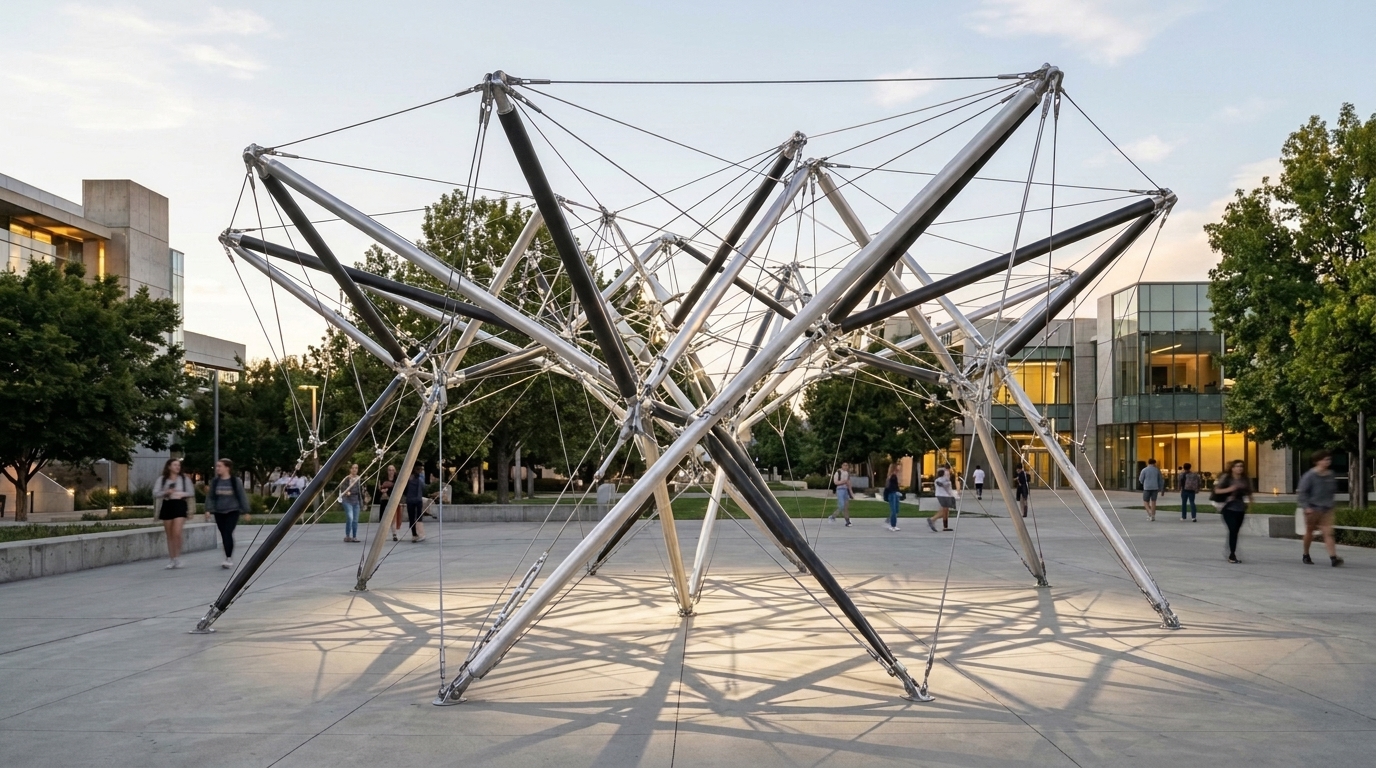
A research team led by Alberto Pugnale, Gabriele Mirra, Jack Halls, Michael Minghi Park, Michael Mack, and Sofia Colabella has introduced FloaTree, an experimental human-machine design and fabrication workflow that converts artificial intelligence abstractions of large trees into functional, deployable tensegrity structures. Published in the journal Architectural Intelligence, the study details how generative computational algorithms, structural optimization techniques, and low-tech fabrication methods can produce lightweight spatial systems capable of rapid on-site assembly. The investigative framework was validated through an iterative prototyping sequence that progressed from basic two-module physical experiments to an eight-module architectural pavilion erected in Switzerland. This physical installation was recognized as the winning entry in the 2024 International Association for Shell and Spatial Structures Design Competition and Exhibition of Innovative Lightweight Structures held in Zurich. By successfully uniting advanced parametric design protocols with manual assembly workflows, the project demonstrates that tensegrity systems need not remain confined to purely theoretical explorations or artistic gallery installations, but can instead serve as practical, transportable structures designed with eventual ecological utility in mind.
The underlying motivation for the FloaTree project centers on the urgent ecological challenges brought about by the global loss of large, old trees. As established in foundational forestry literature, mature trees provide indispensable microhabitats, hollows, large branches, and coarse woody debris that shelter birds and diverse wildlife, yet their populations are declining severely, particularly across dense urban environments. While artificial habitat structures have been proposed to mitigate these deficits, conventional artificial designs rarely emulate the complex morphological characteristics of natural arboriform structures. To bridge this morphological gap, the project drew upon prior research conducted by Mirra and colleagues in 2022, wherein an artificial intelligence agent was trained within a simplified computer-aided design environment to extract and generate three-dimensional visual abstractions of large trees. These outputs were expressed as open polylines, which human designers could interpret as structural line sketches that preserve essential spatial branching cues relevant to avian nesting and perching behaviors while providing a simplified geometric basis for physical fabrication using standard components.
To translate these linear polyline representations into physical three-dimensional forms, the researchers selected tensegrity systems after evaluating competing options, including reciprocal frame assemblies. Tensegrity, a concept pioneered in 1948 by artist Kenneth Snelson with his original X-module sculpture and later popularized alongside Buckminster Fuller, describes a structural typology composed of isolated compression struts suspended within an unbroken, continuous network of pre-tensioned cables. Because compression members do not make direct contact with one another, equilibrium is achieved strictly through geometric configuration and tensile prestress rather than rigid jointing. This discontinuous compression logic produces highly efficient, lightweight systems characterized by minimal bar-to-bar connections, high strength-to-weight ratios, and an inherent capacity to fold into compact bundles. These geometric and structural properties aligned directly with the project goals, offering both the formal capacity to mimic sprawling natural branches and the logistical efficiency needed for modular transport and deployability.
The computational workflow developed for FloaTree established an automated generative pipeline implemented in Rhinoceros 3D and Grasshopper to systematically construct tensegrity geometries along any arbitrary input polyline. The script executed a four-step generative process: constructing pairs of reference planes oriented along each segment, defining the spatial coordinates of paired struts to generate independent modular towers, generating the complete cable network, and finally adding external ground anchoring lines. Tension members were categorized into edge lines defining module boundaries, draw lines pulling consecutive units together, and sling lines suspending the modules. To maintain geometric continuity at sharp polyline vertices, the algorithm enforced specific boundary rules requiring the terminal module of an incoming segment to align its lateral edge cables directly with the base plane of the subsequent module. The team monitored these complex spatial relationships using connectivity matrices, a standard graph-representation technique that mapped member arrangements and element types across matrix diagonals, facilitating direct visual and topological comparisons between alternative configurations.
Because the initial base geometry was dictated by the visual branching directions of the AI sketch rather than pure mechanical form-finding, the resulting 12-module structure required rigorous numerical verification. Structural simulations were carried out under self-weight using the Karamba3D finite element analysis solver, with boundary conditions comprising four fixed foundation supports and an applied initial cable prestress strain of 0.02 percent. To comply with strict international travel constraints, the researchers downscaled the numerical model by 25 percent, reducing overall spatial bounding dimensions from 4.01 by 3.41 by 4.32 meters to 2.99 by 2.54 by 3.22 meters. The initial analysis revealed severe structural deficiencies: while all 24 timber struts remained under compression, 14.8 percent of the 114 steel cables experienced compression, meaning they were slack and mechanically inactive. Furthermore, the cantilevered form exhibited an unacceptable maximum nodal displacement of 54 centimeters, demonstrating that manual geometric alignment alone could not yield a viable, stable tensegrity system.
To correct these deficiencies without distorting the underlying tree-like morphology, the researchers implemented a two-tiered digital adjustment pipeline combining dynamic relaxation and multi-objective evolutionary optimization. First, the Kangaroo2 physics engine executed a dynamic relaxation routine that incorporated element length goals, cable shortening to simulate prestress, anchor goals to prevent node drift, and fabrication constraints that snapped element dimensions to uniform five-centimeter increments. While dynamic relaxation reduced compressed cables to 10.43 percent, it increased maximum displacement to 41.95 centimeters and could not achieve full equilibrium. The team subsequently linked the model to the SPEA-2 genetic algorithm in Octopus, formulating a 128-variable optimization problem that permitted bounded spatial repositioning of 46 free nodes within a plus-or-minus 0.2-meter window. Terminated after 60 generations, the algorithm identified an optimal Pareto-front configuration at generation 55 that completely eliminated both compressed cables and tensioned struts while reducing maximum structural deflection down to just 3.13 centimeters.
Physical fabrication progressed through four structured prototyping phases to iteratively validate computational simulations against real-world manufacturing and assembly constraints. Phase 1 involved constructing Prototype 1, a small-scale two-module tensegrity featuring birch plywood struts machined on a three-axis computer numerical control router and paired with 50-millimeter-wide woven jute webbing tension members. Although the struts featured serrated, wavy edges designed to simulate organic perching surfaces, testing revealed that the jute webbing stretched substantially under tensile load and that the irregular profiles caused excessive machining time and material waste during sheet nesting. Addressing these material shortcomings, Phase 2 examined Prototype 2, a four-module assembly built from 12.7-millimeter tubular steel struts and 2-millimeter steel cables adjusted with turnbuckles. Prototype 2 successfully proved that pre-assembling modules flat on an engineered medium-density fiberboard template before hoisting them into place eliminated the need for complex augmented reality equipment on site.
The insights gathered from these early prototypes informed the full-scale construction of Prototype 3, which was fabricated in Melbourne as Prototype 3A before final transport. The struts were completely re-engineered into a three-piece modular assembly cut from 6-millimeter birch plywood, consisting of standardized end segments and variable-length central sections that interlocked through offset mid-span notches. For the crucial strut-end connections, the team designed custom hardware consisting of a 50-millimeter stainless steel ring retained by twin steel plates. This circular geometry established a continuous perimeter for cable attachment and was divided into four distinct, color-coded quadrants, preventing cable entanglements and allowing near-direct load paths. The complete eight-module pavilion incorporated 75 steel cable assemblies of 2-millimeter diameter, each fabricated with dedicated turnbuckles using a custom measuring jig. Initial full-scale assembly in Melbourne was assisted by three heavy-duty C-stands acting as temporary erection props.
The fourth and culminating phase evaluated the transportability and rapid deployment of the structure under realistic international exhibition conditions in Zurich, where it was designated Prototype 3B. A central logistical mandate of the competition required that the entire disassembled pavilion fit securely into no more than six pieces of standard airline checked luggage. Upon arrival in Switzerland, a four-person crew erected the eight-module structure within a strict two-day timeframe without relying on scaffolding, ladders, or heavy mechanical hoisting gear. Temporary ratchet straps were tensioned across consecutive modules to stabilize intermediate self-stress loops during sequential erection. Assembly was directed entirely by two-dimensional schematic drawings and paired axonometric diagrams keyed to physical labels on each component. Final tensioning required systematic measurement of all 75 cables from the foundation up to the eighth module using a comprehensive length schedule to ensure the completed installation achieved structural self-equilibrium.
Despite its competition victory, the Zurich deployment highlighted critical engineering trade-offs inherent in combining low-tech timber fabrication with tensegrity mechanics. Following successful erection, the pavilion suffered an overnight structural failure when an unpredicted combination of rainfall and temperature swings triggered the buckling of a primary timber strut at its notched joint interface. Subsequent Euler buckling calculations for pinned conditions established that the strut section had a critical buckling capacity of 3.05 kilonewtons, which was exceeded by the actual compressive load of 4.45 kilonewtons induced by the operational prestress. Furthermore, three-dimensional photogrammetric scans of the Melbourne prototype revealed cumulative tolerance stack-up, where minor manual tensioning adjustments produced noticeable geometric drift by the eighth module, exacerbated by a 30-millimeter eccentric load offset at the node rings. Future research trajectories will explore weather-resistant hardwood species such as Gaboon, hollow closed cross-sections capable of housing nesting cavities, variable cable pre-tensioning algorithms, and systematic field monitoring to quantify genuine ecological occupancy by wild bird populations.
Subject of Research: Computational design and low-tech fabrication workflow for tree-inspired tensegrity structures
Article Title: Deploying FloaTree: computational design-to-construction workflow of a low-tech tensegrity system
Article References: Pugnale, A., Mirra, G., Halls, J., Park, M. M., Mack, M., & Colabella, S. (2026). Deploying FloaTree: computational design-to-construction workflow of a low-tech tensegrity system. Architectural Intelligence, 5(1), Article 2. https://doi.org/10.1007/s44223-025-00112-4
Image Credits: AI Generated
DOI: 10.1007/s44223-025-00112-4
Keywords: tensegrity structures, computational design, parametric modeling, artificial habitats, structural optimization, digital fabrication, lightweight architecture, dynamic relaxation, Deploying, FloaTree, computational, design-to-construction
News Source: Denise Maddox. (November 8, 2026). Computational Workflow Translates AI Tree Sketches into Deployable Tensegrity Pavilion. Scienmag.