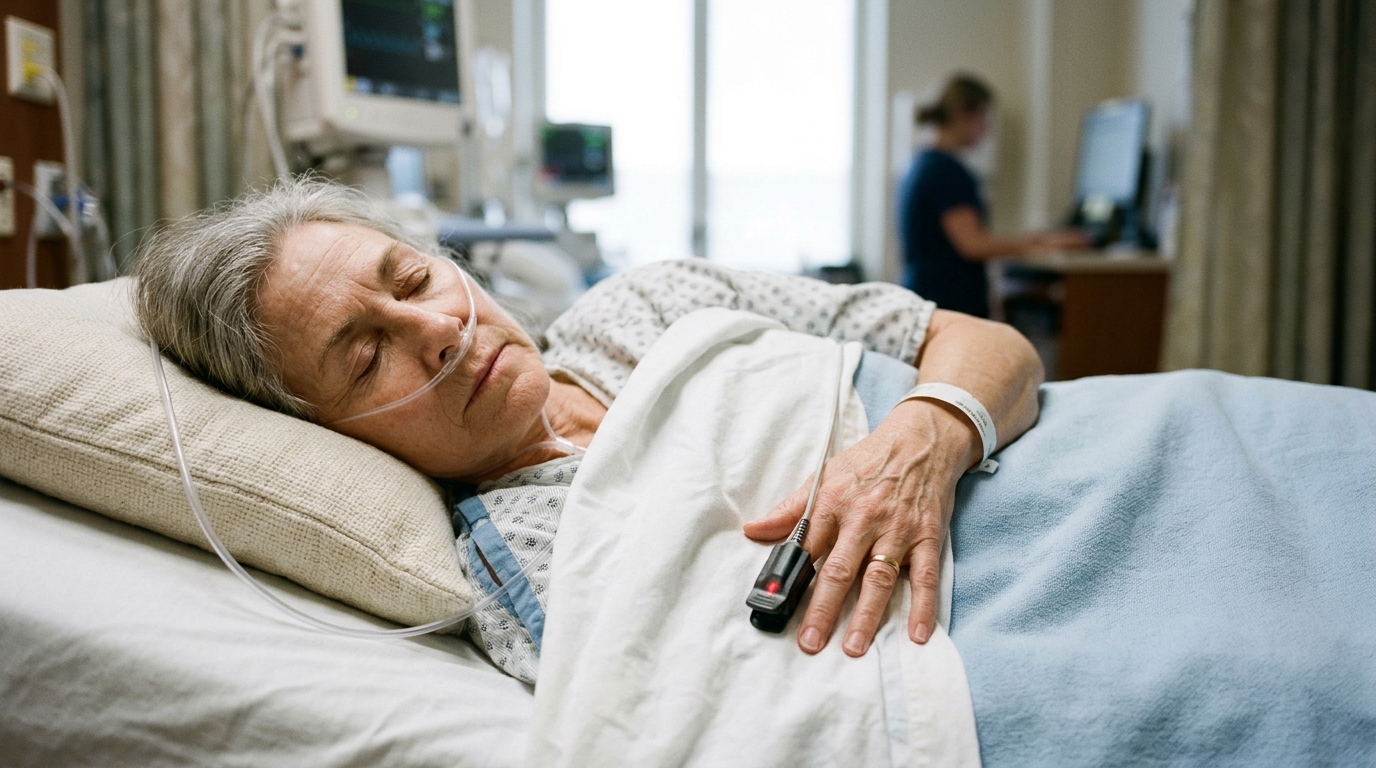
A narrative mini-review published in Frontiers in Medicine examines how supplemental oxygen complicates the detection of opioid-induced respiratory depression (OIRD) in postoperative patients. The review, authored by Jing Wen and Qiang Fu from The Third People’s Hospital of Chengdu, highlights a critical gap in current clinical practice: while oxygen is standard care for postoperative hypoxemia, it can mask the ventilatory decline caused by opioids, delaying the warning signs that monitors typically provide. This distinction is vital because respiratory depression may develop after extubation and remain unrecognized during intermittent observation on general wards, where continuous monitoring is often absent.
The core physiological issue lies in the divergence between oxygenation and ventilation. Pulse oximetry measures hemoglobin saturation, not alveolar ventilation or carbon dioxide clearance. When supplemental oxygen is administered, it can preserve peripheral oxygen saturation (SpO2) even as minute ventilation falls and arterial carbon dioxide levels rise. This phenomenon means that a patient may be experiencing significant hypoventilation without triggering a desaturation alarm. The review emphasizes that this masking effect does not imply that clinically indicated oxygen should be withheld; rather, it changes the interpretation of what SpO2 alone can reveal once oxygen has been administered.
Experimental evidence supports the concept of signal masking, though the clinical magnitude of physiological potentiation remains uncertain. In a randomized post-anesthesia care unit (PACU) cohort, desaturation occurred in 9.0% of patients on room air versus 2.3% of those receiving oxygen. These findings demonstrate that oxygen can obscure hypoventilation, but they do not establish that oxygen actively worsens opioid effects. The review notes that while hyperoxia may reduce peripheral chemoreceptor drive in experimental settings, the clinical importance of this effect during routine low-flow oxygen therapy is not yet proven.
Current monitoring technologies face inherent limitations in this context. Continuous oximetry and capnography detect more respiratory abnormalities than intermittent assessment, but monitor-defined episodes do not necessarily represent clinically important or opioid-attributable respiratory depression. Capnography, which measures end-tidal carbon dioxide, addresses part of the oxygenation-ventilation mismatch by providing data on respiratory rate and apnea duration. However, supplemental oxygen can dilute nasal carbon dioxide samples or degrade capnograms if delivery and sampling pathways are not adequately separated. Therefore, signal reliability becomes partly device-dependent, and no single signal can determine whether an event is technically valid, clinically significant, or primarily caused by opioids.
The review evaluates existing machine learning approaches for interpreting these complex respiratory signals. Several studies have used algorithms to predict threshold-defined events, classify breaths, or quantify ataxic breathing. For instance, a support vector machine in a small PACU pilot predicted threshold-defined events ten minutes before crossing with approximately 80% accuracy. Another study used a convolutional neural network to classify breath versus no-breath segments from capnography data, achieving high accuracy and precision. These results support the technical feasibility of automated signal interpretation and respiratory phenotype discovery. However, the review stresses that these models were trained on intermediate tasks, such as detecting breaths or classifying waveform segments, rather than identifying clinically adjudicated OIRD outcomes.
A critical limitation of the current machine learning evidence is the lack of prospectively adjudicated clinical OIRD outcomes. Among the studies reviewed, none explicitly modeled oxygen delivery as a time-varying exposure. Instead, oxygen was often treated as a static variable or not modeled dynamically, despite the fact that delivered oxygen concentration varies with flow rate, respiratory pattern, and individual physiology. This omission means that existing models may not account for the changing clinical context of oxygen administration, which is a key factor in how respiratory depression presents. The review argues that future models must integrate respiratory time series with oxygen delivery, medication administration, and changing clinical context to be clinically relevant.
Observational data further complicates the picture. A secondary analysis of the PRODIGY trial found that apnea and bradypnea were more frequent during oxygen exposure than during room-air exposure. However, because oxygen administration was not randomized, confounding by indication remains possible; patients may have received oxygen because they were already showing signs of respiratory decline. Generalized estimating equations in this analysis showed an association between supplemental oxygen exposure and higher rates of monitor-defined OIRD episodes, but this does not establish causality. The review highlights that these analyses address recurrent monitor-defined event rates rather than the probability of clinically important deterioration, underscoring the difference between statistical association and clinical impact.
The distinction between technical validity, clinical significance, and opioid attribution is central to the review’s argument. A threshold-defined episode may be technically valid but transient, or clinically important but predominantly non-opioid in origin. Conversely, supplemental oxygen may prevent an SpO2 threshold from being crossed despite worsening ventilation. Binary event labels can combine different respiratory phenotypes while missing others. This creates a target-definition problem for machine learning: better prediction of a monitor-defined label is not equivalent to better recognition of clinically important respiratory deterioration to which opioids materially contributed. Models can only learn the outcome represented by their training labels, so if the labels are imperfect, the models will inherit those limitations.
The review proposes a testable development pathway for future research. This pathway involves integrating respiratory time series with oxygen delivery, medication administration, and changing clinical context, followed by external validation across devices, institutions, and healthcare settings. Oxygen-aware models could represent oxygen-delivery device, prescribed flow, and timing as time-varying clinical proxies. These inputs could be combined with respiratory waveforms, opioid dose and route, other sedatives, and baseline susceptibility. Model outputs should distinguish technical signal validity, physiological severity, and probable opioid contribution rather than collapsing these dimensions into a single binary OIRD label. This approach requires careful validation to ensure that models do not generate unacceptable alarm burdens while failing to detect serious harm.
Clinical value should ultimately be judged by earlier appropriate intervention and reduced respiratory harm, not by improved prediction of threshold-defined episodes alone. The review notes that while continuous monitoring increases the recognition of desaturation and respiratory depression, randomized evidence has not consistently shown reductions in intensive care unit transfers or mortality. The mixed outcome evidence may reflect differences in the intervention being tested, such as the integration of notification systems and response protocols. A device identifies abnormalities, but a surveillance system must also suppress nonactionable alarms, deliver notifications to available clinicians, and support appropriate responses. The review suggests that a hybrid approach, using baseline risk to determine initial monitoring intensity and updating surveillance as postoperative exposures change, could be clinically plausible but requires prospective validation.
The limitations of the current evidence base are significant. OIRD definitions vary widely, ranging from naloxone administration to monitor-defined bradypnea or desaturation, which limits comparison across studies. The association between supplemental oxygen and apnea or bradypnea is observational and susceptible to confounding. Machine learning evidence is dominated by secondary analyses of specific datasets and small experimental cohorts, with limited independent validation. The focused PubMed evidence map used in the review was restricted to predefined acute opioid-related monitoring studies and did not include formal risk-of-bias assessment or meta-analysis. Its focus on adult postoperative ward care also limits extrapolation to pediatric patients, critical care, procedural sedation, and community opioid exposure.
In conclusion, the review underscores that supplemental oxygen is a standard and necessary treatment for postoperative hypoxemia, but it alters the landscape of respiratory monitoring. The evidence for delayed oximetric warning during impaired ventilation is stronger than the evidence that routine postoperative oxygen materially potentiates OIRD. The practical implication is not a change in oxygen administration thresholds, but a shift in how clinicians and algorithms interpret respiratory signals in the presence of supplemental oxygen. Future research must focus on developing oxygen-aware models that can distinguish technical artifacts from clinically significant opioid-related respiratory depression, validated in diverse clinical settings to ensure they reduce harm without overwhelming clinical workflows with false alarms.
Subject of Research: Impact of supplemental oxygen on postoperative opioid-induced respiratory depression monitoring and machine learning detection
Article Title: Postoperative opioid-induced respiratory depression monitoring in the context of supplemental oxygen: current limitations and emerging machine-learning approaches
Article References: Wen, J., & Fu, Q. (2026). Postoperative opioid-induced respiratory depression monitoring in the context of supplemental oxygen: current limitations and emerging machine-learning approaches. Frontiers in Medicine, 13, Article 1961833. https://doi.org/10.3389/fmed.2026.1961833
Image Credits: AI Generated
DOI: 10.3389/fmed.2026.1961833
Keywords: opioid-induced respiratory depression, postoperative monitoring, supplemental oxygen, machine learning, pulse oximetry, capnography, clinical translation, respiratory depression, Postoperative, opioid-induced, respiratory, depression
News Source: Ophelia Keating. (November 8, 2026). Supplemental Oxygen Masks Postoperative Opioid Respiratory Risks. Scienmag.