A research team led by Jianjie Wang, Dahai Zhu, Naici Bing, Huaqing Xie, Wei Yu, and Yifan Li has fabricated a biomimetic ternary composite aerogel that captures carbon dioxide from ambient air and releases it through solar-driven photothermal heating. Published in the journal Carbon Neutrality, the investigation addresses persistent thermodynamic challenges in direct air capture, where conventional solid-state amine sorbents demand intensive energetic inputs for thermal regeneration. Traditional industrial approaches have long relied on aqueous amine solutions such as monoethanolamine, which display rapid binding kinetics but suffer from high regeneration energy burdens, poor chemical stability, severe equipment corrosiveness, and solvent volatility at low gas concentrations. Solid-state sorbents built from porous inorganic scaffolds functionalized with polyethyleneimine present lower corrosiveness and higher amine density, yet inorganic supports frequently introduce substantial operational pressure drops, high manufacturing expenses, and extended fabrication cycles. To overcome these limitations, the investigators engineered an ultra-lightweight, bio-based composite structure modeled after natural silkworm cocoons, combining a flexible bacterial cellulose matrix, an active polyethyleneimine sorbent, and photothermal carbon nanotubes into an integrated capture and release platform.
The structural synthesis of the ternary aerogel leverages bacterial cellulose, an environmentally benign nanomaterial produced by microorganisms that inherently possesses an interconnected three-dimensional nanofibrous network characterized by high mechanical strength, extensive surface area, and adjustable porosity. To prepare the composite, the investigators dissolved 0.25 grams of branched polyethyleneimine with an average molecular weight of 600 in 7.5 grams of deionized water until reaching complete homogeneity, subsequently blending in 12.5 grams of an aqueous bacterial cellulose suspension. Multi-walled carbon nanotubes were then integrated into the aqueous precursor across systematic mass fractions of 0 weight percent, 50 weight percent, 100 weight percent, 150 weight percent, 200 weight percent, and 250 weight percent relative to the dry bacterial cellulose mass. The mixtures underwent two hours of continuous ultrasonication within an ice bath to achieve uniform colloidal dispersion without thermal degradation. The resulting suspensions were cast into designated molds situated directly on high-conductivity brass blocks and subjected to directional freezing via liquid nitrogen, establishing anisotropic vertical temperature gradients that guided ice crystal nucleation before a 72-hour vacuum freeze-drying step removed the solvent without collapsing the delicate cellular architecture.
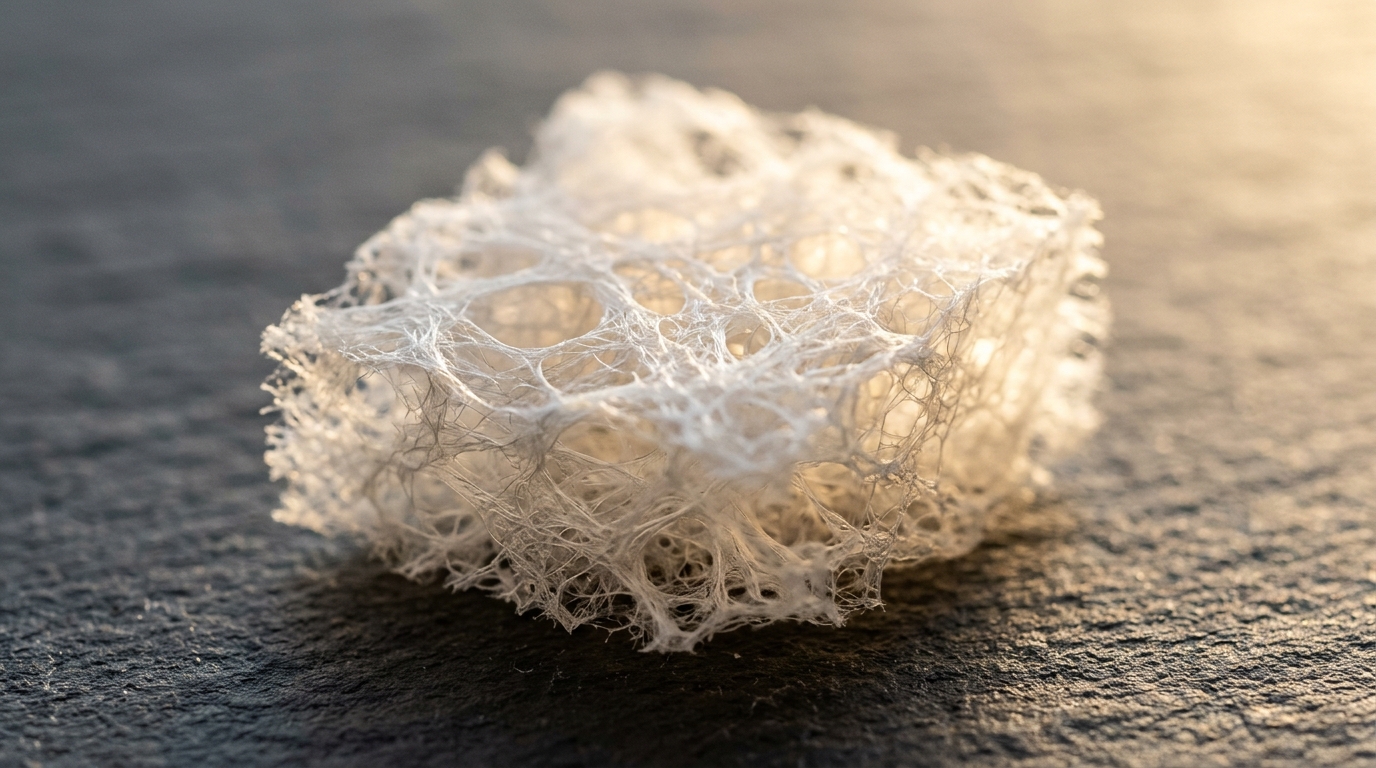
Morphological and chemical characterizations verified that the directionally frozen composite, designated as BPC-200 at the optimal 200 weight percent nanotube ratio, formed a regular honeycomb-like cellular lattice with uniform channels displaying average pore diameters of approximately 20 micrometers. Scanning electron microscopy confirmed that the rapid unidirectional heat conduction of the copper substrate forced anisotropic crystal growth along the vertical axis, creating axially aligned, interconnected transport channels bridged by individual bacterial cellulose nanofibers. Energy-dispersive X-ray spectroscopy mapping across the pore walls demonstrated an intimately co-distributed elemental composition consisting of 70.1 atomic percent carbon, 13.8 atomic percent nitrogen, and 16.1 atomic percent oxygen. Wide-scan X-ray photoelectron spectroscopy confirmed these elements, with high-resolution carbon 1s spectra exhibiting binding energy peaks at 284.8 electron volts for carbon-carbon bonds, 286.56 electron volts for carbon-oxygen linkages, 287.14 electron volts for beta-glycosidic bonds, 287.78 electron volts for carbonyl groups, and 285.30 electron volts for carbon-nitrogen functional groups. High-resolution nitrogen 1s spectra resolved into tertiary amine peaks at 399.38 electron volts alongside amide signatures at 400.18 electron volts.
Fourier transform infrared spectroscopy provided detailed insight into the chemical binding mechanism governing carbon dioxide capture across the functionalized framework. In its unexposed state, the pristine composite aerogel exhibited distinct vibrational peaks at 3430 inverse centimeters and 1632 inverse centimeters, which correspond directly to the fundamental stretching and bending vibrations of nitrogen-hydrogen bonds in the immobilized polyethyleneimine chains. Following exposure to gaseous carbon dioxide, the intensity of both nitrogen-hydrogen vibrational modes decreased sharply, while three prominent new absorption bands emerged at 1565 inverse centimeters, 1474 inverse centimeters, and 1297 inverse centimeters. These newly observed spectral peaks correspond respectively to the asymmetric stretching vibration of carboxylate groups, the characteristic vibration of carbamate functional units, and the skeletal carbamate vibration. These spectral transformations confirm that the basic amino groups distributed along the polymer chains chemically bind acidic carbon dioxide molecules from surrounding air streams through electron pair donation, forming stable zwitterionic carbamate species across the surface of the interconnected cellular skeleton during low-temperature sorption operations.
Equilibrium gas sorption measurements conducted inside a sealed cylindrical quartz chamber measuring 8 centimeters in diameter and 8 centimeters in height revealed that carbon nanotube concentration critically dictates total sorption capacity. Sorbent uptake displayed a non-monotonic trend with rising carbon nanotube content, climbing progressively from bare matrices to a maximum measured capacity of 0.076 grams of carbon dioxide per gram of aerogel at 200 weight percent nanotube loading before declining at 250 weight percent. The authors attribute this initial enhancement to the exceptional electron mobility of the embedded carbon nanotubes, which accelerates interfacial charge transfer between adjacent amine moieties and incoming carbon dioxide molecules to promote carbamate synthesis. Beyond 200 weight percent, however, excessive carbon nanotube loading dilutes the accessible mass concentration of polyethyleneimine within the composite; the modest physical sorption contributed by excess carbon nanoparticles cannot offset the volumetric loss of active amine coordination sites. The resulting material possesses an ultra-low bulk density of 0.022 grams per cubic centimeter, allowing monolithic structures to float unsupported upon delicate plant foliage.
Density functional theory simulations and frontier molecular orbital calculations clarified the quantum mechanical mechanisms through which the carbon nanotubes enhance the chemical reactivity of the polyethyleneimine chains toward carbon dioxide. Computational models revealed that incorporating carbon nanotubes significantly reduces the computed adsorption energy between carbon dioxide and polyethyleneimine from negative 20.014 kilojoules per mole down to negative 34.501 kilojoules per mole, demonstrating a markedly enhanced thermodynamic binding affinity within the hybrid framework. The calculated spatial distance separating the carbon atom of the gas molecule and the nitrogen atoms of the amine groups remained greater than the combined covalent radii sum of 1.47 angstroms, accompanied by negative reaction Gibbs free energy values. Frontier molecular orbital analysis established that carbon dioxide carbon atoms dominate the lowest unoccupied molecular orbital, requiring electron donation from the highest occupied molecular orbital of the amine. Incorporating carbon nanotubes raised the highest occupied molecular orbital energy while lowering the lowest unoccupied molecular orbital energy, thereby narrowing the interactive energy gap and facilitating rapid interfacial electron exchange.
The optical absorption and photothermal conversion behavior of the aerogel matrices were systematically assessed using ultraviolet-visible-near-infrared spectrophotometry over wavelengths spanning from 300 to 1400 nanometers. In accordance with the Lambert-Beer relationship, the light absorbance across the aerogels increased directly with carbon nanotube content, reaching a maximum absorbance of 1.643 at 1400 nanometers in the BPC-200 formulation compared to just 1.049 in nanotube-free aerogels. This corresponded to a peak absorption rate of 97.52 percent and a minimal optical reflectance of 2.48 percent at 1400 nanometers, closely tracking the reference AM1.5 solar spectral irradiance distribution. At 250 weight percent loading, optical absorbance declined moderately due to dense nanoparticle aggregation that reduced the effective illuminated surface area. When subjected to simulated solar illumination from a full-spectrum xenon lamp at an intensity of 1 kilowatt per square meter, the surface temperature of the BPC-200 aerogel rose rapidly from room temperature to 62.9 degrees Celsius within 90 seconds, demonstrating immediate photothermal transduction throughout the dark conjugated carbon network.
Photothermally induced gas desorption experiments confirmed that clean radiant energy effectively drives the endothermic decarboxylation of bound carbamate groups without requiring external electrical heating elements. Under 1 kilowatt per square meter xenon lamp irradiation, the unmodified bacterial cellulose aerogel yielded a desorption capacity of only 0.012 grams of carbon dioxide per gram of sorbent, whereas the BPC-200 aerogel achieved a peak photothermal desorption capacity of 0.050 grams per gram. Further raising the nanotube loading to 250 weight percent caused photothermal desorption to fall to 0.027 grams per gram; although BPC-250 reached an external surface temperature rise of 43.1 degrees Celsius over one hour, severe nanotube agglomeration prevented generated heat from conducting into internal pore channels, causing thermal dissipation into the atmosphere. The BPC-200 composite maintained resilient photothermal heating even under altered illumination angles, retaining a 25.6 degree Celsius elevation above ambient conditions. Increasing beam irradiance to 2 kilowatts per square meter produced a temperature rise of 53.4 degrees Celsius, while shutting off the lamp triggered rapid cooling from 72.3 degrees Celsius to 21.6 degrees Celsius within 90 seconds.
Long-term operational durability and mechanical stability assessments demonstrated that the silkworm cocoon-inspired architecture provides outstanding resistance against cyclic thermal and atmospheric degradation. Across five successive capture and photothermal regeneration cycles conducted at a regeneration temperature of 75 degrees Celsius, the BPC-200 aerogel retained 91.65 percent of its initial carbon dioxide adsorption capacity, with minor degradation attributed to small amounts of incompletely decomposed carbamate species. Thermogravimetric and derivative thermogravimetric analyses conducted under nitrogen from 40 to 200 degrees Celsius at 10 degrees Celsius per minute revealed a total mass loss of only 12.62 percent at 200 degrees Celsius, comprising initial moisture desorption and carbamate breakdown. Sealed shelf-life evaluations demonstrated that after two weeks of enclosed ambient storage, the sorbent capacity experienced an operational decrease of only 7.38 percent, caused by minor physical pore relaxation within the interpenetrating dual network formed by hydrogen bonding and van der Waals interactions between cellulose fibrils and nanotubes. Furthermore, directional molding allowed scalable production, yielding intact monolithic panels up to 20 centimeters in diameter.
Field performance tests conducted outdoors within a sealed 1.61-liter chamber validated the aerogel under authentic atmospheric conditions in March 2025. Between 11:00 AM and 2:00 PM under direct solar irradiation, a fully pre-loaded 0.25-gram sample of BPC-200 stabilized at a core temperature of 45.0 degrees Celsius, elevating the interior chamber carbon dioxide concentration to 1663 parts per million. Meteorological comparisons indicated that on sunny days, solar-driven desorption reached a maximum gas concentration of 1848 parts per million, which was nearly double the 938 parts per million achieved under cloudy skies. The authors note that while these findings demonstrate high environmental responsiveness without supplemental solar concentrators, practical architectural integration must balance carbon capture efficiency against natural indoor lighting requirements due to the material’s strong optical opacity. In addition, because the commercial precursors employed in this study represent refined laboratory-grade materials, the research team emphasizes that future commercial scale-up will depend on adapting low-cost, waste-derived carbon and cellulose sources to ensure broad economic and environmental sustainability.
Subject of Research: Direct air carbon dioxide capture and photothermal desorption using bioinspired cellulose aerogels
Article Title: Bioinspired silkworm cocoon-like cellulose aerogels with dual functions of high-efficiency CO2 adsorption and photothermal-triggered desorption
Article References: Wang, J., Zhu, D., Bing, N., Xie, H., Yu, W., & Li, Y. (2025). Bioinspired silkworm cocoon-like cellulose aerogels with dual functions of high-efficiency CO2 adsorption and photothermal-triggered desorption. Carbon Neutrality, 4(1), Article 39. https://doi.org/10.1007/s43979-025-00146-7
Image Credits: AI Generated
DOI: 10.1007/s43979-025-00146-7
Keywords: carbon capture, direct air capture, bacterial cellulose, aerogels, polyethyleneimine, carbon nanotubes, photothermal desorption, carbon neutrality, Bioinspired, silkworm, cocoon-like, cellulose
News Source: Sloane Callahan. (November 8, 2026). Cocoon-Inspired Cellulose Aerogels Capture Carbon and Desorb Using Sunlight. Scienmag.