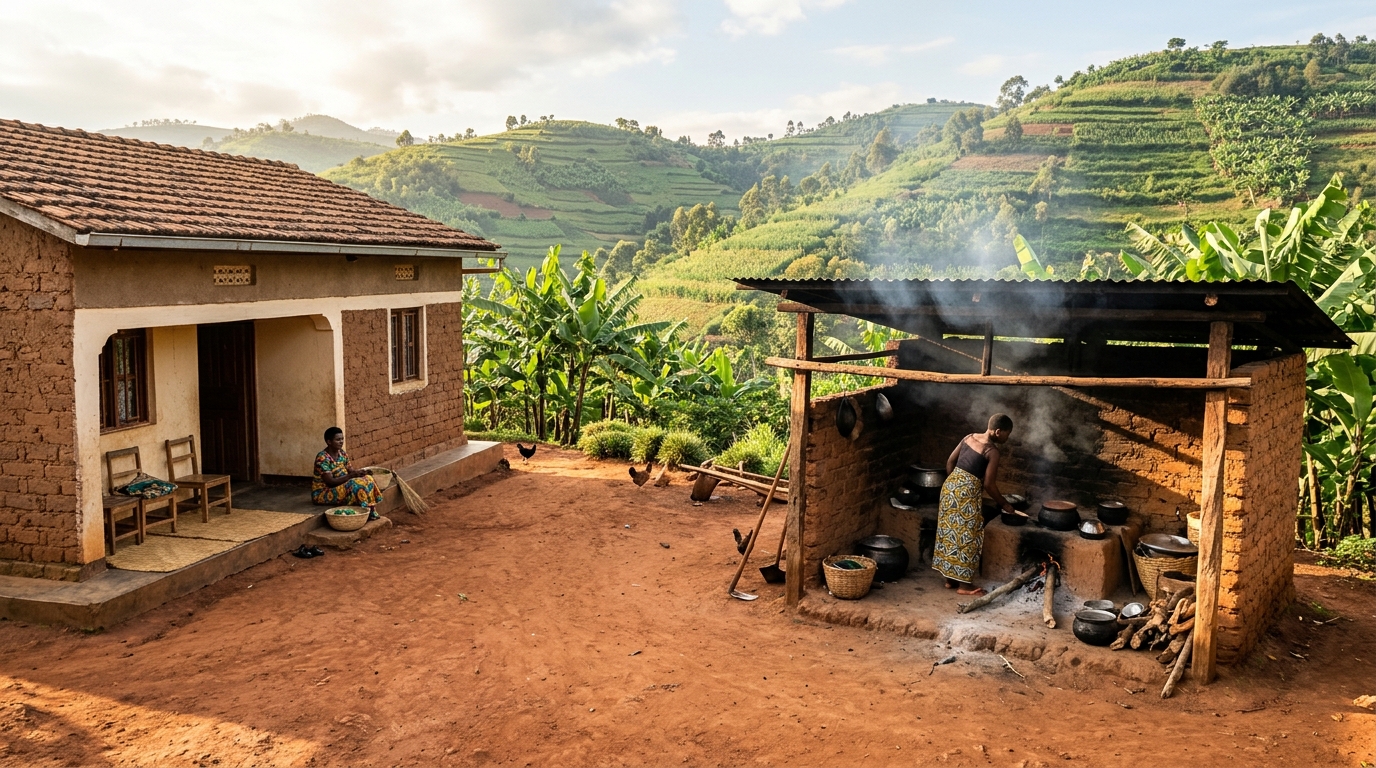
Cooking in a separate building is associated with lower odds of diarrhoea and stunting among children under five years of age in Rwanda compared to cooking inside the living house, according to findings from a pooled analysis of two nationally representative surveys published in BMC Public Health.
Household air pollution arising from solid-fuel cooking represents a leading environmental threat to children in sub-Saharan Africa. In environments where nearly every family relies on biomass fuel, comparing different fuel types provides little practical contrast for health evaluations. Consequently, a research team led by Etienne Nsereko evaluated whether the location where cooking takes place correlates with specific child health measures.
The researchers pooled data from two independent rounds of the Rwanda Demographic and Health Surveys: the 2014–15 round encompassing 7,552 children under five, and the 2019–20 round comprising 7,796 children under five. Household cooking location was self-reported and classified into three primary categories: inside the house, which served as the reference group; in a separate building; or outdoors. The health outcomes evaluated in the analysis included acute respiratory infection defined according to Demographic and Health Survey criteria, fever, diarrhoea, stunting, anaemia, and an exploratory evaluation of low birth weight.
To evaluate these associations, the investigators employed survey-weighted logistic regression models with design-based Taylor-series linearisation variance. The models adjusted for child age and sex, urban or rural residence, maternal education, household wealth, province, household size, and survey year. The three-category cooking location defined the primary analysis, with Benjamini–Hochberg corrections applied across twelve contrasts to account for multiple testing. In addition, the team evaluated a combined away-from-living-space indicator as a secondary exposure, and conducted sensitivity analyses incorporating water and sanitation conditions, housing quality, and household indoor smoking within a common complete-case sample.
The primary analysis revealed that, relative to cooking inside the house, cooking in a separate building was associated with a 27 percent reduction in the odds of diarrhoea (pooled adjusted odds ratio 0.73, 95% confidence interval 0.64–0.84) and a 24 percent reduction in the odds of stunting (pooled adjusted odds ratio 0.76, 95% confidence interval 0.66–0.87). Both associations retained statistical significance following Benjamini–Hochberg adjustment. For outdoor cooking, primary point estimates also fell below unity—0.84 (95% confidence interval 0.71–1.00) for diarrhoea and 0.87 (95% confidence interval 0.74–1.03) for stunting—though confidence intervals spanned the null.
Tests of heterogeneity revealed that the stunting association for outdoor cooking differed significantly by residential setting (joint test p = 0.002), showing an adjusted odds ratio of 0.81 (95% confidence interval 0.68–0.98) among rural children compared with 1.06 (95% confidence interval 0.68–1.65) among urban children. In contrast, acute respiratory infection, fever, anaemia, and low birth weight demonstrated no statistically significant association with cooking location in the primary analysis. The authors emphasized that because the study relied on cross-sectional survey data and did not directly measure personal or household pollutant concentrations, these observed associations require further evaluation in prospective and interventional studies.
Published on 07 November 2026 in BMC Public Health, the peer-reviewed report was released as an early-access article with a permanent DOI ahead of the final Version of Record.
In addition to assessing urban and rural differences, the sensitivity analyses specifically evaluated heterogeneity across the two independent survey rounds to determine whether associations remained consistent between the 2014–15 and 2019–20 sampling periods.
Subject of Research: Cooking location and child health outcomes in Rwanda
Article Title: Cooking location and child health outcomes in Rwanda: a pooled analysis of two demographic and health surveys
Article References: Nsereko, E., Noel, K., De Dieu, H. J., Leonard, T. J., D’Arc, M. J., Ornella, M., Candide, M., Josée, M. M., Moreland, P. J., & Desie, S. (2026). Cooking location and child health outcomes in Rwanda: a pooled analysis of two demographic and health surveys. BMC Public Health. https://doi.org/10.1186/s12889-026-30356-2
Image Credits: AI Generated
DOI: 10.1186/s12889-026-30356-2
Keywords: household air pollution, Rwanda, child health, stunting, diarrhoea, cooking location, biomass fuel, Demographic and Health Surveys, Cooking, location, child, health
News Source: Ophelia Keating. (November 7, 2026). Separate Building Cooking Linked to Reduced Diarrhoea and Stunting in Rwanda. Scienmag.