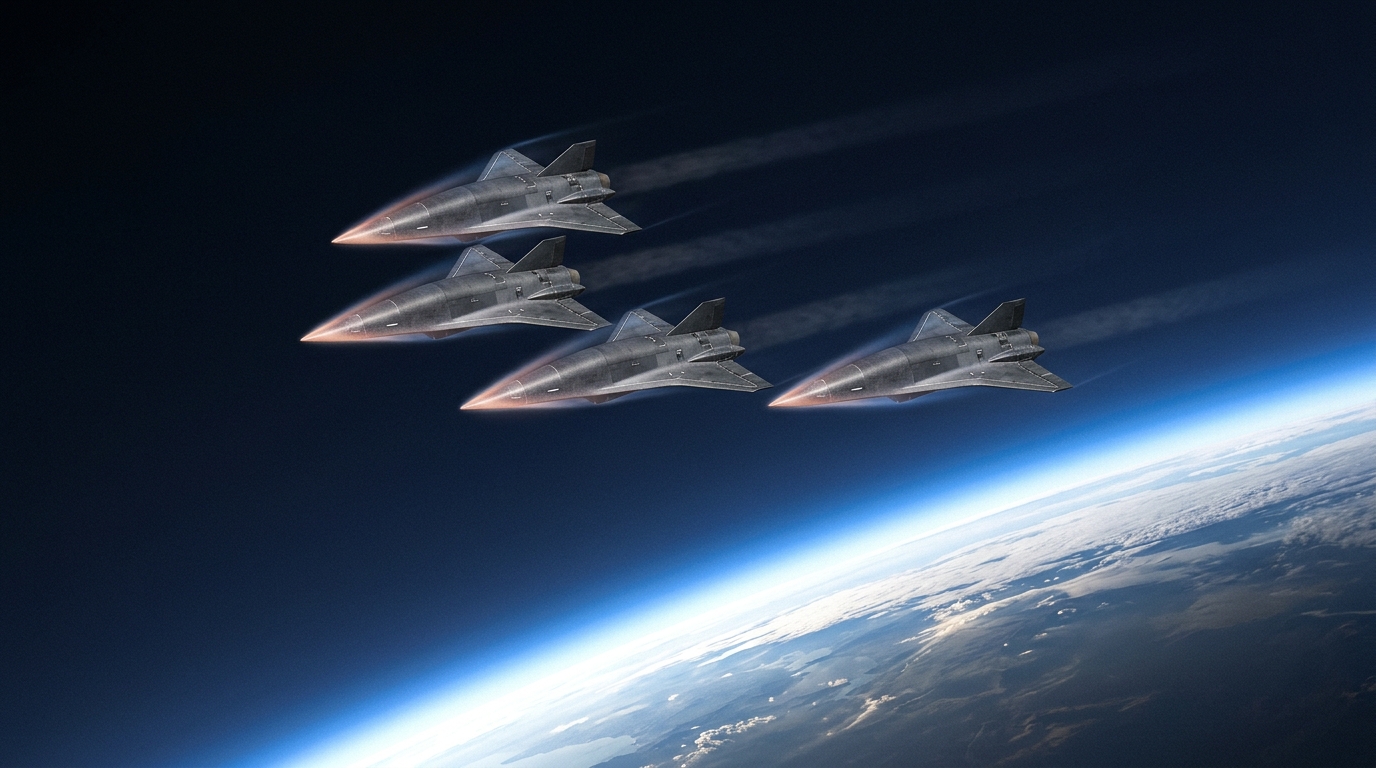
Aerospace engineering researchers have formulated a distributed integrated control and optimization protocol designed to coordinate hypersonic flight vehicle swarms while strictly confining vehicle trajectory outputs within predetermined safety boundaries. Operating hypersonic craft in multi-agent formations presents severe dynamic control complications because vehicle flight behaviors exhibit intense aerodynamic coupling, pronounced nonlinearities, and acute vulnerability to changing environmental and atmospheric conditions. While hypersonic platforms offer rapid response capabilities and maneuverability for modern aerospace operations, standard linear controllers often struggle with the strong state interactions inherent to these platforms. Prior cooperative swarm literature has largely emphasized consensus tracking or bipartite containment under dynamic event-triggered communication architectures without simultaneously resolving safety-critical boundaries alongside cost-minimization objectives. The newly formulated framework addresses the acute physical dilemma where a calculated optimal trajectory lies directly on the structural perimeter of a safety envelope, a scenario where the extreme physical momentum and inertia of high-speed vehicles typically force outputs to exceed operational thresholds.
To overcome boundary overshoot caused by dynamic vehicle inertia, the researchers engineered a coordinated two-layer architecture separating dynamic optimization from physical trajectory execution. In the higher-level decision layer, the protocol deploys a distributed projection mechanism operating across a continuously expanding time-varying constraint set rather than enforcing a static operational domain. Traditional distributed optimization algorithms generally assume static constraint boundaries and frequently fail when subjected to external disturbance or measurement corruption. In this formulation, the expanding constraint domain is constructed through a radial contraction method that initiates strictly within the interior of the permissible domain and gradually expands outward toward the true boundary. By forcing the intermediate decision variables to optimize across this radially scaled internal set, the decision trajectory prevents the mathematical search path from driving the system state abruptly against the physical constraints before dynamic stabilization can take effect.
Complementing the optimization layer, the lower-level execution architecture incorporates a reference-tracking safety controller that works in unison with an exact feedback linearization procedure. Hypersonic longitudinal dynamics are governed by a system of differential equations linking velocity, altitude, flight path angle, angle of attack, and pitch rate to aerodynamically coupled lift, drag, thrust, and pitching moments. The formulation integrates a second-order actuator model representing engine dynamics and elevator angular deflection, which effectively raises the relative degree of the vehicle equations to allow full input-output linearization. The resulting input-output representation yields a controllable and observable seventh-order state dynamic system tracking virtual velocity and altitude inputs. The control layer continuously monitors vehicle trajectory states relative to a contracted time-varying safety set, applying state feedback matrices to align vehicle outputs with the reference targets while preventing trajectory transients from violating the physical envelope.
Rigorous theoretical verification of the closed-loop multi-agent system was established by coupling the small-gain theorem with time-varying control barrier function analysis. To guarantee algorithmic convergence across the networked swarm, the researchers analyzed the interconnected tracking error dynamics and decision trajectory variables as coupled subsystems. Under formal assumptions requiring strongly convex local cost functions with Lipschitz continuous gradients, compact convex constraint sets, and bounded boundary curvature, the team demonstrated that the interconnected system achieves input-to-state stability with respect to discrete boundary evolution steps. By satisfying explicit algebraic small-gain inequalities governing feedback matrix gains and optimization step sizes, the team proved that output consensus errors and optimization tracking errors asymptotically decay to zero as time approaches infinity, ensuring that vehicle outputs converge precisely to the true global optimum even when that optimum resides on the domain boundary.
The preservation of operational safety throughout the entire flight regime is guaranteed through the systematic construction of a time-varying control barrier function. The analytical framework defines an explicit state-space safety domain bounded by the minimum eigenvalues of a positive definite matrix derived from a Lyapunov-like matrix inequality. By evaluating the Lie derivatives and partial temporal derivatives of this barrier function along the linearized closed-loop trajectories, the researchers identified precise mathematical bounds on controller parameters that enforce forward invariance of the safe operating set.
The communication topology among the hypersonic flight vehicles is modeled using algebraic graph theory based on an undirected, connected network structure. In this networked multi-agent configuration, individual vehicles communicate exclusively with immediate local neighbors, exchanging intermediate decision states and gradient evaluations across an adjacency matrix with positive real Laplacian eigenvalues. Rather than relying on a centralized coordinator to oversee fleet trajectory calculations, each agent updates its local state variables using only local cost functions and neighbor information.
To evaluate the practical effectiveness and robustness of the control protocol, the research team conducted comprehensive numerical simulations using a five-vehicle hypersonic swarm governed by established aerodynamic baseline coefficients. The simulation environment defined a rigorous operational flight envelope constraining vehicle altitudes between 14,000 and 80,000 units and restricting vehicle velocities between 7,000 and 12,000 units. The mission target assigned each vehicle a strongly convex local objective function defined as half the squared Euclidean distance between its output vector and an offset target coordinate, creating an aggregate optimization problem whose mathematical minimum resided in close proximity to the flight envelope boundary. The communication graph was established across the five vehicles using bidirectional links connecting agents in a connected mesh topology with unit edge weights.
Simulation runs validated that the distributed two-layer protocol successfully governed the five hypersonic vehicles through aggressive transient maneuvers without breaching safety limits. Output trajectories for both altitude and velocity demonstrated that all five vehicles remained strictly inside the permissible constraint region throughout the entire simulated flight profile. The decentralized consensus mechanism rapidly eliminated output discrepancies among the agents, bringing the altitude and velocity outputs into unified alignment. Even under initial flight conditions distributed across diverse state offsets, the feedback linearization controller tracked the evolving reference trajectories smoothly, demonstrating that the combination of expanding constraint projection and barrier-enforced tracking effectively prevents vehicle inertia from causing transient boundary violations.
The researchers further evaluated the disturbance rejection capabilities and algorithmic resilience of the framework by introducing zero-mean Gaussian random noise into the optimization gradient measurements. In test trials incorporating random perturbation levels scaled to standard deviations of 0.5 and 1.5, the swarm maintained trajectory tracking performance without exhibiting numerical instability or safety margin degradation. Tracking error norms between the actual vehicle outputs and the theoretical optimal trajectory rapidly contracted toward zero under both disturbance magnitudes. Simultaneously, internal physical flight parameters, including flight path angle, angle of attack, and pitch rate, remained well-behaved and stable throughout the noise-injected flight simulations, confirming the input-to-state stability properties predicted by the theoretical small-gain derivations.
The study establishes an analytical and computational foundation for integrating constrained distributed optimization with safety-critical control laws in highly dynamic aerospace swarms. By resolving the conflict between inertia-driven overshoot and boundary-localized optima, the two-layer protocol demonstrates that autonomous high-speed formations can execute decentralized cost-minimization tasks while upholding strict physical survivability limits.
Subject of Research: Distributed optimal output consensus and safety-critical control for hypersonic flight vehicle swarms
Article Title: Distributed integrated design for optimity and safety of hypersonic flight vehicle swarm
Article References: Yao, M., Liang, S., Wang, J., & Hong, Y. (2025). Distributed integrated design for optimity and safety of hypersonic flight vehicle swarm. Autonomous Intelligent Systems, 5(1), Article 28. https://doi.org/10.1007/s43684-025-00115-y
Image Credits: AI Generated
DOI: 10.1007/s43684-025-00115-y
Keywords: hypersonic flight vehicles, distributed optimization, swarm control, control barrier functions, feedback linearization, small-gain theorem, input-to-state stability, aerospace engineering, Distributed, integrated, design, optimity
News Source: Denise Maddox. (November 7, 2026). Distributed Integrated Protocol Safeguards Hypersonic Swarms at Constrained Optimization Boundaries. Scienmag.