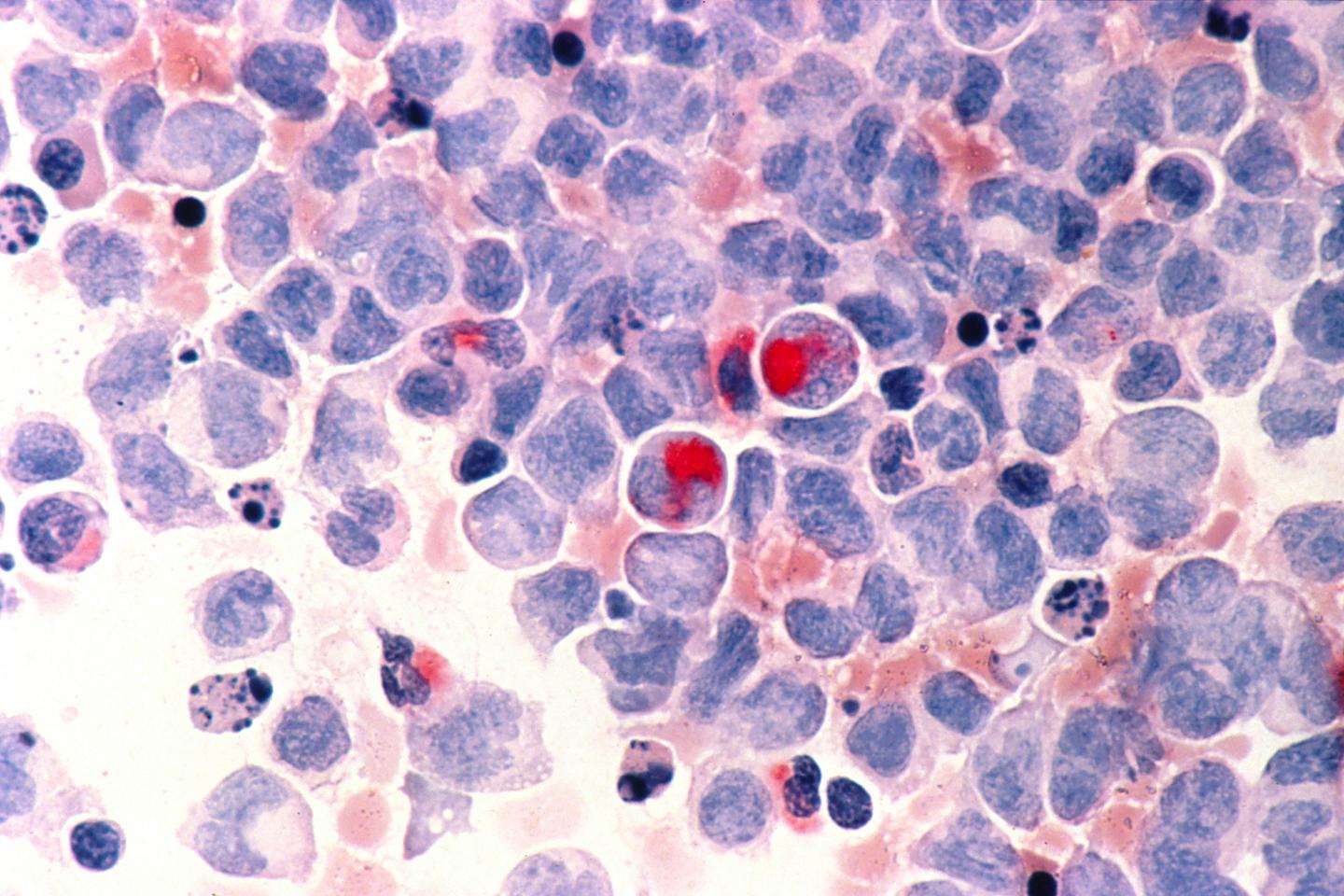
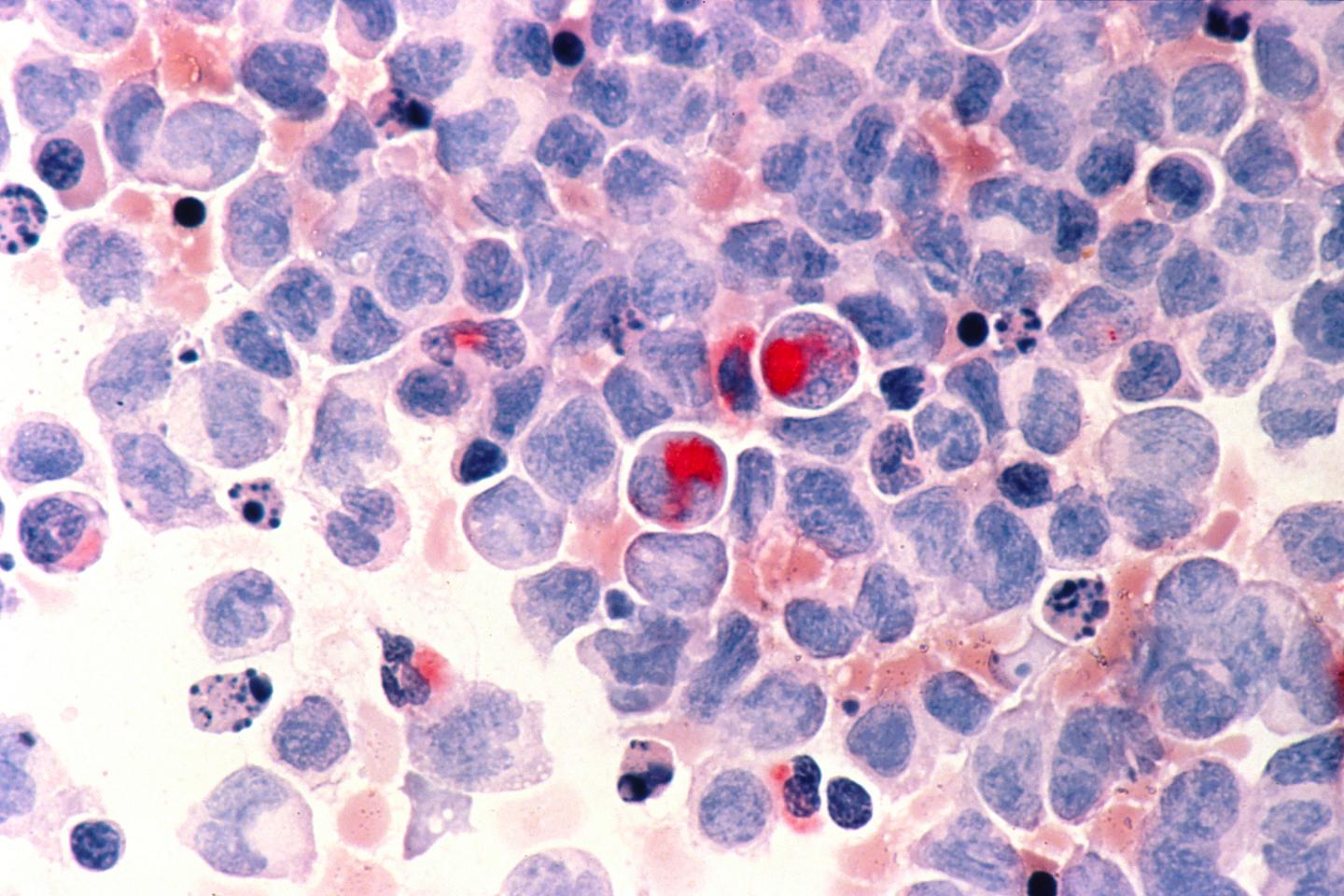
Credit: The website of the National Cancer Institute (https://www.cancer.gov).
MIAMI, March 27, 2017 – Scientists at Sylvester Comprehensive Cancer Center at the University of Miami Miller School of Medicine have shown that p300, a protein that increases gene expression by attaching acetyl molecules to DNA, may stop myelodysplastic syndrome (MDS) from developing into acute myeloid leukemia (AML). The study was published in the journal Leukemia.
"The loss of p300 allows these defective cells to grow and become leukemic," said Sylvester Director Stephen Nimer, M.D., principal investigator of the study. "This work offers us a window into AML, which we are now going to try to exploit."
MDS affects blood stem cells, preventing them from becoming mature, healthy blood cells. Around a third of MDS patients develop leukemia. For Nimer, who has been studying MDS for three decades, teasing out new information about the function of p300 could generate new insights and possibly new therapeutics.
The p300 protein, along with its close cousin CBP, is part of a family of molecules called histone acetyltransferases (HATs). By adding acetyl groups to the histones that package DNA, they help turn on genes. Previous studies have indicated that p300 and CBP may promote cancer under certain circumstances. However, in this study, the team found that mice without p300 rapidly developed leukemia. Surprisingly, despite its close relationship to p300 and similar structure, CBP deletion had no effect.
"When we eliminated p300, 100 percent of the mice developed leukemia," said Nimer. "It indicated that, under this specific circumstance, p300 is a tumor suppressor, offering great insight into how MDS converts to leukemia. It was quite surprising that CBP plays no role at all."
"While investigating how p300 functions in MDS cells, we found that MDS cells do not grow well in the lab," said Nimer. "However, when you eliminate p300, suddenly the cells continue to grow."
While p300 apparently plays a critical role in MDS progressing to leukemia, this function is highly contextual as the protein has no obvious effect on healthy stem cells. Nimer and his colleagues believe the molecular variations that drive MDS also make them vulnerable to p300 loss of deficiency. Now that p300 has been established as a tumor suppressor, the team will begin delineating the pathways it uses to control MDS cells. These findings could ultimately help MDS patients avoid leukemia.
"Other than chemotherapy, right now, there's no way to prevent MDS from developing into myeloid leukemia," said Nimer. "However, drugs are being developed that can promote p300 function and possibly prevent MDS patients from developing leukemia."
###
About Sylvester Comprehensive Cancer Center
Sylvester Comprehensive Cancer Center, part of UHealth – the University of Miami Health System and the University of Miami Miller School of Medicine, is among the nation's leading cancer centers and South Florida's only Cancer Center of Excellence. A 2015 study by Memorial Sloan Kettering Cancer Center, published in The Journal of the American Medical Association, showed that cancer patients treated at Sylvester have a 10 percent higher chance of survival than those treated at nearly any other cancer center in the nation. With the combined strength of more than 120 cancer researchers and 130 cancer specialists, Sylvester discovers, develops and delivers more targeted therapies, providing the next generation of cancer clinical care – precision cancer medicine – to each patient. Our comprehensive diagnostics, coupled with teams of scientific and clinical experts who specialize in just one type of cancer, enable us to better understand each patient's individual cancer and develop treatments that target the cells and genes driving the cancer's growth and survival, leading to better outcomes. At Sylvester, patients have access to more treatment options and more cancer clinical trials than most hospitals in the southeastern United States. To better serve current and future patients, Sylvester has a network of conveniently located outpatient treatment facilities in Miami, Kendall, Hollywood, Plantation, Deerfield Beach, Coral Springs, and Coral Gables. For more information, visit sylvester.org.
Media Contact
Patrick Bartosch
[email protected]
305-243-8219
http://www.med.miami.edu/