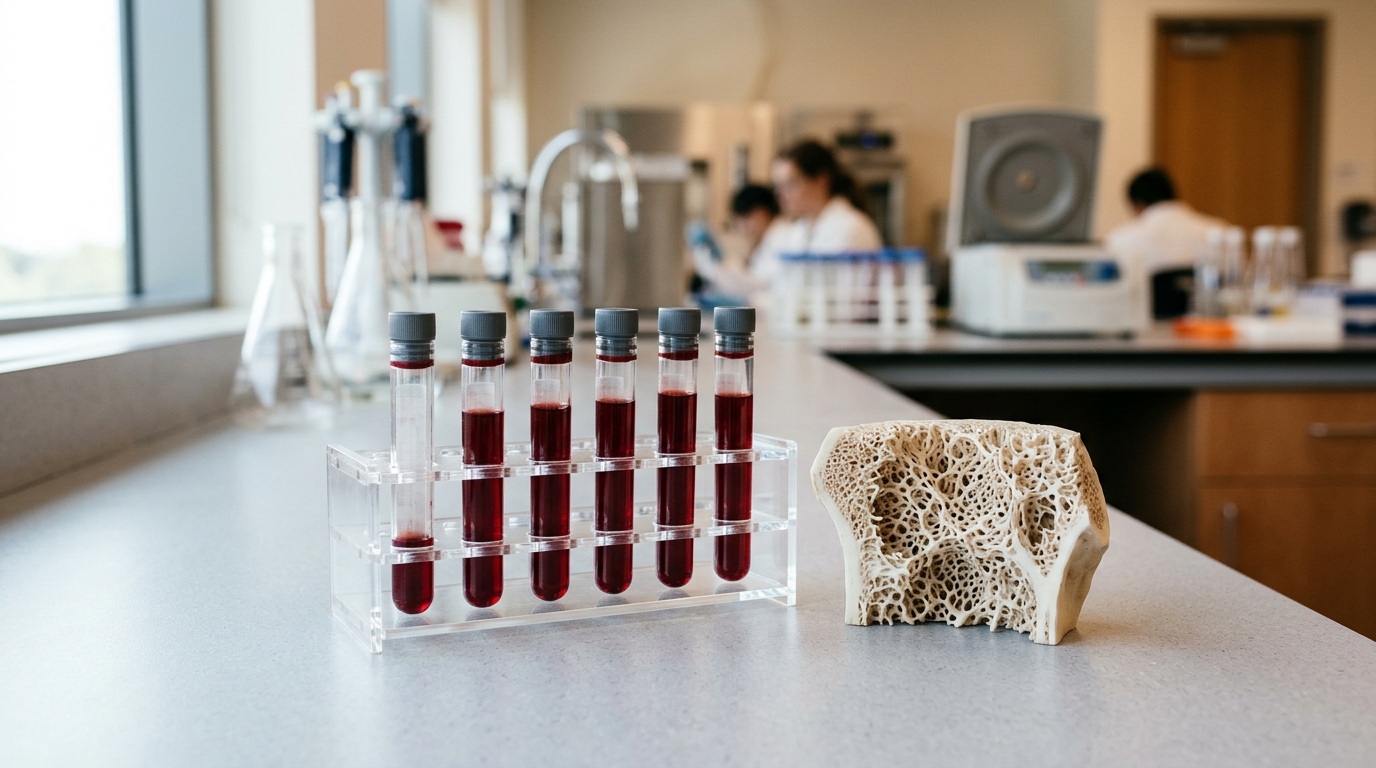
People hoping their blood type might explain their bone health can largely set that idea aside. A retrospective case–control study published in the European Journal of Medical Research reports that ABO and Rh blood group phenotypes showed no independent association with osteoporosis diagnosed by dual-energy X-ray absorptiometry (DXA). The finding, drawn from 857 osteoporosis cases and 1,097 controls at a single hospital center, remained consistent after the researchers adjusted for age and sex and re-ran the numbers across separate age brackets.
Osteoporosis is a multifactorial skeletal disorder shaped by demographic, metabolic, environmental, and genetic factors. Because ABO blood group phenotypes have been associated with inflammatory, endothelial, and thrombotic pathways that may theoretically interact with bone remodeling, blood type has been considered as a possible factor in bone health. Prior evidence on that question, however, has remained limited and inconsistent, which is the gap the study set out to address.
The research team, led by Abdurrahim Oğuz with colleagues including İbrahim Halil Dündar, Necati Çiçek, and Abdulkadir Dost, designed the investigation as a retrospective case–control study with age- and sex-adjusted analyses. They reviewed hospital records spanning January 1, 2013, to June 1, 2022, and assembled two distinct groups. The osteoporosis group comprised 857 unique patients whose diagnosis was confirmed by DXA and who were subsequently treated with pharmacological therapy. Controls came from a separate source population of 2,747 individuals recorded as having normal bone mineral density, from which 1,097 were purposively selected so that their mean age would sit close to that of the osteoporosis group.
Classification depended on the lowest recorded T-score from the lumbar spine (L1–L4) and the femoral neck. Blood group phenotype, age, and sex were then analyzed using both crude estimates and models adjusted for age and sex, with additional age-stratified sensitivity analyses to check whether any association might appear only in particular age bands.
The two groups turned out to be well matched on the variables most likely to confound a blood-type signal. Mean age was 72.13 ± 10.63 years in the osteoporosis group and 70.97 ± 12.13 years in the control group, a small difference that reached statistical significance at p = 0.025 but was handled through adjustment. Women made up 84.13 percent of the osteoporosis group and 83.77 percent of the controls, a nearly identical proportion with p = 0.831.
When the researchers compared how ABO phenotypes were distributed between cases and controls, the difference was essentially nil: p = 0.958. Rh distributions told the same story, with p = 0.727. In other words, ABO phenotype distributions did not differ between the osteoporosis cases and the normal-BMD controls.
The adjusted analysis sharpened the conclusion. Using blood group O as the reference category, the odds ratio for osteoporosis was 1.00 with a 95 percent confidence interval of 0.81 to 1.23 for blood group A, 0.94 with an interval of 0.73 to 1.22 for group B, and 0.94 with an interval of 0.65 to 1.38 for group AB. Every one of those intervals crosses 1.0, the point of no effect, meaning the data cannot distinguish any of these phenotypes from the reference group. Rh-positive status likewise showed no independent association, with an adjusted odds ratio of 1.04 and a 95 percent confidence interval of 0.78 to 1.39.
Age-stratified sensitivity analyses reinforced the pattern. Findings remained consistent across age-stratified sensitivity analyses.
The authors are careful about what the study can and cannot claim. Their conclusion states that ABO and Rh blood group phenotypes were not independently associated with osteoporosis in this hospital-based cohort, and that the results do not support moderate-to-large phenotype-level associations. They also note a boundary: smaller effects, particularly for less frequent phenotypes, cannot be excluded. A single-center retrospective design drawing on treated patients and purposively selected controls carries inherent limits, and the authors note that smaller effects, particularly for less frequent phenotypes, cannot be excluded.
For readers, the practical takeaway is straightforward. The study adds a negative result to a literature that the authors describe as limited and inconsistent, using crude and age- and sex-adjusted estimates along with age-stratified sensitivity analyses.
Subject of Research: Whether ABO and Rh blood group phenotypes are associated with DXA-defined osteoporosis
Article Title: ABO and Rh blood group phenotypes in DXA-defined osteoporosis: an age- and sex-adjusted case–control study
Article References: Oğuz, A., Dündar, İ. H., Çiçek, N., & Dost, A. (2026). ABO and Rh blood group phenotypes in DXA-defined osteoporosis: an age- and sex-adjusted case–control study. European Journal of Medical Research. https://doi.org/10.1186/s40001-026-05395-5
Image Credits: AI Generated
DOI: 10.1186/s40001-026-05395-5
Keywords: osteoporosis, ABO blood group, Rh factor, DXA, bone mineral density, case-control study, T-score, epidemiology, bone health, retrospective study, blood, group
News Source: Ophelia Keating. (November 7, 2026). Blood type offers no shield from osteoporosis, large case–control study finds. Scienmag.