A comprehensive review article published in the journal City and Built Environment systematically analyzes 99 studies conducted between 2018 and 2025 to evaluate the thermal performance of 3D-printed building walls. The research, led by Renyu Geng and colleagues, establishes a multiscale framework that integrates structural topology, material composition, and printing processes. The authors identify a significant gap in the current scientific literature, noting that while structural safety and mechanical performance have been primary focuses, thermal efficiency remains underrepresented in the field of additive construction.
The study utilizes a PRISMA-directed protocol to screen literature from Web of Science, ScienceDirect, and Scopus. From an initial pool of 2,243 articles, the researchers narrowed the selection to 99 core studies that specifically address wall thermal performance. Bibliometric analysis using VOSviewer revealed that core thermal efficiency studies account for only approximately 7.3% of the research domain, whereas topics such as 3D printing technology, sustainability, and mechanical properties dominate the discourse. This disparity highlights a critical knowledge gap regarding how to optimize building envelopes for energy efficiency using additive manufacturing techniques.
One of the central findings of the review is the strong anisotropy of thermal conductivity in 3D-printed walls. Due to the layer-by-layer extrusion process, heat transfer varies significantly depending on the direction relative to the print path. The thermal conductivity is highest along the X-axis, which corresponds to the printing direction, followed by the Y-axis, or interlayer stacking direction, and is lowest along the Z-axis, or vertical layering direction. This directional dependence means that the orientation of the wall within the building structure can have a profound impact on its overall thermal resistance and energy performance.
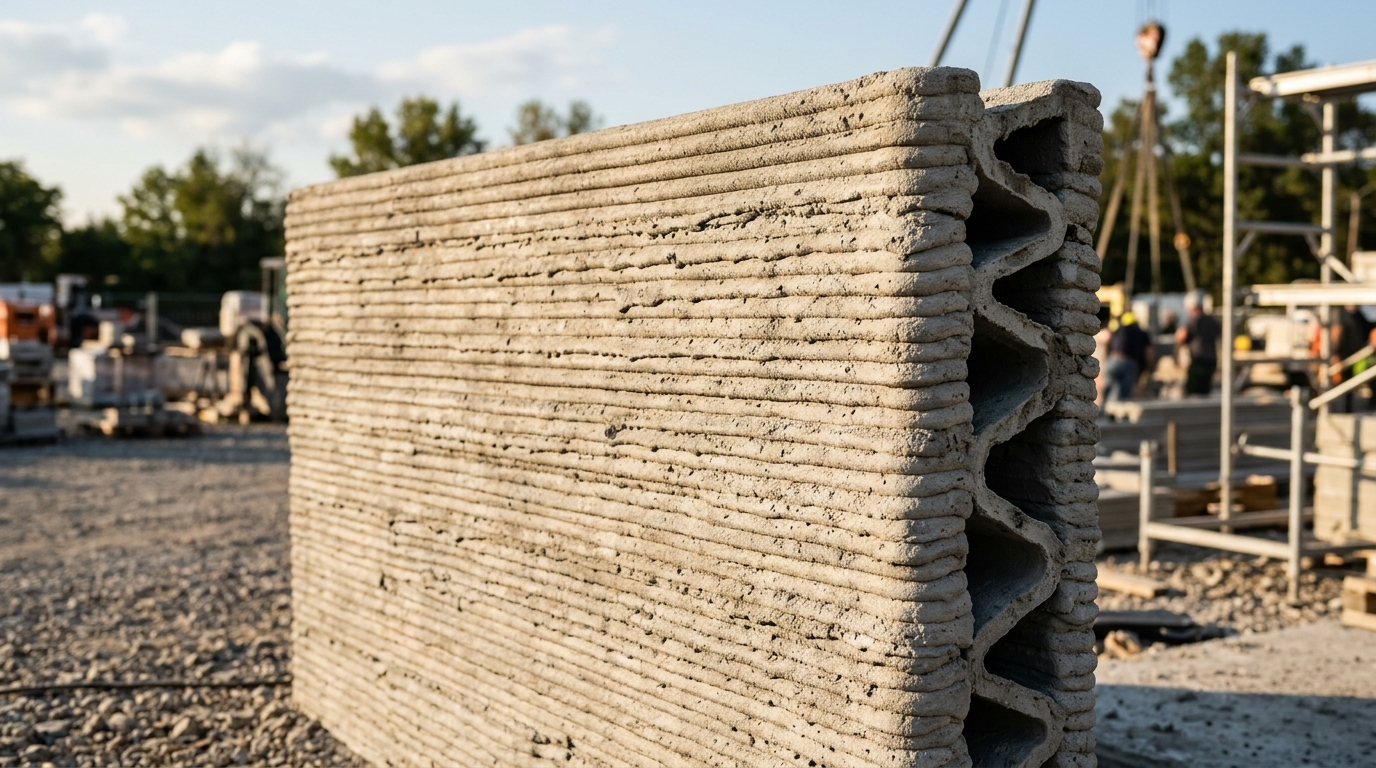
The review examines how internal geometric configurations influence heat transfer pathways. Structures such as cavities, sandwich composites, and bio-inspired topologies, including triply periodic minimal surfaces (TPMS), are shown to significantly enhance insulation and thermal inertia. TPMS structures, such as gyroid and Schoen surfaces, offer continuous curvature that elongates heat conduction paths, thereby reducing effective thermal conductivity compared to conventional lattice structures. These designs also distribute mechanical loads more uniformly, avoiding stress concentrations that can compromise structural integrity under thermal stress.
Material modifications represent another critical lever for improving thermal performance. The incorporation of phase change materials (PCMs), waste glass, expanded thermoplastic microcapsules (ETM), and cork into the printing mixtures can reduce thermal conductivity. However, the review notes that these enhancements often come with trade-offs in mechanical strength. For instance, while PCMs introduce latent heat storage capacity that aids in thermal comfort regulation, they may reduce the compressive strength of the printed concrete. Balancing these competing properties remains a key challenge for engineers designing high-performance walls.
Insulation layer systems are analyzed through three primary approaches: geometric cavity filling, sandwich composite materials, and bio-based integration. Geometric cavity filling involves optimizing the shape and size of internal voids and filling them with high-resistance materials to suppress thermal bridging. Experimental data cited in the review indicates that subdividing or filling cavities with insulating materials can reduce U-values by up to 60%. Sandwich composites, such as the ‘foam-concrete-foam’ structure developed by Furet et al., use prefabricated functional templates to achieve gradient design and interface reinforcement, significantly mitigating thermal bridges across structural ribs.
The review also explores the synergistic optimization of fire resistance and thermal performance. Traditional approaches often treat fire safety and energy efficiency as separate design constraints, but the authors argue for an integrated strategy. Bio-inspired honeycomb structures and fire-resistant composites, such as rock wool, can simultaneously enhance thermal resistance and fire safety. Finite element simulations and experimental tests show that non-load-bearing 3D-printed cavity walls insulated with mineral wool exhibit excellent fire resistance, outperforming solid walls in certain scenarios while maintaining a significant weight reduction of up to 64%.
Despite these advancements, the review identifies several unresolved challenges that limit the practical application of thermally optimized 3D-printed walls. The cross-scale coupling mechanisms between material properties, cavity geometry, and printing process parameters are not yet fully quantified, particularly under dynamic real-world thermal environments. Most existing studies isolate these variables, lacking integrated models that simulate their nonlinear interactions. Additionally, the anisotropic thermal behavior induced by different path planning strategies, such as contour versus zigzag printing, remains insufficiently studied in large-scale wall sections or under transient thermal loads.
Standardization of experimental benchmarking protocols is another critical issue. Current methods for measuring the thermal performance of 3D-printed walls vary significantly across studies, making cross-comparison difficult. The absence of standardized methods that account for printing defects, interlayer gaps, and actual insulation insertions hinders the development of reliable performance predictions. The review calls for the establishment of unified testing standards that reflect the complexities of additive manufacturing processes and their impact on thermal behavior.
The field of fire-thermal synergistic design is described as nascent, with limited integrated experimental or numerical work available. Most studies focus on either thermal performance or fire resistance independently, whereas real-world applications demand multifunctional, co-optimized wall systems. The review highlights the need for interdisciplinary approaches that combine materials science, heat transfer, fire engineering, and digital fabrication to develop truly performant and code-compliant building envelopes.
Climate-responsive design strategies are also noted as a significant gap in current research. Thermal performance studies are rarely linked with climatic zoning, occupancy behavior, or building energy simulations, which limits the practical relevance of the findings. The authors suggest that future research should focus on developing thermally adaptive materials, data-driven multiscale optimization, and real-time performance monitoring via digital twins. These advancements could enable the creation of building envelopes that dynamically respond to environmental conditions, further enhancing energy efficiency.
The review concludes that while 3D printing offers transformative potential for sustainable construction, the thermal optimization of walls requires a holistic approach that integrates structure, material, and process parameters. By addressing the identified knowledge gaps and developing standardized testing protocols, the field can move toward the widespread adoption of high-performance, thermally efficient, and fire-safe 3D-printed building envelopes. This work provides a comprehensive framework for researchers and practitioners aiming to balance energy efficiency, structural integrity, and safety in additive construction.
The review also evaluates the contrasting capabilities of material extrusion and binder jetting in construction applications. Material extrusion represents 82.4 percent of building applications, utilizing extrusion molding with temperature precision of 0.5 degrees Celsius. Fabricating hollow honeycomb walls with 42 percent porosity through extrusion achieves a 59 percent reduction in thermal conductivity compared to solid assemblies. By contrast, binder jetting operates at a low energy demand of 0.4 to 0.6 kilowatt-hours per kilogram with layer precision between 0.1 and 0.3 millimeters. Although binder jetting cut construction schedules by 70 percent in Dubai’s 1,200-component Modular Mosque project, its compressive strength remains 19 to 26 percent lower than extruded concrete.
Beyond process selection, numerical simulations under ISO 10211 standards clarify the specific geometric parameters governing heat transfer across printed wall sections. In evaluations of 200-millimeter-wide walls, expanding the internal cavity ratio from 0.2 to 0.6 decreased U-values by 34 percent, whereas every 0.1 increase in rib thickness ratio raised thermal conductivity by 9.8 percent. Cavity shapes also proved decisive: triangular voids restricted radiant heat flux more effectively than rectangular geometries, while incorporating U-shaped filaments reduced peak heat flux by 12 percent in an experimental Chinese test building. However, printing speed directly influenced thermal barrier integrity, as operating above 80 millimeters per second produced interlayer defect rates of 7.2 percent, significantly worsening localized thermal bridges.
Empirical field trials and specialized composite envelopes further demonstrate the operational efficiencies achievable through additive fabrication. The Yhnova residential building in France verified the dynamic template sandwich approach, incorporating curved corners to suppress thermal bridging. This 95-square-meter prototype achieved an annual primary energy consumption of 33.1 kilowatt-hours per square meter alongside bioclimatic needs of 34.2, outperforming French RT2012 regulatory benchmarks by 30 to 40 percent. Other composite systems demonstrate comparable multifunctional performance: functionally graded concrete containing expanded polystyrene cores attained a compressive strength of 28.8 megapascals and a thermal conductivity of 0.33 watts per meter-kelvin, while vertical green walls with polystyrene insulating soil reduced annual air conditioning demand by 9.12 percent.
Alternative printing media and internal filling schemes also display distinct thermodynamic profiles. Experimental testing of concrete slabs showed that solid geometries kept inner surface temperatures one degree Celsius lower than hollow slabs with unfilled cavities. However, inserting insulating fillers restored thermal resistance, with polylactic acid exhibiting a thermal conductivity over 70 percent lower than concrete. Dedicated tests on polylactic acid insulation boards printed with porosities between 43 and 71 percent demonstrated minimum thermal conductivities of 0.037 watts per meter-kelvin, verifying their viability as lightweight insulation.
Nonetheless, long-term durability and material processing constraints present critical hurdles for practical implementation. Polyurethane foam exhibits degraded closed-cell ratios and increased thermal conductivity following 50 freeze-thaw cycles, while sandwich composite interfaces display shear strength below 0.5 megapascals under standard tests, risking interlayer delamination under thermal stress. Printing polylactic acid requires temperatures between 190 and 220 degrees Celsius, requiring 2.3 times more energy per unit volume than concrete extrusion. In addition, rock wool insulation absorbs over 3 percent moisture in high humidity, causing fiber pulverization at elevated temperatures, while thermal cycling induces concrete interface tensile stresses that exceed epoxy adhesive thresholds.
Subject of Research: Multiscale thermal optimization of 3D-printed walls: integrating structure, material, and process with fire-thermal synergy
Article Title: Multiscale thermal optimization of 3D-printed walls: integrating structure, material, and process with fire-thermal synergy
Article References: Geng, R., Jiang, J., Du, P., Zhang, H., Yu, R., & Gao, W. (2025). Multiscale thermal optimization of 3D-printed walls: integrating structure, material, and process with fire-thermal synergy. City and Built Environment, 3(1), Article 25. https://doi.org/10.1007/s44213-025-00066-3
Image Credits: AI Generated
DOI: 10.1007/s44213-025-00066-3
Keywords: Multiscale, thermal, optimization, D-printed, walls, integrating, structure, material, process, fire-thermal, synergy, scientific research
News Source: Denise Maddox. (November 7, 2026). Review Finds 3D-Printed Wall Thermal Performance Lags Behind Structural Research. Scienmag.