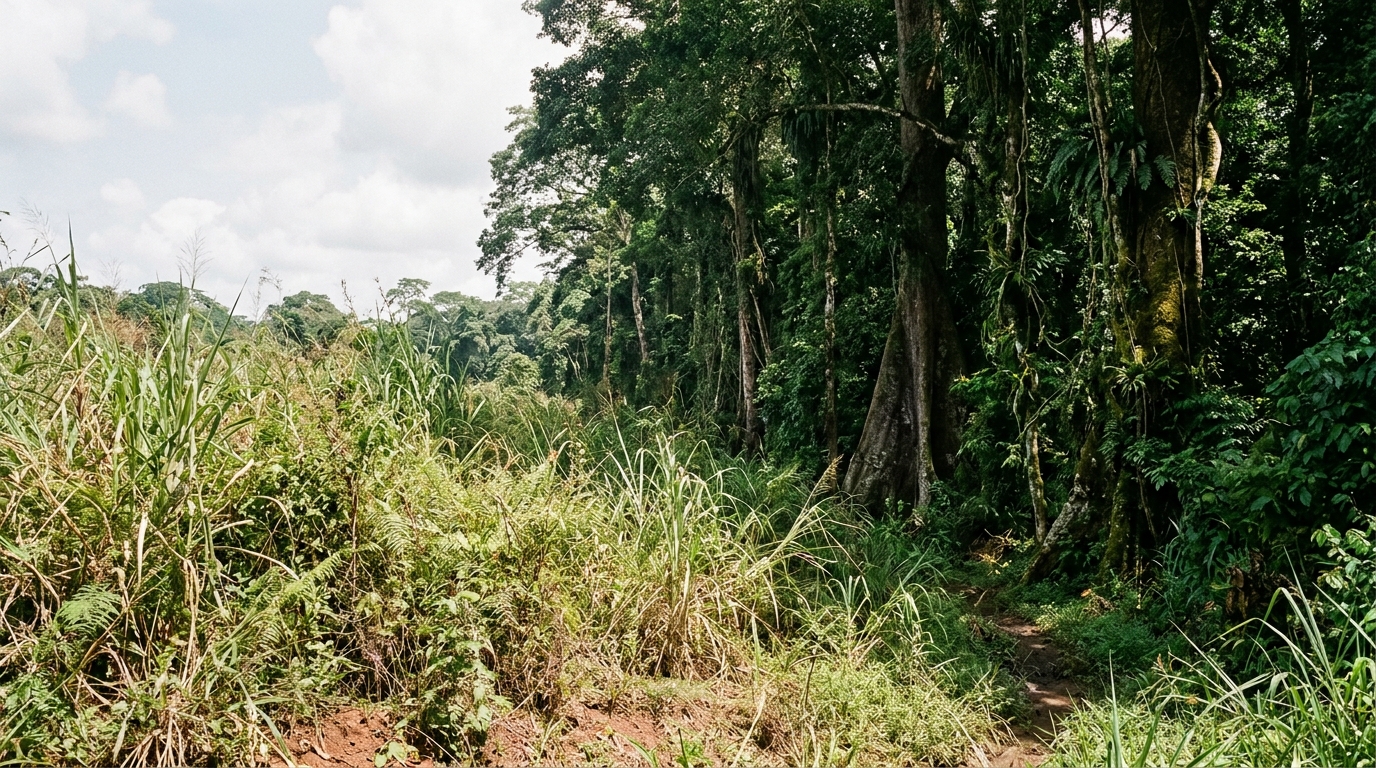
A disturbed patch of Nigerian lowland rainforest along the Warri River is slowly growing back, but it is not yet the forest it once was. A new field study comparing one disturbed forest site with two neighboring undisturbed sites found that the recovering site brims with forbs and grasses, while the untouched sites hold taller, denser trees and a more balanced community of species.
The research team, led by Edache Bernard Ochekwu and Cornelius Onyedikachi Nichodemus, surveyed forest sites along the Warri River in Delta State, in the lowland region of southern Nigeria also called the Niger Delta Swamp Forest. The area is evergreen rainforest with high species richness, annual rainfall of 2770 millimeters, an average temperature of 28 degrees Celsius, and an elevation of about 150 meters above sea level. The river originates at Utagba Uno in Ndokwa West and flows through freshwater wetlands, mangrove swamps, and coastal sand ridges before emptying silt into the Gulf of Guinea. Toward the coast, surrounding rainforest sites are separated by water bodies, creating isolated forest patches that hold a sizable number of species.
The history of the region explains why the comparison was possible. The Nigerian lowland rainforest experienced massive disturbance after oil and gas deposits were discovered in 1956, when indiscriminate tree cutting and industrialization degraded forest and soil. Later, the Warri crisis between the Ijaws, Itsekiri, and Urhobo in the late 1990s and early 2000s destroyed property and disrupted oil and gas operations. After the crisis, disturbance intensity decreased in some areas, and land previously cleared for industrial operations was left empty, particularly along the Warri River. That lull may have allowed dispersal, habitat connectivity, and the soil seed bank to support natural regeneration.
The inventory tallied 144 plant species in 123 genera and 50 families, spread across seven growth forms: 34 trees, 12 shrubs, 48 forbs, 23 lianas, 14 grasses, 9 sedges, and 8 ferns. The most species-rich families were Fabaceae with 17 species, Poaceae with 14, Asteraceae with 11, Euphorbiaceae with 10, and Cyperaceae with 9, while families such as Vitaceae, Urticaceae, Clusiaceae, Apocynaceae, Musaceae, and Caricaceae contributed a single species each. Species found across all three sites included Cocos nucifera, Elaeis guineensis, Raphia hookeri var. hookeri, Terminalia catappa, and Manniophyton fulvum. A Pearson’s Chi-squared test on growth form composition, yielding a statistic of 17.938 with 14 degrees of freedom and a p value of 0.2096, found no statistically significant difference across sites at the 0.05 level, although trees, forbs, and grasses contributed most to the test statistic.
The diversity metrics told a sharper story. Using Hill numbers, which express diversity as the effective number of species, the disturbed forest site scored highest on species richness, with 118 effective species at order q = 0, where all species count equally. The undisturbed sites excelled on evenness-weighted metrics: undisturbed forest site 1 reached an exponential Shannon diversity of 101.46 at q = 1 and an inverse Simpson diversity of 94.65 at q = 2, while undisturbed forest site 2 scored 85.29 on the inverse Simpson metric. Because the higher orders weight abundant species more heavily, these figures indicate that the undisturbed forests distribute abundance more evenly among their species, whereas the disturbed site’s high raw richness is inflated by many forbs and grasses, early habitat pioneers that thrive in open, heterogeneous conditions. Rank-abundance curves reinforced the pattern, showing flatter curves, a signature of evenness, for the undisturbed sites, and rarefaction curves showed higher species richness for the disturbed site.
Cluster analysis based on the Bray-Curtis dissimilarity index grouped the two undisturbed sites together, confirming that they share more species with each other than either does with the disturbed site. Structurally, the undisturbed forests are homogeneous stands of tall, dense, contacting trees forming a closed canopy, while the disturbed site is heterogeneous, with abundant grasses, forbs, and shrubs and a few spaced small trees under an open canopy. Multiple species formed the tree layer of 10 meters or taller across all three sites, including Anthocleista vogelii, Cocos nucifera, Elaeis guineensis, Gmelina arborea, Raphia hookeri var. hookeri, Musanga cecropioides, Manniophyton fulvum, Terminalia catappa, and Rhizophora racemosa. Among shrubs, Alchornea cordifolia, Clappertonia ficifolia, and Manihot esculentus grew in all sites, while Vernonia amygdalina was restricted to the disturbed site. The herbs Ageratum conyzoides and Aspilia africana also occurred only in the disturbed forest.
The conservation assessment added a note of urgency. Cross-checking the IUCN Red List of Threatened Species and Earth’s Endangered Creatures, the team found that five sampled species are listed as near threatened, vulnerable, or endangered: Khaya ivorensis, Brachystegia nigerica, Nauclea diderrichii, Mallotus oppositifolius, and Milicia excelsa. Across all sampled species, 76 were listed as Least Concern, 56 as Not Evaluated, 2 as Data Deficient, and 5 could not be scored because fine species-level classification was lacking.
The authors are candid about the study’s limits. Because species data were aggregated per site, with 117 species in the disturbed site, 111 in undisturbed site 1, and 104 in undisturbed site 2, the design cannot resolve plot-level floristic differences within sites; a cluster analysis of individual plots would be more informative. The absence of voucher specimens, a consequence of financial constraints, makes independent validation of species identifications harder, and the team recommends revisiting the sites to collect them. Quantifying the original disturbance level is also difficult, since the recorded disturbance along the Warri River occurred roughly three decades ago, and recent forest recovery has obscured its footprint. Future work, they suggest, should combine plot-level monitoring with assessments of dispersal, soil properties, seed banks, and functional traits to understand what drives recovery.
The disturbed site’s wealth of forbs and grasses reflects pioneer colonization of open habitat, not the restored tree dominance of an intact rainforest. The authors call for regular biodiversity assessments, enforcement of conservation measures, awareness campaigns for local communities on reforestation and sustainable management, and an end to illegal and indiscriminate tree cutting.
Subject of Research: Floristic composition and diversity of disturbed versus undisturbed Nigerian lowland rainforest sites
Article Title: Comparative assessment of floristic composition and diversity following anthropogenic disturbance in Nigerian lowland rainforest
Article References: Ochekwu, E. B., & Nichodemus, C. O. (2026). Comparative assessment of floristic composition and diversity following anthropogenic disturbance in Nigerian lowland rainforest. Discover Plants, 3(1), Article 516. https://doi.org/10.1007/s44372-026-01005-0
Image Credits: AI Generated
DOI: 10.1007/s44372-026-01005-0
Keywords: Nigerian lowland rainforest, anthropogenic disturbance, forest recovery, Hill numbers, species evenness, Bray-Curtis dissimilarity, IUCN Red List, Warri River, tropical forest conservation, floristic inventory, Comparative, assessment
News Source: Drew Townsend. (November 7, 2026). Disturbed Nigerian rainforest grows back with grasses while old forest keeps its trees. Scienmag.