Biophysical assays and computational docking analyses have demonstrated that the unconventional rice G protein OsYchF1 binds to its activator OsGAP1 through its amino-terminal G domain and carboxy-terminal TGS domain, while an inserted alpha-helical domain imposes steric hindrance. In a study published in Botanical Studies, researchers showed that the intact OsYchF1–OsGAP1 interaction exhibits a weak dissociation constant of 102.6 ± 11.7 micromolar, driven predominantly by hydrophobic interactions and conformational rearrangements. Although the automated template-based docking program ClusPro accurately recapitulated these experimentally verified binding interfaces and known contact residues, the artificial intelligence structure prediction platform AlphaFold2 failed to predict the interaction geometry.
OsYchF1 belongs to the universally conserved YchF subfamily within the Obg family of the TRAFAC superfamily of P-loop GTPases, functioning as an unconventional molecular switch across living kingdoms with the exception of algae. In rice (Oryza sativa), OsYchF1 acts as a negative regulator of responses to biotic and abiotic stresses. The protein comprises a core amino-terminal G domain that spans amino acids 1 to 128, an inserted large alpha-helical domain spanning residues 141 to 199, and a carboxy-terminal TGS domain spanning residues 303 to 394. Unlike classical G proteins that bind only guanosine triphosphate, YchF proteins contain an unusual amino acid sequence in the G4 motif of the core G domain that enables the binding and hydrolysis of both GTP and adenosine triphosphate. OsGAP1, a C2 domain-containing GTPase-activating protein, is the sole known binding partner of OsYchF1, stimulating its enzymatic activity and functioning as a positive regulator in environmental stress defense.
To dissect the structural basis of the OsYchF1–OsGAP1 complex, the researchers first monitored interaction dynamics using yeast two-hybrid assays in the AH109 yeast strain. Full-length OsYchF1 and a series of truncated derivatives—the isolated N-terminal G domain, the inserted helical domain, the C-terminal TGS domain, and a non-TGS construct encompassing residues 1 to 302—were expressed from pGBKT7 bait vectors alongside full-length OsGAP1 in the pGADT7 prey vector. Although the combination of full-length OsYchF1 with OsGAP1 failed to grow on media lacking adenine, leucine, tryptophan, and histidine, yeast strains expressing the isolated N-terminal G domain or C-terminal TGS domain with OsGAP1 showed visible growth.
Further yeast two-hybrid testing revealed that strains expressing either the isolated helical domain or the non-TGS construct containing both the G and helical domains with OsGAP1 displayed no visible growth on quadruple dropout plates. The Gal4 DNA binding domain tag added approximately 16.2 kilodaltons to the bait constructs, while the Gal4 activation domain contributed approximately 13.6 kilodaltons to OsGAP1. The observation that the non-TGS derivative, despite containing the functional G domain, could not support reporter growth indicated that the co-present helical domain acts as a physical barrier. The authors deduced that the coiled-coil helical domain inserted between the terminal domains sterically impedes the accessibility of binding interfaces in the context of the yeast two-hybrid reporter assembly.
To evaluate these binding properties in vitro, the team expressed full-length OsYchF1 and its truncated derivatives as N-terminal hexahistidine-tagged recombinant proteins, along with glutathione S-transferase-tagged OsGAP1, in Escherichia coli BL21(DE3) pLysS competent cells. Recombinant constructs, verified by Sanger sequencing across cloning junctions, were purified from bacterial lysates and dialyzed overnight at 4 degrees Celsius against a dialysis buffer composed of 20 millimolar Tris-HCl at pH 7.5, 20 millimolar sodium chloride, and 1 millimolar dithiothreitol. Isothermal titration calorimetry experiments were conducted at 25 degrees Celsius on a MicroCal ITC200 system by titrating 400 to 500 micromolar of the hexahistidine-tagged OsYchF1 derivatives from the syringe into an ITC chamber containing 20 to 30 micromolar GST-OsGAP1.
Calorimetric measurements showed that the interaction between the isolated TGS domain and GST-OsGAP1 was exothermic, yielding a dissociation constant of 5.1 ± 2.3 micromolar. This association was thermodynamically favored by both negative solvent enthalpy (-3.4 ± 1.1 kcal/mol) and favorable entropic contributions (-3.5 ± 2.5 kcal/mol), demonstrating strong binding sustained by both hydrogen bonds and hydrophobic forces. Titration of the isolated G domain into GST-OsGAP1 likewise generated an exothermic burst with a dissociation constant of 11.9 ± 6.7 micromolar, driven by an enthalpy of -2.0 ± 1.4 kcal/mol and an entropy factor of -0.8 ± 0.6 kcal/mol. In contrast, the non-TGS construct exhibited a markedly weakened affinity, displaying a dissociation constant of 98.7 ± 24.1 micromolar, while negative control titrations pairing hexahistidine-OsYchF1 with GST alone or hexahistidine peptide with GST-OsGAP1 showed no detectable binding signal.
When intact full-length OsYchF1 was titrated against GST-OsGAP1, isothermal titration calorimetry revealed a weak dissociation constant of 102.6 ± 11.7 micromolar, representing an affinity approximately twenty-fold lower than that observed for the isolated TGS domain. The binding process of the full-length complex was distinctively endothermic, characterized by an unfavorable enthalpy of 170.6 ± 25.8 kcal/mol that was compensated entirely by a substantial entropic driving force with -TΔS of -173.5 ± 35.6 kcal/mol. This thermodynamic signature indicates that intact OsYchF1 must undergo conformational changes to expose buried hydrophobic binding surfaces, accompanied by the displacement and dispersal of ordered interfacial water molecules into bulk solvent. These measurements also suggested that steric hindrance from the inserted helical domain and expression tags prevents the formation of a rigid, long-lived complex, accounting for the historical inability to obtain co-crystals of intact OsYchF1 with OsGAP1.
The functional consequences of these interactions were verified through P-loop NTPase activity assays using an EnzChek Phosphate Assay Kit to monitor inorganic phosphate release during the hydrolysis of 0.5 millimolar GTP and 0.5 millimolar ATP. Purified full-length OsYchF1 and its non-TGS derivative displayed basal GTPase and ATPase activities, whereas the isolated TGS domain, lacking the catalytic G domain, lacked enzymatic function. The addition of GST-OsGAP1 noticeably accelerated the NTPase rate of both full-length OsYchF1 and the non-TGS derivative over a ten-minute time course at molar ratios of approximately 1 to 2. Interestingly, the non-TGS derivative exhibited higher ATPase activity than GTPase activity in both basal and stimulated states, suggesting that the TGS domain normally moderates ATPase turnover. Furthermore, the ability of OsGAP1 to enhance the enzymatic rate of the non-TGS protein confirmed that transient physical interactions persist even when stable complex formation is undetectable in two-hybrid screens.
Because low-affinity interactions routinely resist structural characterization by X-ray crystallography, the authors investigated whether modern computational modeling could reliably reconstruct the OsYchF1–OsGAP1 complex. Five independent AlphaFold2 runs were performed via the ColabFold implementation with Amber relaxation, using tandem sequence inputs separated by a semicolon and generating models evaluated by predicted Local Distance Difference Test scores and Predicted Aligned Error matrices. Although the top-ranked AlphaFold2 prediction achieved a high overall pLDDT score of 81.7 and positioned both the G and TGS domains near OsGAP1, the spatial orientation of the interface conflicted directly with known biochemical benchmarks. Previous mutagenesis had demonstrated that OsGAP1 binds OsYchF1 through surface cluster 1 (Leu-5, Leu-8, Thr-58, Ser-60) and cluster 3 (Lys-37, Lys-39, Lys-40, Arg-43); in the AlphaFold2 structural model, however, these critical residues were positioned far away from the OsYchF1 docking interface.
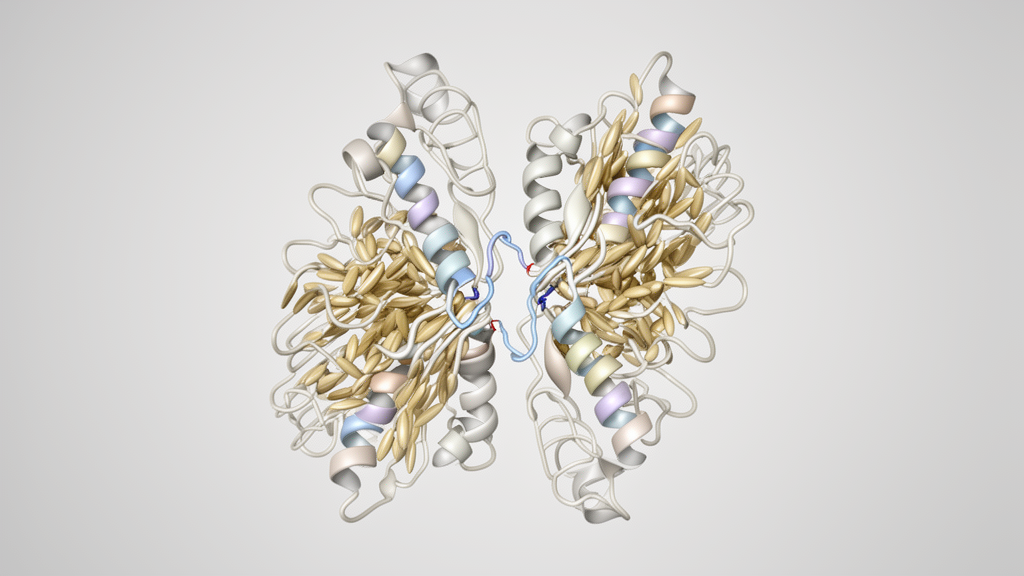
To explore alternative modeling strategies, the investigators employed the ClusPro 2.0 template-based rigid-body docking web server, incorporating protonation states calculated via the H++ server under matching buffer conditions of 20 millimolar salinity and pH 7.5. The top-ranked docking model showed that the backbone carbonyl oxygen of Glu-354 in the OsYchF1 TGS domain forms a direct hydrogen bond with the side-chain hydroxyl of Thr-58 within OsGAP1 cluster 1. Additionally, Glu-71 and Asp-74 in the OsYchF1 G domain form salt bridges with Lys-41 and Lys-39 in OsGAP1 cluster 3, while hydrophobic residues Phe-78 and Ile-79 of OsGAP1 insert into a non-polar pocket formed by Leu-244, Ile-259, Ile-260, and Phe-262 of OsYchF1. Uninvolved residues, such as Asp-23 and Asp-28 of cluster 2, remained solvent-exposed and distant from the interface.
These collective observations indicate that while deep-learning algorithms such as AlphaFold2 excel at predicting stable, high-affinity macromolecular assemblies, they remain prone to errors when modeling dynamic, transient protein complexes characterized by weak submillimolar affinities. By contrast, template-based docking algorithms that combine rigid-body fast Fourier transform correlations with experimental site-directed mutagenesis and thermodynamic parameters can successfully reconstruct low-affinity signaling modules. The structural coordinates of the top-ranked OsYchF1–OsGAP1 model generated in this study have been deposited in the ModelArchive repository under accession code ma-n6brr.
Subject of Research: Biophysical characterization and structural modeling of the rice OsYchF1–OsGAP1 protein complex
Article Title: From biophysical interaction to structural modeling: bi-terminal G and TGS domains drive rice OsYchF1-OsGAP1 complex formation
Article References: Huang, S., Wu, Z., Wang, K., Liao, Y., Zeng, J., & Miao, R. (2025). From biophysical interaction to structural modeling: bi-terminal G and TGS domains drive rice OsYchF1-OsGAP1 complex formation. Botanical Studies, 66(1), Article 29. https://doi.org/10.1186/s40529-025-00480-0
Image Credits: AI Generated
DOI: 10.1186/s40529-025-00480-0
Keywords: OsYchF1, OsGAP1, rice stress response, G proteins, isothermal titration calorimetry, yeast two-hybrid, AlphaFold2, ClusPro, biophysical, interaction, structural, modeling
News Source: Alan Morgan. (November 7, 2026). Terminal Domains Drive Rice OsYchF1-OsGAP1 Complex Formation and Guide Modeling. Scienmag.