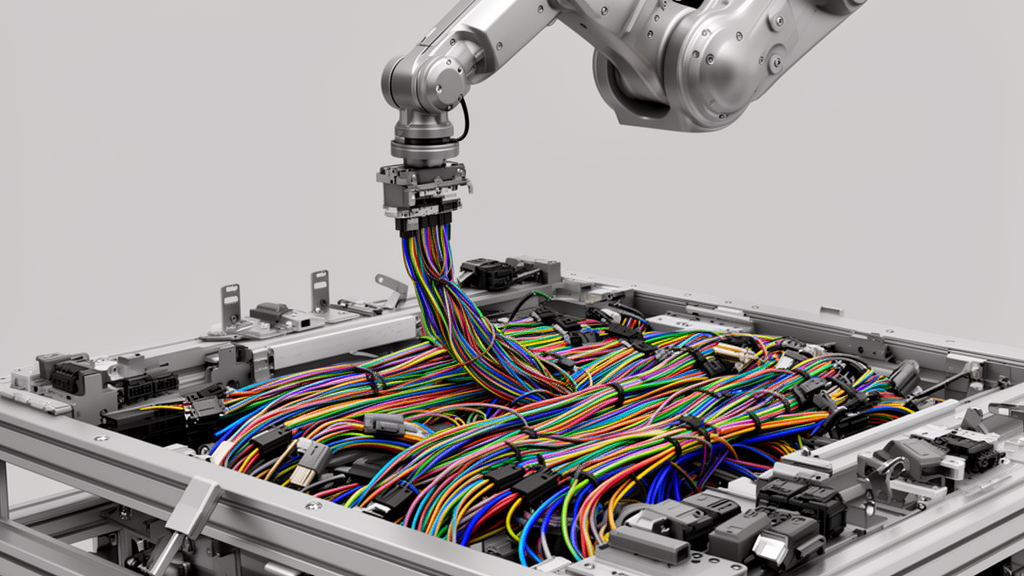
In a simulation study investigating automated wire harness handling, an end-to-end reinforcement learning approach demonstrated superior performance over algorithmic multi-agent path planning. Researchers Ludwig Streloke, Marco Peyerl, Jörg Franke, and Patrick Bründl evaluated both planning and learned control paradigms within a MuJoCo-based simulation environment featuring a Gymnasium-compatible interface.
Wire harness manufacturing continues to represent one of the most labor-intensive phases of automotive production. The primary assembly bottleneck centers on the form-and-tape process, prompting emerging industrial concepts to transition automation from single-wire routing toward module-based forming. In this setting, moving connector housing fixtures become strongly coupled through the partially assembled harness, creating a complex multi-agent planning and control problem governed by the contact-rich and variable behavior of wires as linear deformable objects.
To navigate these physical couplings, the researchers first examined multi-agent path planning methodologies applied to continuous, cable-coupled motion. Their approach implemented prioritized planning combined with heuristic guidance and reactive constraint checking. Across target evaluations, the highest-performing planner configuration achieved an overall success rate of 78 percent and completed 65 out of 120 target permutations.
The study subsequently evaluated reinforcement learning algorithms, comparing Soft Actor-Critic (SAC), Proximal Policy Optimization (PPO), and Trust Region Policy Optimization (TRPO). These methods were tested both as standalone controllers and as residual policies operating on top of a geometric base policy. Plain end-to-end SAC yielded the highest performance, reaching a mean overall success rate of 98 percent, with runs spanning 95 percent to 99 percent, and successfully solving nearly 114 of 120 complete target permutations.
Although residual reinforcement learning demonstrated greater stability on individual transitions, it failed to generalize across the complete sequence of target configurations. The authors concluded that these outcomes highlight a central trade-off between rule-based algorithmic planning and learned control in deformable wire harness handling, and they have made their simulation environment publicly accessible via an open-source repository.
The investigation was conducted by Ludwig Streloke, Marco Peyerl, Jörg Franke, and Patrick Bründl at the Lehrstuhl für Fertigungsautomatisierung und Produktionssystematik within Friedrich-Alexander-Universität Erlangen-Nürnberg in Erlangen, Germany. Published as an original research article in the Mechatronics section of Frontiers in Mechanical Engineering, the work addresses long-standing automation challenges in automotive assembly. Ludwig Streloke served as the corresponding author for the study, which was formally received on 15 June 2026 and accepted for publication on 16 October 2026 under an open-access Creative Commons Attribution license.
The research focuses specifically on overcoming the primary operational bottleneck identified in wire harness manufacturing: the traditional form-and-tape assembly phase. Industrial automation strategies are increasingly seeking to transition away from single-wire routing toward integrated module-based forming. However, implementing this transition introduces severe mechanical coupling because the connector housing fixtures must move while remaining linked through the partially formed wire harness. The physical behavior of the wires, functioning as linear deformable objects, involves contact-rich states and extreme variability that make analytical modeling exceptionally challenging for automated systems.
To evaluate how automated systems can address these coupled dynamics, the researchers implemented their benchmark within a specialized simulation platform. The testing framework paired the physics engine MuJoCo with a Gymnasium-compatible interface, allowing the team to directly compare classical algorithmic planning against modern learning techniques. The algorithmic investigation applied multi-agent path planning methods to continuous, cable-coupled motion, deploying prioritized planning supported by heuristic guidance alongside reactive constraint checking. When evaluated across benchmarks, the most successful planner configuration achieved a 78 percent success rate, successfully completing 65 out of 120 target permutations.
In parallel, the researchers examined learning-based control by benchmarking three reinforcement learning algorithms: Soft Actor-Critic (SAC), Proximal Policy Optimization (PPO), and Trust Region Policy Optimization (TRPO). The algorithms were tested both as standalone policies and as residual controllers operating on top of a geometric base policy. The experimental trials revealed that plain end-to-end SAC delivered the strongest overall results, achieving an average success rate of 98 percent, with individual runs spanning between 95 percent and 99 percent across trials, and resolving nearly 114 of the 120 complete target permutations.
A notable outcome observed during testing involved the failure of residual reinforcement learning to scale across multi-step sequences. Although the residual architecture provided greater stability during isolated single transitions, it was unable to generalize across the complete sequence of target configurations. The authors emphasized that these contrasting behaviors demonstrate a fundamental trade-off between rule-based algorithmic planning and learned robotic control in deformable object handling. To assist further exploration in multi-agent path finding and robotic manipulation, the authors made their simulation code publicly available in an online repository.
Subject of Research: Planning and reinforcement learning control for automotive wire harness handling
Article Title: Multi-agent path planning and reinforcement learning for wire harness handling
Article References: Streloke, L., Peyerl, M., Franke, J., & Bründl, P. (2026). Multi-agent path planning and reinforcement learning for wire harness handling. Frontiers in Mechanical Engineering, 12, Article 1910151. https://doi.org/10.3389/fmech.2026.1910151
Image Credits: AI Generated
DOI: 10.3389/fmech.2026.1910151
Keywords: wire harness manufacturing, reinforcement learning, multi-agent path planning, robotics, MuJoCo simulation, Soft Actor-Critic, automotive production, linear deformable objects, Multi-agent, path, planning, reinforcement
News Source: Denise Maddox. (November 7, 2026). Reinforcement Learning Outperforms Algorithmic Planning in Simulated Automotive Wire Harness Assembly. Scienmag.