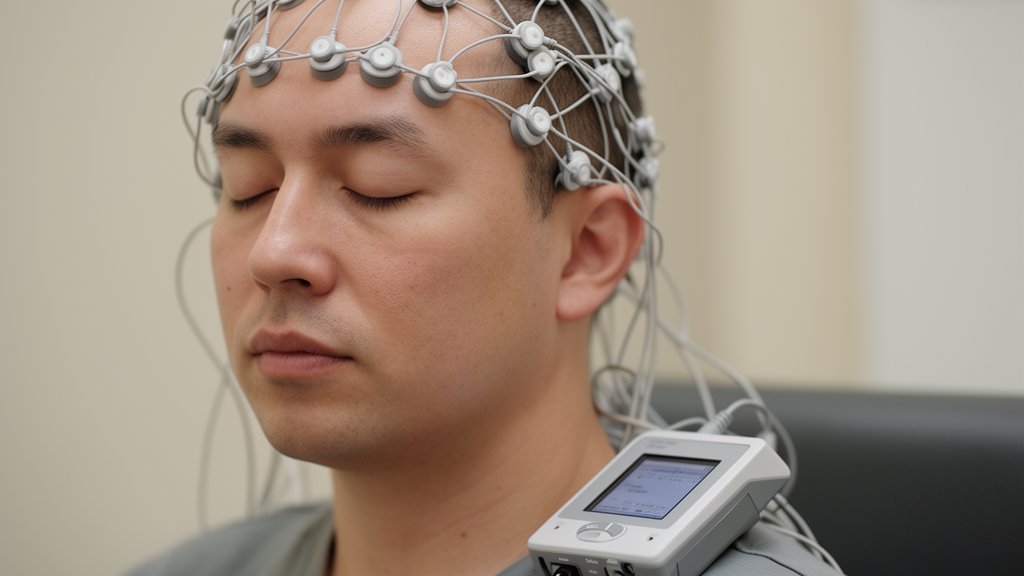
Researchers from Fuzhou Institute of Technology and Xiamen University of Technology have developed a new electroencephalography (EEG) framework that improves the detection of driving fatigue across different individuals. Published in Frontiers in Neuroscience, the study addresses a persistent challenge in neural decoding: the significant variability in brainwave patterns between different drivers. By establishing an early personal spectral reference and encoding residual deviations over long causal sequences, the proposed method enables shared-parameter models to distinguish fatigue signals from individual baseline differences without requiring specialized models for each driver.
The core problem in cross-subject EEG fatigue detection is that existing decoders typically rely on short, second-scale windows to analyze spectral features. However, fatigue is characterized as a slow drift that accumulates over minutes, meaning short windows provide limited direct evidence of this gradual change. Furthermore, each individual possesses a unique spectral baseline level and fatigue-change pattern. Simply extending the analysis window does not resolve this issue, as models struggle to predict fatigue across different people when relying solely on observed absolute spectral features. The new work aims to enable cross-subject fatigue decisions under shared parameters, eliminating the need for per-driver specialized models.
The proposed framework consists of two main components: early personal spectral reference and causal long-sequence residual encoding. The first component estimates a personal spectral reference from a short, frozen session-opening window. This reference serves as a baseline, allowing subsequent spectral observations to be mapped into a residual space. By subtracting this individual-specific intercept, the model structurally attenuates the temporally stable individual spectral level, thereby emphasizing fatigue-related deviations. This approach reduces the interference of identity features in fatigue decisions, which is a critical step for cross-subject generalization.
The second component involves state-conditioned temporal modeling that accumulates and updates a residual state over a long causal sequence. Unlike traditional recurrent models that might carry state across the entire session, this method uses a right-aligned causal trail of a specific length for within-window aggregation. The model performs feature reorganization, conditioned temporal mixing, and persistent state updates within this causal window. Fatigue is then read out from the terminal state of this encoding process. This design ensures that the accumulation of slow-drift evidence is confined to a single prediction window, maintaining causality for potential online deployment.
The study evaluated the framework on two public driving-fatigue EEG benchmarks: the Multimodal Phenotyping Dataset of Driving Fatigue (MPD-DF) for binary classification and the SEED Vigilance dataset (SEED-VIG) for continuous vigilance regression. The MPD-DF dataset includes 50 subjects with 32 channels, while SEED-VIG comprises 23 subjects with 17 channels. All experiments followed a leave-one-subject-out (LOSO) protocol, where the test subject and all their samples were strictly excluded from training and validation. This rigorous setup ensures that the model’s performance reflects its ability to generalize to unseen individuals rather than memorizing subject-specific patterns.
In the binary classification task on MPD-DF, the proposed method achieved a five-seed macro-averaged F1 score of 0.655 ± 0.005. This result outperformed the best matched-protocol absolute-spectrum baseline, which was EEGNet with a score of approximately 0.587. The method also surpassed representative domain-alignment and transfer learning baselines, including MSMDA (0.597), CORAL (0.569), and DANN (0.559). These comparisons demonstrate that the residual-space decoding approach offers a viable path for cross-subject fatigue detection that does not rely on complex domain alignment techniques or target-domain data.
For the continuous vigilance regression task on SEED-VIG, the framework demonstrated superior performance in estimating the percentage of eyelid closure over time (PERCLOS). Under the 5Bands feature setting, the root mean square error (RMSE) was 0.209 ± 0.005, and under the 2 Hz setting, it was 0.200 ± 0.003. Both values were lower than the matched-protocol baselines, with the runner-up being VIGNet at 0.225 RMSE for 5Bands and SVR at 0.226 RMSE for 2 Hz. The method also achieved the lowest mean absolute percentage error (MAPE) in both settings, indicating high precision in continuous vigilance estimation.
Ablation studies revealed the critical importance of the early personal spectral reference. Removing the early subtraction of the personal reference (μ) sharply degraded performance on both datasets. On MPD-DF, the Macro-F1 score dropped from 0.660 to 0.590, and on SEED-VIG, the RMSE increased significantly. This confirms that absolute spectral patterns alone cannot reliably separate individual identity from fatigue state. The findings suggest that the primary role of the early reference is to remove a relatively stable individual spectral offset, analogous to high-passing a DC component, rather than assuming the opening window represents a purely alert physiological state.
The study also examined the impact of causal sequence accumulation. Disabling the long-sequence residual encoding block resulted in similar relative degradations for both classification and regression tasks. However, the dependence on the updated state at readout differed between tasks. Classification showed a stronger dependence on the updated state, with a larger performance drop when using only the instantaneous residual, whereas regression remained relatively robust. This difference aligns with the supervision density: SEED-VIG provides continuous labels every second, making instantaneous residuals sufficient for regression, while MPD-DF provides discrete labels every 10 seconds, making sequence-state readout more critical for stable classification.
Sensitivity analyses indicated that the performance is not dependent on extremely long opening windows or encoding trails. The freeze length for estimating the personal reference can be as short as 1 second without significant loss in performance, supporting the practicality of the method for real-time applications. Similarly, the causal encoding window length showed gains that plateaued after approximately 30 seconds, suggesting that moderate window lengths are sufficient to capture the necessary slow-drift evidence. These findings highlight that the benefits arise from the causal accumulation mechanism on residuals rather than from the physical length of the window alone.
The authors acknowledge several limitations of the study. The datasets used are from specific laboratories and driving scenarios, which may limit the direct transferability of the results to real-world, multi-center in-vehicle environments. Additionally, the sample sizes are relatively small, with 50 subjects for MPD-DF and 23 for SEED-VIG, which constrains statistical power. The binary merging of fatigue grades in MPD-DF and the use of PERCLOS as a proxy in SEED-VIG may also mask continuous severity changes. Despite these constraints, the study provides a robust framework for cross-subject fatigue decoding that outperforms existing baselines without the need for per-driver models or domain alignment.
This research contributes to the field of neural technology by offering a practical premise for cross-subject fatigue decoding. By structurally separating individual spectral levels from fatigue-related deviations, the framework addresses a fundamental limitation in EEG-based monitoring systems. The ability to use shared parameters across different drivers reduces the computational and data requirements associated with personalized models.
Subject of Research: Cross-subject EEG driving fatigue detection using early personal spectral reference and causal long-sequence residual encoding
Article Title: Cross-subject EEG driving fatigue detection: early personal spectral reference and causal long-sequence residual encoding
Article References: Gao, S., & Lv, L. (2026). Cross-subject EEG driving fatigue detection: early personal spectral reference and causal long-sequence residual encoding. Frontiers in Neuroscience, 20, Article 1997832. https://doi.org/10.3389/fnins.2026.1997832
Image Credits: AI Generated
DOI: 10.3389/fnins.2026.1997832
Keywords: EEG, driving fatigue, cross-subject generalization, spectral reference, residual encoding, vigilance estimation, neural decoding, machine learning, Cross-subject, driving, fatigue, detection
News Source: Ophelia Keating. (November 7, 2026). EEG Fatigue Detection Improves via Personal Spectral Baselines. Scienmag.