• HOME
  • NEWS
  • EXPLORE
    • CAREER
      • Companies
      • Jobs
    • EVENTS
    • iGEM
      • News
      • Team
    • PHOTOS
    • VIDEO
    • WIKI
  • BLOG
  • COMMUNITY
    • FACEBOOK
    • INSTAGRAM
    • TWITTER
Monday, November 16, 2026
BIOENGINEER.ORG
No Result
View All Result
  • Login
  • HOME
  • NEWS
  • EXPLORE
    • CAREER
      • Companies
      • Jobs
        • Lecturer
        • PhD Studentship
        • Postdoc
        • Research Assistant
    • EVENTS
    • iGEM
      • News
      • Team
    • PHOTOS
    • VIDEO
    • WIKI
  • BLOG
  • COMMUNITY
    • FACEBOOK
    • INSTAGRAM
    • TWITTER
No Result
View All Result
Bioengineer.org
No Result
View All Result
Home NEWS Science News Health

Improved 2.5D-UNet Enhances Pseudo-CT Generation for Head PET Attenuation Correction

by
November 7, 2026
in Health, Technology
Reading Time: 2 mins read
0
Improved 2.5D-UNet Enhances Pseudo-CT Generation for Head PET Attenuation Correction

Improved 2.5D-UNet Enhances Pseudo-CT Generation for Head PET Attenuation Correction

Share on FacebookShare on TwitterShare on LinkedinShare on RedditShare on Telegram

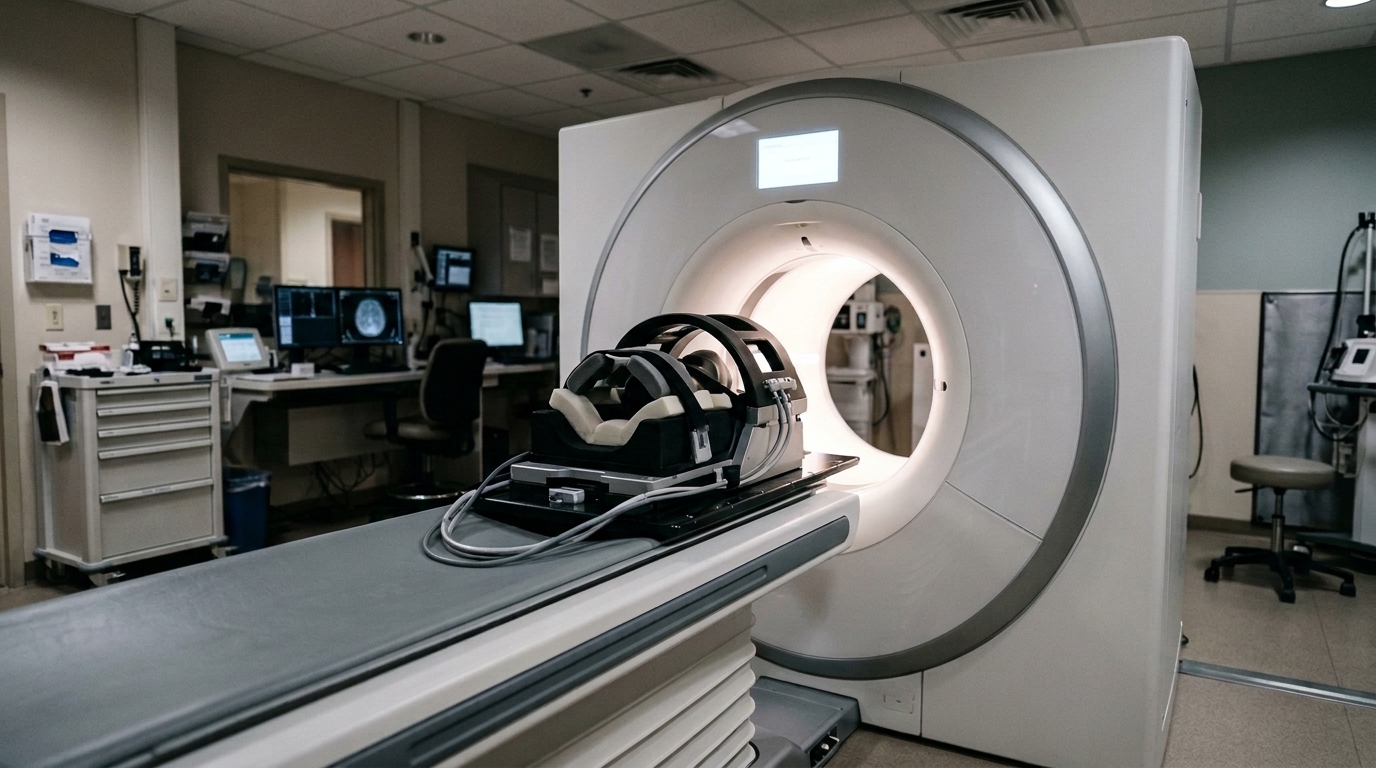
An improved 2.5D-UNet deep learning architecture enhances the accuracy of pseudo-computed tomography images generated from non-attenuation-corrected positron emission tomography scans, according to an original research study published in EJNMMI Physics. By utilizing adjacent image slices to provide contextual anatomical information, the model enables attenuation correction without requiring additional radiation exposure or dedicated imaging equipment.

In positron emission tomography, tissue attenuation represents a significant imaging challenge that can lead to quantification errors, the underestimation of lesions, and the misinterpretation of the extent of disease. Correcting for attenuation is commonly achieved using a computed tomography scan, which provides the necessary anatomical details. However, relying on computed tomography substantially increases the radiation dose received by patients, raises imaging equipment expenses, and can introduce misregistration errors between the scans.

To overcome these clinical limitations, deep learning methods have been introduced to synthesize pseudo-computed tomography images directly from non-attenuation-corrected scans. In this work, researchers developed an improved 2.5D-UNet architecture designed to process three consecutive slices to provide enriched contextual information for generating a single slice. The model was trained using a dataset consisting of 189 non-attenuation-corrected head scans from patients injected with either 18F-fluorodeoxyglucose or 11C-acetoacetate radiotracers, paired with corresponding computed tomography images.

Evaluating the generated pseudo-computed tomography images across all patients revealed overall performance gains with the proposed 2.5D network over a standard 2D architecture. The soft tissue Dice score improved from 0.905 ± 0.015 with the 2D model to 0.922 ± 0.017 with the 2.5D approach. In addition, the structural similarity index measure increased from 0.889 ± 0.023 in the 2D configuration to 0.921 ± 0.019 using the 2.5D framework.

Beyond slice-level numerical metrics, three-dimensional forward projections comparing total attenuation projection values between actual computed tomography scans and synthesized pseudo-computed tomography images highlighted the superior attenuation maps produced by the 2.5D deep learning framework. The authors concluded that incorporating adjacent slices for contextual guidance allows the 2.5D-UNet to outperform 2D models, delivering fast and effective attenuation correction from non-attenuation-corrected head scans.

Subject of Research: Deep learning-based pseudo-CT generation for PET attenuation correction

Article Title: Improved 2.5D-UNet pseudo-CT generation for attenuation correction in PET imaging using 18F-fluorodeoxyglucose and 11C-acetoacetate radiotracers

Article References: St-Georges, A., Houle, A., Cenci, T., Giroux, J.-S., Toussaint, M., Thibaudeau, C., Auger, E., Croteau, É., Cunnane, S., Lecomte, R., & Michaud, J.-B. (2026). Improved 2.5D-UNet pseudo-CT generation for attenuation correction in PET imaging using 18F-fluorodeoxyglucose and 11C-acetoacetate radiotracers. EJNMMI Physics. https://doi.org/10.1186/s40658-026-00909-w

Image Credits: AI Generated

DOI: 10.1186/s40658-026-00909-w

Keywords: PET imaging, attenuation correction, pseudo-CT, deep learning, 2.5D-UNet, radiotracers, medical imaging, head scans, Improved, D-UNet, generation, attenuation

News Source: Ophelia Keating. (November 7, 2026). Improved 2.5D-UNet Enhances Pseudo-CT Generation for Head PET Attenuation Correction. Scienmag.
Tags: 2.5D-UNetattenuationattenuation correctionD-UNetdeep learninggenerationhead scansimprovedMedical ImagingPET imagingpseudo-CTradiotracers
Share12Tweet7Share2ShareShareShare1

Related Posts

Fibrillar Bodies Underlie Characteristic Cytokeratin Dot Pattern in Merkel Cell Carcinoma

Fibrillar Bodies Underlie Characteristic Cytokeratin Dot Pattern in Merkel Cell Carcinoma

November 16, 2026
Postoperative Radiotherapy Boosts Survival in Advanced Esophageal Squamous Cell Carcinoma

Postoperative Radiotherapy Boosts Survival in Advanced Esophageal Squamous Cell Carcinoma

November 16, 2026

Molecular Testing Detects Beta Thalassemia Variants in Fifteen Percent of Atypical Cohorts

November 16, 2026

Plasma Proteomic Clocks Reveal Divergent Organ Aging and Related Disease Risks

November 16, 2026

POPULAR NEWS

  • Higher Serum Uric Acid Associated With Obesity in Children With Tonsillar Hypertrophy

    Higher Serum Uric Acid Associated With Obesity in Children With Adenoid and/or Tonsillar Hypertrophy

    29 shares
    Share 12 Tweet 7
  • Clonal Haematopoiesis Associated With Elevated Cardiovascular Risk in MASLD Cohort

    29 shares
    Share 12 Tweet 7
  • Resting-state Brain Age Links Neurodevelopmental Burden to Schizophrenia Severity

    29 shares
    Share 12 Tweet 7
  • Low Preoperative Nutritional Index Predicts ICU Admission After Orthopedic Surgery

    29 shares
    Share 12 Tweet 7

About

We bring you the latest biotechnology news from best research centers and universities around the world. Check our website.

Follow us

Recent News

Fibrillar Bodies Underlie Characteristic Cytokeratin Dot Pattern in Merkel Cell Carcinoma

Postoperative Radiotherapy Boosts Survival in Advanced Esophageal Squamous Cell Carcinoma

Molecular Testing Detects Beta Thalassemia Variants in Fifteen Percent of Atypical Cohorts

Subscribe to Blog via Email

Enter your email address to subscribe to this blog and receive notifications of new posts by email.

Join 87 other subscribers
  • Contact Us

Bioengineer.org © Copyright 2023 All Rights Reserved.

Welcome Back!

Login to your account below

Forgotten Password?

Retrieve your password

Please enter your username or email address to reset your password.

Log In
No Result
View All Result
  • Homepages
    • Home Page 1
    • Home Page 2
  • News
  • National
  • Business
  • Health
  • Lifestyle
  • Science

Bioengineer.org © Copyright 2023 All Rights Reserved.