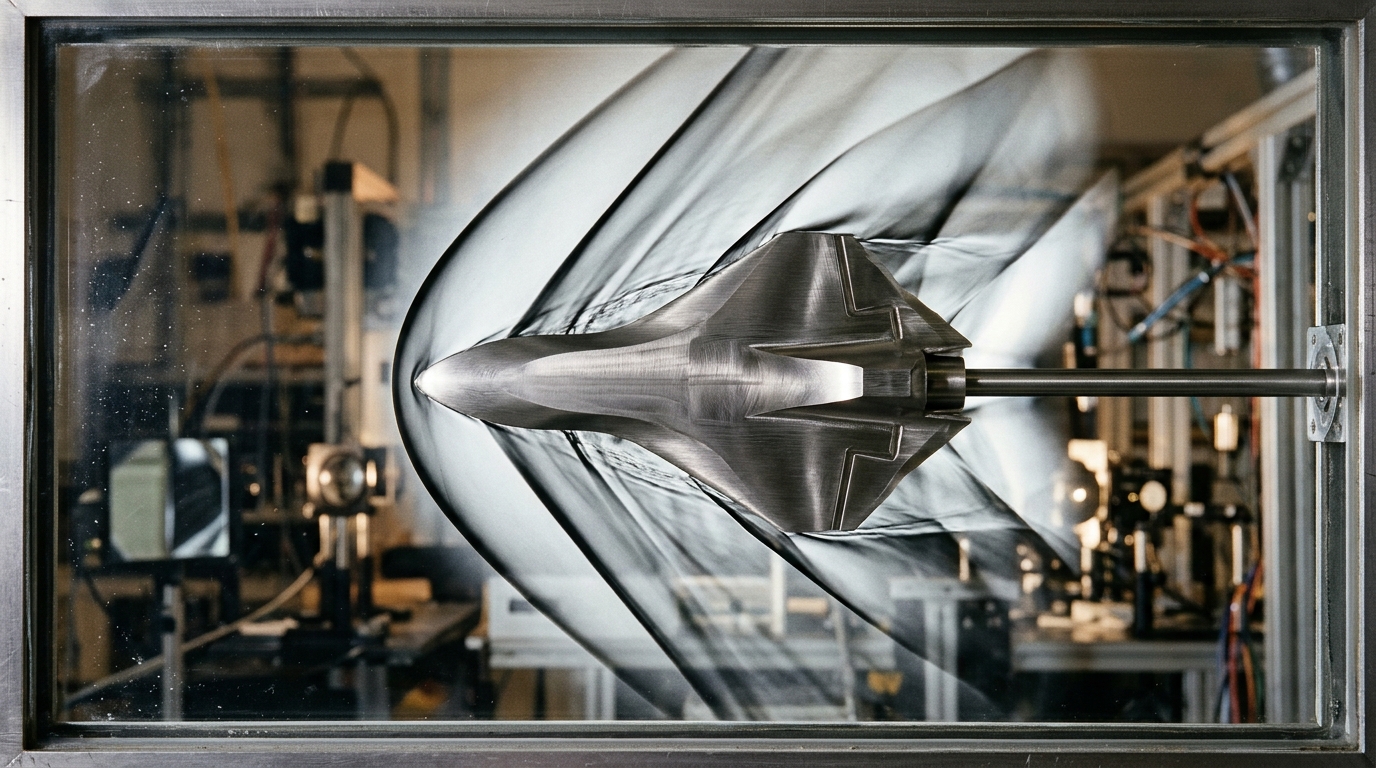
Computational fluid dynamics researchers have developed an integrated numerical framework that achieves third-order accuracy and robust shock-capturing capability when simulating inviscid compressible fluid flows around geometrically complex objects on Cartesian meshes. The investigation, detailed in Advances in Aerodynamics by Yanqun Jiang, Huanhuan Yang, Qinghong Tang, and Yixin Zhu, couples a specialized third-order weighted compact nonlinear scheme with an advanced constrained weighted least squares immersed boundary technique. The primary objective of the work is resolving longstanding numerical dilemmas in aerodynamic simulations, where resolving discontinuities like shock waves alongside irregular or curved solid boundaries typically requires trade-offs between geometric flexibility, algorithmic stability, computational efficiency, and high-order spatial accuracy.
Simulating high-speed compressible flows governed by the two-dimensional Euler equations on structured Cartesian grids has long offered major advantages over traditional body-fitted mesh approaches. Body-fitted meshes require complex, time-consuming grid generation and demand large computer memory storage to handle intricate shapes, whereas Cartesian grids allow fully automated, rapid, and high-quality spatial discretization with straightforward data structures. However, when complex solid physical boundaries do not align with the underlying rectangular mesh lines, implementing high-order finite difference stencils directly near the walls becomes problematic. Conventional boundary approaches present distinct challenges: cut-cell techniques generate tiny fractional cells that severely restrict the explicit numerical time step and induce instabilities, while inverse Lax-Wendroff procedures require intricate algebraic derivations of high-order normal derivatives that become cumbersome in multidimensional conservation laws.
To overcome these challenges, the researchers formulated the WCNS-ZM spatial discretization method, operating in tandem with a fourth-order central difference baseline operator to evaluate spatial flux derivatives. The semi-discrete formulation computes the point values of conservative variables over fluid cells through numerical fluxes positioned at cell edges. These fluxes are evaluated using a characteristic-wise nonlinear interpolation technique relying on Lax-Friedrichs splitting of the inviscid flux vectors into positive and negative components. The characteristic decomposition calculates local sound speeds and Jacobian eigenvectors across arithmetic-mean intermediate states, projecting fluid data into characteristic space so that non-oscillatory interpolations can be performed component by component before being transformed back into physical space.
The interpolation relies on a two-level weighted essentially non-oscillatory adaptive-order framework applied across a three-point global stencil alongside two nested two-point sub-stencils. In smooth flow regions, the nonlinear weighting mechanism fully recovers an optimal third-order interpolation polynomial by assigning linear stencil weights of one-tenth to each sub-stencil and eight-tenths to the global stencil. When discontinuities or steep gradients appear, the adaptive weights dynamically drop the contribution of stencils containing non-smooth data, preserving the essential non-oscillatory property. To maintain third-order convergence specifically at first-order and second-order critical points where flow gradients vanish, the authors introduced a novel global smoothness indicator that monitors the squared differences between the global and sub-stencil smoothness measurements.
Theoretical analysis of the resulting WCNS-ZM scheme revealed that setting the weighting power parameter to one point five guarantees third-order accuracy across critical points where first and second derivatives vanish. Using the approximate dispersion relation method to evaluate the spectral dissipation and dispersion characteristics, the researchers demonstrated that the WCNS-ZM formulation delivers superior spectral properties compared to the standard WCNS-Z scheme. Although setting the dissipation scaling parameter to one-hundredth minimizes dissipative error across intermediate and high wavenumbers, the researchers selected a balanced value of zero point five to provide both sharp spatial resolution and robust shock-capturing capability without incurring unphysical oscillations near discontinuities.
To enforce physical boundary conditions along arbitrary immersed walls without distorting the Cartesian mesh, the researchers implemented a third-order constrained weighted least squares immersed boundary method. Two distinct layers of ghost cells are designated within the solid body based on a rook distance metric that evaluates coordinate separation from nearby active fluid cells. For each ghost cell, the nearest point along the physical boundary represents a body-intercept point that defines the inward unit normal and unit tangential coordinate vectors. Surrounding fluid cells located within an adaptive elliptical neighborhood are identified, and the target fluid variable is approximated by a six-coefficient, second-order bivariate polynomial whose spatial scaling is normalized by the local Cartesian cell spacings.
The six polynomial coefficients are obtained by minimizing a weighted quadratic cost function that prioritizes fluid data points located closer to the target ghost point through an inverse distance weighting factor. Crucially, the minimization is performed subject to the exact physical boundary condition enforced directly at the body-intercept point as an equality constraint. Slip-wall reflecting boundary conditions for inviscid flow enforce a Dirichlet condition on normal fluid velocity and Neumann conditions on fluid density, static pressure, and tangential velocity. Solving the constrained system via Lagrange multipliers produces a Karush-Kuhn-Tucker linear system governed by an invertible matrix, which is solved efficiently and uniquely using QR factorization during an initial precomputing phase for stationary geometric boundaries.
To prevent nonphysical values when shock waves pass directly over or near the immersed solid boundaries, the framework incorporates a simplified WENO-type extrapolation. Evaluating standard multidimensional smoothness indicators across curved stencils is computationally expensive, so the authors instead evaluate flow smoothness along the boundary normal line using three collinear sampling points. The fluid properties at these points are evaluated through the local constrained polynomial, and a scale-independent, dimensionless nonlinear weight is calculated from their local smoothness indicators. This weight smoothly transitions the final ghost-cell value between the third-order constrained polynomial extrapolation and a robust first-order approximation, ensuring optimal convergence in smooth regions while completely suppressing spurious oscillations near wall-bounded shocks.
The performance of the combined numerical framework was verified through a comprehensive series of numerical benchmarks, starting with grid convergence and efficiency tests using smooth manufactured solutions. Solving periodic two-dimensional Euler equations under three distinct initial density profiles confirmed third-order convergence rates in both the maximum and mean error norms across successively refined Cartesian grids ranging from sixteen-by-sixteen up to two-hundred-fifty-six by two-hundred-fifty-six cells. Tracking numerical errors against computational central processing unit time demonstrated that the WCNS-ZM scheme achieved significantly higher computational efficiency than classic WCNS-JS and WCNS-Z schemes. A manufactured steady-state problem in a circular domain further demonstrated strict third-order convergence for both Dirichlet and Neumann conditions when using the WENO-type extrapolation.
The shock-capturing robustness of the scheme was further validated across challenging discontinuous flow problems, including two-dimensional extensions of the Lax and Shu-Osher shock tube tests, as well as the strongly nonlinear two-blast-wave interaction problem. In the blast wave simulation, where extreme pressure ratios of one hundred thousand to one generate powerful colliding shock waves, the WCNS-ZM scheme on a four-hundred by forty grid successfully suppressed numerical oscillations while capturing sharp wave profiles with less dissipation than competing third-order schemes. Simulations of a Mach ten shock impinging on a thirty-degree ramp demonstrated that the immersed boundary treatment closely matched standard grid-aligned computations, successfully resolving fine-scale Mach stems, triple points, and slip lines.
Complex aerodynamic configurations were examined by simulating supersonic flows across forward-facing steps and multiple circular and ellipsoidal obstacles. Mach three wind tunnel simulations over rounded and square steps showed that the immersed boundary method accurately captured complex shock reflections while eliminating the artificial corner entropy and enthalpy corrections typically needed in Cartesian simulations of sharp corners. In supersonic flow past circular and ellipsoidal cylinders, the constrained weighted least squares approach maintained smooth, oscillation-free surface pressure distributions where conventional high-order linear extrapolations produced severe numerical fluctuations. Finally, simulations of a planar Mach three shock impacting single and multiple circular cylinders accurately reproduced intricate shock-shock and shock-surface diffraction patterns, confirming the versatility of the method for complex geometries and paving the way for future extensions to compressible viscous flows.
Subject of Research: High-order Cartesian grid numerical simulation of inviscid compressible fluid dynamics with immersed boundaries
Article Title: High-order WCNS scheme with a constrained weighted least squares immersed boundary method for inviscid compressible flow simulations
Article References: Jiang, Y., Yang, H., Tang, Q., & Zhu, Y. (2026). High-order WCNS scheme with a constrained weighted least squares immersed boundary method for inviscid compressible flow simulations. Advances in Aerodynamics, 8(1), Article 9. https://doi.org/10.1186/s42774-025-00224-5
Image Credits: AI Generated
DOI: 10.1186/s42774-025-00224-5
Keywords: fluid dynamics, compressible flow, Euler equations, numerical methods, Cartesian grids, immersed boundary method, WCNS scheme, shock waves, aerodynamics, computational physics, High-order, WCNS
News Source: Denise Maddox. (November 7, 2026). New High-Order Immersed Boundary Numerical Framework Resolves Compressible Flows Around Irregular Geometries. Scienmag.