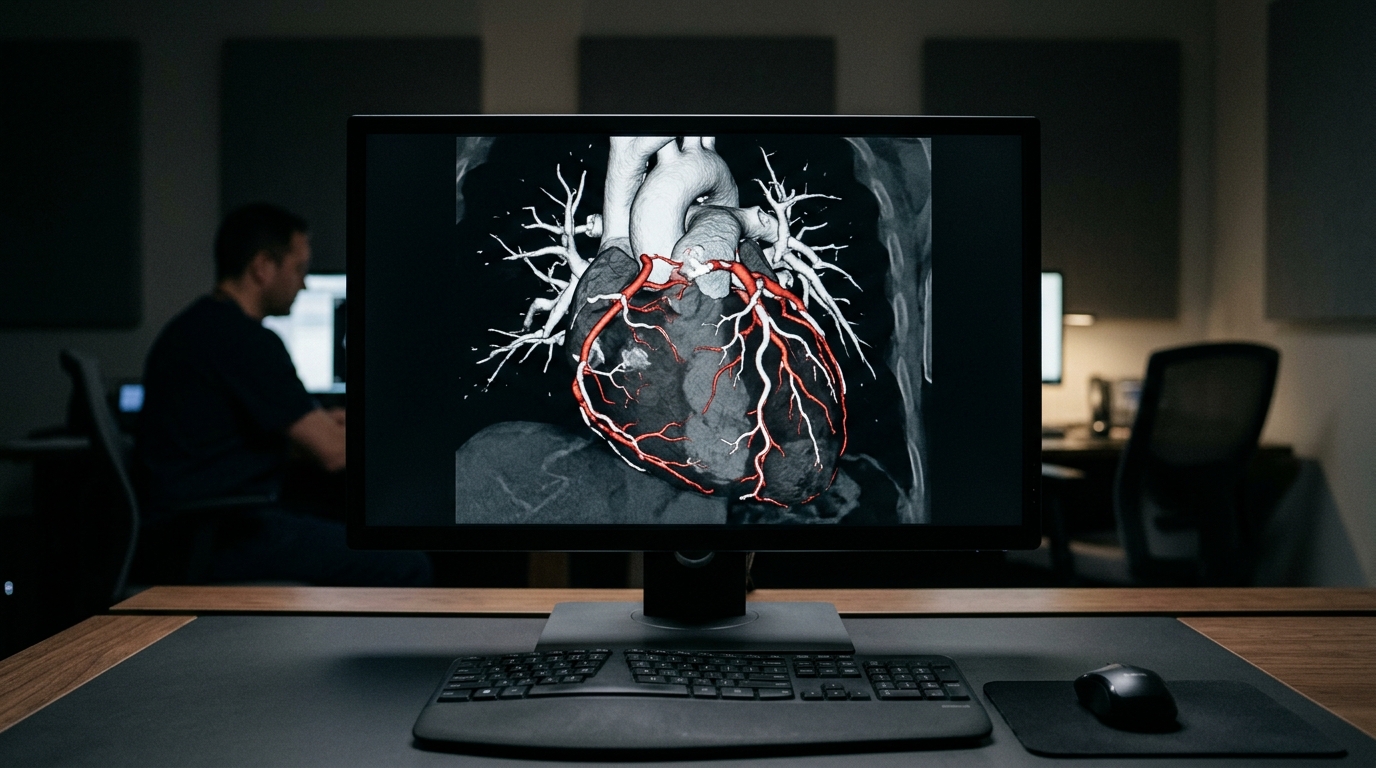
Researchers have developed a lightweight knowledge distillation framework named KDLight that incorporates adversarial training to improve coronary artery vessel segmentation while addressing computational costs. In experimental evaluations conducted across two datasets, the architecture outperformed existing state-of-the-art approaches in coronary vessel segmentation tasks, with performance improvements statistically confirmed by consistent p-values of less than 0.05.
Accurate vessel segmentation plays a significant role in diagnosing coronary atherosclerotic heart disease. While deep learning techniques have progressed in segmenting coronary vessels, existing deep learning-based approaches face substantial practical challenges. These limitations include high computational demands, a tendency toward overfitting when operating in small sample scenarios, and traditional loss functions that struggle to balance class imbalance alongside vascular topological continuity.
To overcome these computational and training obstacles, the investigators structured KDLight around three core components: an adversarial attacker module, a generator, and a knowledge distillation module. The system embeds an adversarial attack module featuring a black-box attacker upstream of the generator. Throughout the training process, this black-box attacker generates meaningful perturbations and adversarial examples, which strengthens the model’s generalization capacity and mitigates overfitting.
The distillation framework incorporates teacher and student refinement sub-networks utilizing two dedicated pathways: a feature-level similarity distillation module for feature extraction and a pixel-level similarity distillation module for vessel segmentation. Departing from conventional knowledge distillation setups, the teacher module operates as a segmentation network that ingests additional inputs to capture noise distributions and refine predictions during training. This accumulated knowledge is then transferred to the student module through feature-level distillation, enabling the student network to yield enhanced segmentation outputs.
Evaluation of the framework on Dataset 1 and Dataset 2 demonstrated superior generalization capabilities across varied coronary vessel segmentation tasks compared to benchmark methods. The authors confirmed these gains with consistent p-values below 0.05, establishing statistically verified segmentation improvements within the evaluated experimental datasets.
Subject of Research: Coronary artery vessel segmentation using lightweight knowledge distillation
Article Title: Exploring lightweight knowledge distillation with adversarial attack for efficient coronary artery vessel segmentation
Article References: Dang, H., Nie, X., Jing, S., & Li, P. (2026). Exploring lightweight knowledge distillation with adversarial attack for efficient coronary artery vessel segmentation. Frontiers in Artificial Intelligence, 9, Article 1891993. https://doi.org/10.3389/frai.2026.1891993
Image Credits: AI Generated
DOI: 10.3389/frai.2026.1891993
Keywords: coronary artery segmentation, knowledge distillation, adversarial attack, deep learning, vessel segmentation, medical image processing, atherosclerotic heart disease, Exploring, lightweight, knowledge, distillation, adversarial
News Source: Denise Maddox. (November 7, 2026). Lightweight Knowledge Distillation Framework Improves Coronary Artery Vessel Segmentation. Scienmag.