Experimental shaking table tests investigating prototype reinforced concrete communication poles have demonstrated that intense earthquake excitations induce soil plasticity and severely weaken base anchoring, while physical damage to the poles concentrates as hairline cracks in their bottom third. Dynamic testing further revealed that the seismic response of the interconnected pole-line system was significantly amplified under near-field ground motion.
Communication networks depend fundamentally on overhead lines to link operational nodes and transmit information across communities. Because these overhead transmission lines constitute a substantial portion of overall communication system investment, their continued reliability is essential for network connectivity. However, overhead line infrastructure frequently suffers widespread damage following earthquake events. Prior to this research, existing structural studies remained insufficient in revealing their seismic performance. According to the research team, this critical knowledge gap has hindered the accurate assessment and effective mitigation of seismic risks across the entire communication network.
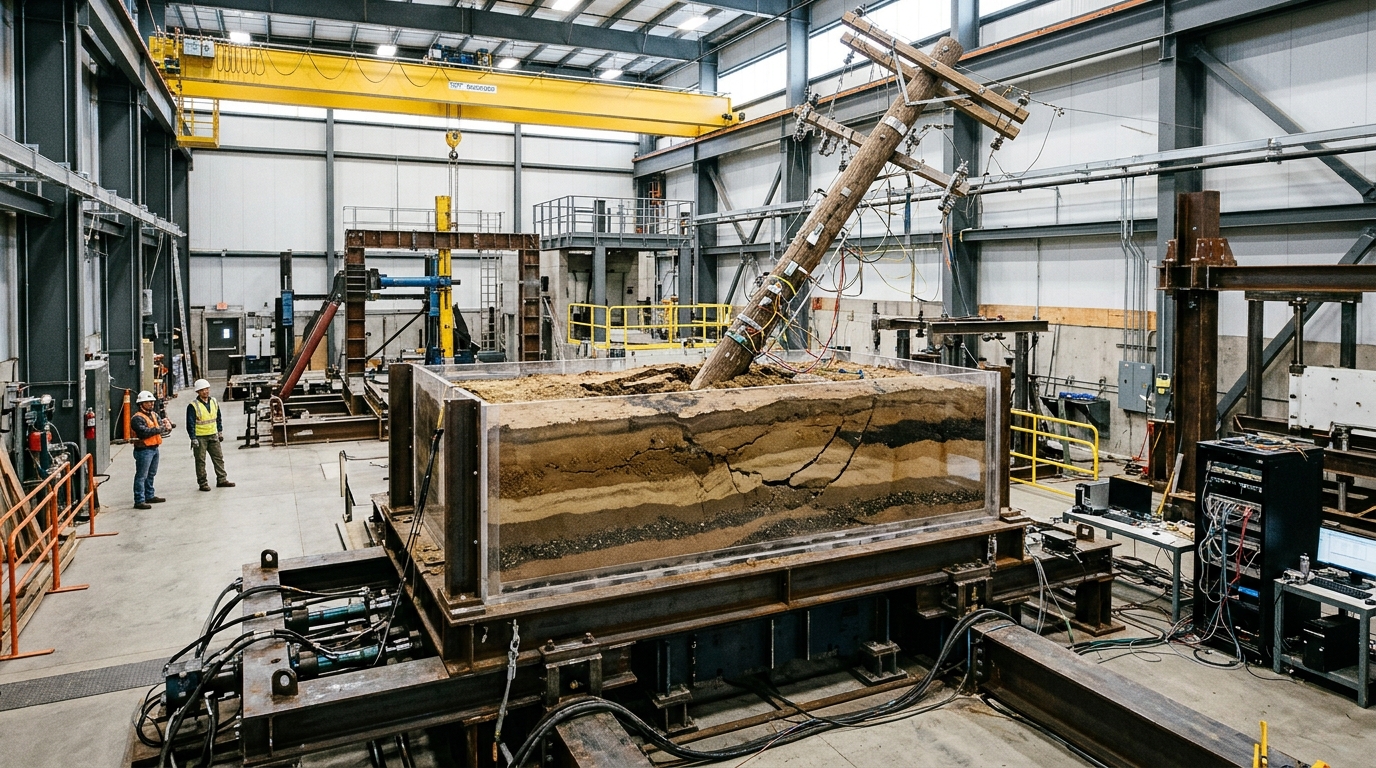
To address this critical gap in earthquake engineering, the investigators conducted a shaking table test on a soil-communication pole-line system utilizing four prototype reinforced concrete poles. Specifically, two of the prototype poles were embedded within a soil box to evaluate foundation support, while two additional poles were anchored directly to the shaking table surface. The complete pole-line system was established by linking one soil-embedded pole to the two anchored poles via suspended messenger wires, creating an interconnected structural configuration for dynamic evaluation.
Through this multi-pole experimental setup, the researchers investigated the characteristic damage patterns and dynamic seismic responses under progressively increased seismic intensity, focusing especially on the base anchoring effect of the soil and the structural influence of the suspended messenger wires. The test results show that the characteristic seismic damage of the reinforced concrete poles manifested as hairline cracks concentrated in the bottom one-third of the pole structures. Crucially, intense seismic excitations induced soil plasticity within the soil box, a behavioral change that severely weakened the base anchoring effect supporting the embedded pole.
Furthermore, the experimental observations revealed that the seismic response of the pole-line system was significantly amplified under near-field ground motion. Consequently, the authors emphasized that in areas characterized by high seismic risk, the necessity of conducting formal seismic design for communication poles deserves serious attention from engineers and infrastructure planners, moving beyond the traditional industry reliance on wind-resistance design alone.
Subject of Research: Seismic performance and damage characteristics of soil-communication pole-line systems
Article Title: Shaking table test study on seismic performance of the soil-communication pole-line system
Article References: Mao, C., Zhang, Z., & Wang, T. (2026). Shaking table test study on seismic performance of the soil-communication pole-line system. Earthquake Engineering and Engineering Vibration, 25(4), 1011-1030. https://doi.org/10.1007/s11803-026-2418-9
Image Credits: AI Generated
DOI: 10.1007/s11803-026-2418-9
Keywords: earthquake engineering, communication poles, shaking table test, seismic performance, reinforced concrete, soil-structure interaction, overhead lines, near-field ground motion, Shaking, table, test, seismic
News Source: Denise Maddox. (November 7, 2026). Shaking Table Experiments Reveal How Earthquakes Damage Soil-Embedded Communication Poles. Scienmag.