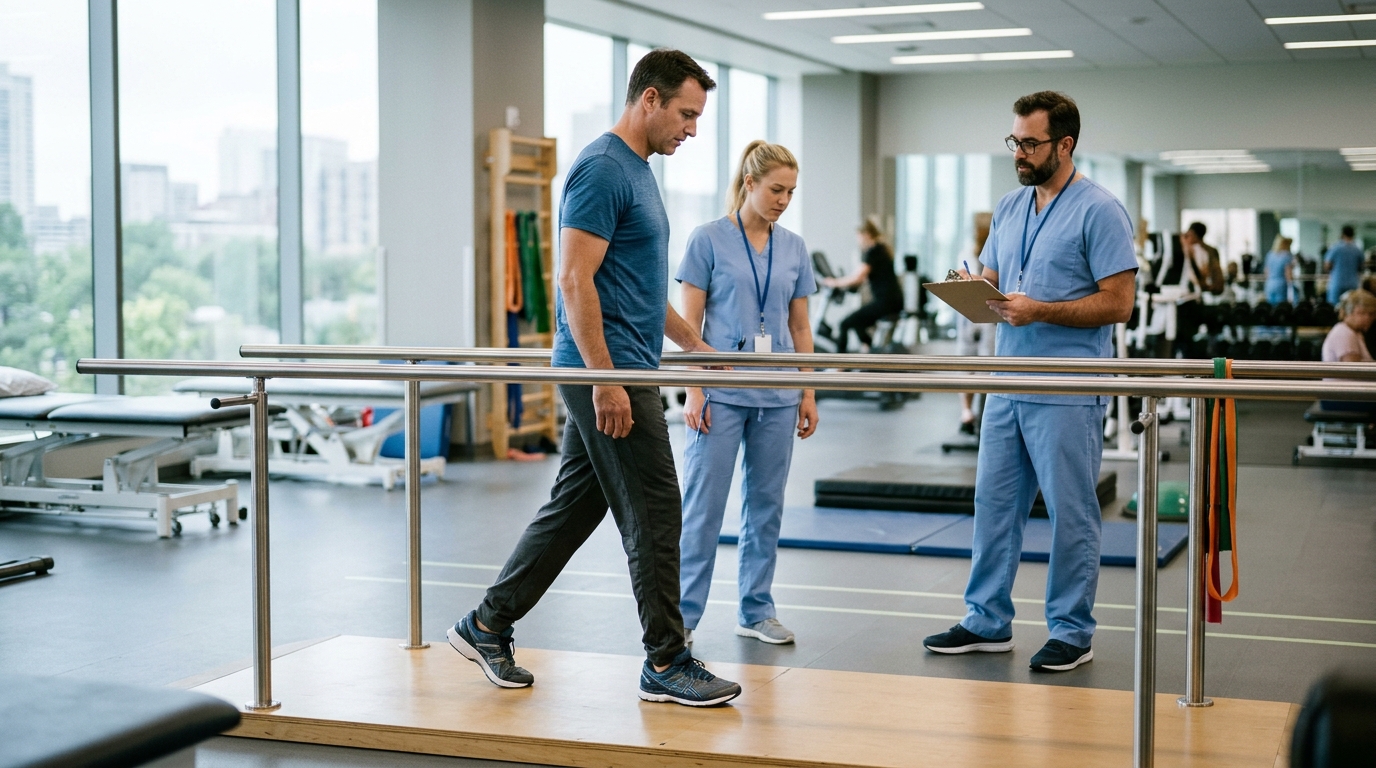
A revised bedside mobility scale that adds a single walking item to an established five-item assessment has shown exceptionally high agreement between independent raters in a new reliability study. The Ability for Basic Movement Scale II-w, or ABMS II-w, was tested on 49 hospital patients by two physical therapists who evaluated each person separately, without seeing each other’s scores. The overall total score produced an intraclass correlation coefficient of 0.92, with a 95 percent confidence interval of 0.86 to 0.95, a level the study’s authors describe as exceptionally high for a clinical mobility measure.
The walking item itself, the central addition to the original scale, achieved a quadratic weighted kappa of 0.99 with a 95 percent confidence interval of 0.97 to 1.00, which corresponds to almost perfect agreement under widely used classification standards. Every one of the six items on the revised scale, including the five carried over from the previous version, reached at least substantial agreement between the two evaluators. The study was conducted in the Department of Rehabilitation Medicine at a university hospital and has been published in Frontiers in Rehabilitation Sciences.
The original ABMS II assesses five basic movements: turning over, sitting up, sitting, standing up, and standing. These items trace a patient’s progress from bed mobility through verticalization, the sequence by which a person moves from lying down to an upright standing position. What the earlier scale could not do was capture what happens next, namely walking along the hospital ward. The revised version closes that gap by appending a sixth item that rates walking over a distance of 50 yards, a functional benchmark of roughly 45 meters borrowed from the Barthel Index, a well-known measure of daily living activities.
Scoring on the new item follows the same six-point ordinal structure as the rest of the scale. A patient who walks the full 50 yards without any assistance scores 6, completely independent. Someone who covers part of the distance independently but needs a walking aid to finish, such as a patient who manages 20 yards unaided and then requires support for the remainder, is rated 5, independent in a special environment. A score of 4 reflects the need for verbal cues, guidance, or standby supervision without physical contact. When physical assistance is required, a patient who performs more than a quarter of the effort receives a 3, while greater dependence earns a 2. A patient medically restricted from moving at all is assigned a score of 1, prohibited from moving.
The study enrolled consecutive patients referred for physical therapy in March 2026, with no restriction on primary disease in order to minimize selection bias. Eligibility required patients to be at least 12 years old, a threshold the researchers set because patients in that age group have an adult-like physical build, are admitted to general adult wards, and are assessed with standard adult functional scales. Of 83 patients screened, 17 were excluded because they could not follow instructions or their physicians declined duplicate evaluation, and another 16 declined participation. Fifty patients were enrolled for dual assessment, and one was later excluded for being unable to complete the second evaluation on the same day, leaving a final analytical sample of 49 and an overall inclusion rate of 59.0 percent.
The two raters were licensed physical therapists with one and seven years of clinical experience respectively, a deliberate contrast in seniority. They assessed each patient strictly independently, with the second rater absent during the first assessment and blinded to the first rater’s scores. The order of evaluations depended on clinical availability rather than strict randomization, but no therapeutic interventions took place between the two assessments, which were completed consecutively within a three-hour window to minimize fatigue or genuine changes in physical status. Both raters could consult standard clinical charts, yet neither saw the other’s mobility evaluations, and all assessments took place in standard ward environments.
Statistically, the total score was analyzed with a two-way random-effects, absolute-agreement intraclass correlation model, chosen because the two evaluators were selected by clinical availability and thus represent a random sample of typical physical therapists in that setting. Sample size planning targeted an expected ICC of 0.80 against a null hypothesis of 0.50, with 80 percent power, yielding a minimum of 22 subjects; the team conservatively recruited 50. For the six ordinal items, the researchers calculated Cohen’s quadratic weighted kappa with 95 percent confidence intervals, interpreting agreement by the Landis and Koch criteria. Internal consistency of the six-item scale was assessed with Cronbach’s alpha, which came to 0.86 overall.
The item-level results showed turning over at a quadratic weighted kappa of 0.81, sitting up at 0.69, sitting at 1.00, standing up at 0.86, and standing at 0.96. Under the Landis and Koch framework, sitting up was rated substantial while the remaining original items reached almost perfect agreement. The new walking item, at 0.99, matched the strongest results in the scale. An exact cross-tabulation of walking scores between raters, reported in a supplementary table, showed 90.0 percent exact agreement. Notably, the alpha-if-item-deleted values for the original items were high, reaching 0.99 if the walking item were removed, which the authors interpret as evidence that the original five items form a tightly inter-correlated construct centered on basic bed mobility, while the walking item introduces a distinct, broader dimension of actual locomotion.
The clinical rationale for the revision rests on how rehabilitation teams share information. In acute rehabilitation medicine, early mobilization is considered crucial for preventing the immobilization, physical inactivity, and deconditioning caused by prolonged bed rest, and sharing reliable information about patient activity levels is essential for evaluating and improving activities of daily living. Because the ABMS II stopped at standing balance, earlier studies had to predict walking ability indirectly; several showed that ABMS II scores could forecast independent walking at 14 and 90 days, predict gait capacity during rehabilitation, and estimate walking outcomes in femoral neck fracture and acute stroke patients. The revised scale allows walking to be rated directly, alongside basic mobility, in a single rapid bedside assessment, bridging the gap between verticalization and ward ambulation within one continuous functional framework.
The authors are careful to frame these findings as a first step rather than a finished validation. The study was single-center with a relatively small sample, and the exceptionally high agreement may partly reflect shared institutional practices and the use of only two evaluators. No formal content-validity assessment or expert panel testing preceded the response categories, and construct validity, predictive validity, and measurement error were not evaluated. The sample was dominated by musculoskeletal conditions, 61.2 percent of patients, with cerebrovascular disease accounting for 22.4 percent and other conditions 16.3 percent, and patients unable to follow instructions were excluded, so ceiling effects and applicability to people with severe cognitive or mobility restrictions remain unclear. Adding the item also changes the total score range from 5 to 30 to 6 to 36, meaning established thresholds and predictive relationships of the original ABMS II cannot be automatically transferred to the revised version. The researchers call for future prospective, multi-center studies to establish construct validity, responsiveness, and the scale’s influence on actual clinical decision-making.
Subject of Research: Inter-rater reliability of a revised clinical mobility scale that adds a walking assessment item to basic movement scoring in rehabilitation patients
Article Title: Inter-rater reliability of the ability for basic movement scale II-w: a revised clinical mobility scale adding a walking item
Article References: Nakayama, Y., Togawa, J., Ueda, A., Yoshida, K., Kinoshita, S., & Abo, M. (2026). Inter-rater reliability of the ability for basic movement scale II-w: a revised clinical mobility scale adding a walking item. Frontiers in Rehabilitation Sciences, 7, Article 1979410. https://doi.org/10.3389/fresc.2026.1979410
Image Credits: AI Generated
DOI: 10.3389/fresc.2026.1979410
Keywords: ABMS II-w, inter-rater reliability, mobility scale, walking assessment, rehabilitation medicine, physical therapy, intraclass correlation coefficient, weighted kappa, Barthel Index, early mobilization, stroke rehabilitation, clinical assessment
News Source: Ophelia Keating. (November 7, 2026). Revised mobility scale with walking item shows near-perfect agreement between raters. Scienmag.