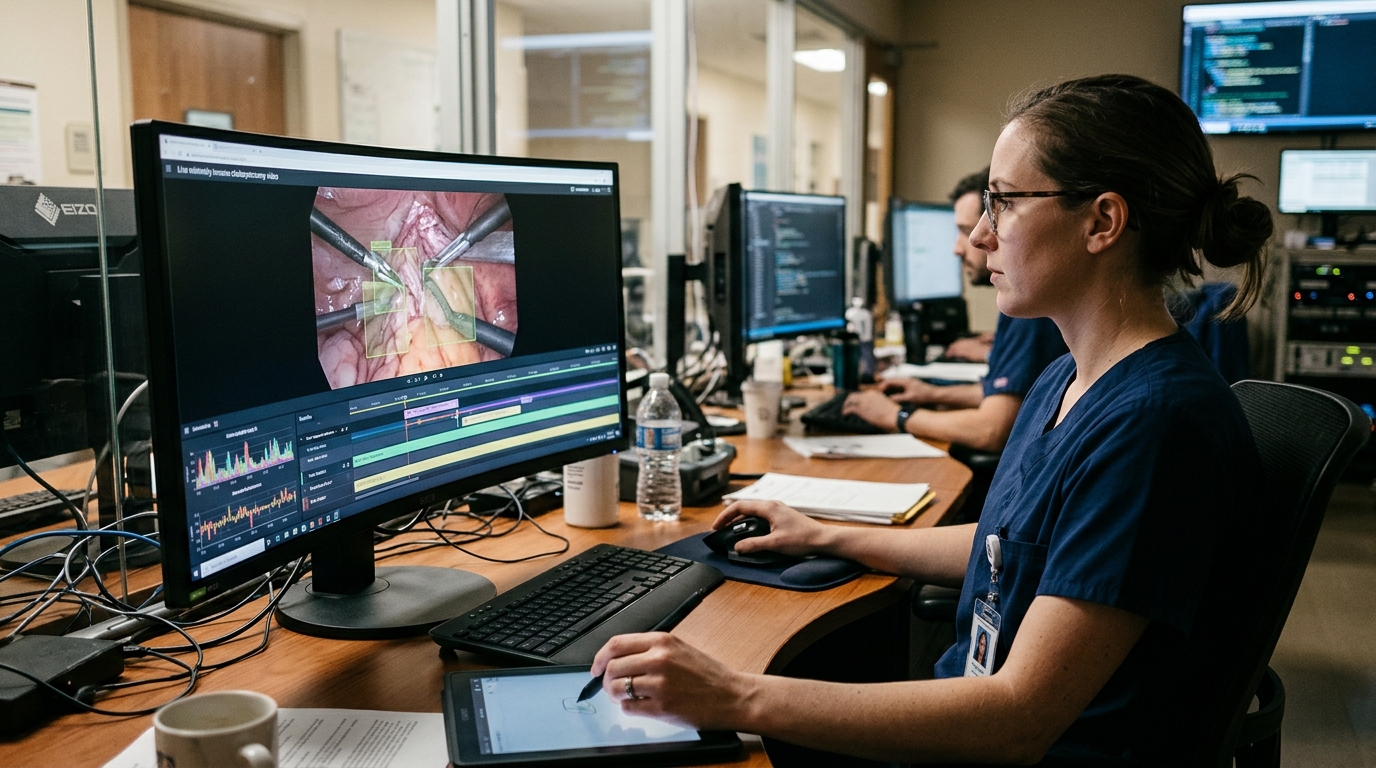
Annotating laparoscopic surgery footage is one of the most labor-intensive chores in surgical data science. Every frame that teaches a machine to recognize a grasper or a stapler must be traced pixel by pixel, and only experts who understand the anatomy and the instruments can do it reliably. A team led by Manasa Dendukuri, Matjaž Jogan, Daniel A. Hashimoto and Guiqiu Liao now reports a human-in-the-loop knowledge acquisition framework that combines active learning with dual-loss optimization to dramatically shrink that workload. In a short communication published in the International Journal of Computer Assisted Radiology and Surgery, the authors demonstrate that their pipeline reduces the effort of surgical video annotation by approximately 50 percent by the end of training compared with fully manual annotation.
The core problem the researchers attack is spatial-temporal annotation: marking not just where objects sit in each image but how they persist and move across time. Precise labels of this kind are time-consuming and demand expert knowledge, which has long limited the size and diversity of datasets available for training surgical tool segmentation models. Rather than asking annotators to produce dense pixel-level masks upfront, the new pipeline iteratively proposes pseudo-masks that guide the expert to refine what the model has already learned, so human effort is spent only where it changes the model’s knowledge.
Technically, the method rests on a foundation model that generates temporally consistent class activation maps, or CAMs, from video. These maps localize the regions of each frame that the network associates with a given surgical tool class, and enforcing temporal consistency keeps those localizations stable as instruments move through the operative field. The framework trains this model with two complementary objectives. The first is a weak supervision loss computed on video-level tool presence labels, which applies to weakly annotated data where someone has only recorded which tools appear in a clip, not where they are. The second is an image-level mask loss computed on human-corrected annotations obtained through active learning.
Active learning is what makes the human involvement efficient. Instead of labeling everything, the expert annotator corrects the pseudo-masks the model proposes, concentrating attention on the frames and regions where the model’s automatic localization is least reliable. Each round of correction feeds higher-quality image-level masks back into training through the mask loss, which in turn improves the CAMs and the pseudo-masks proposed in the next round. The loop therefore behaves as a knowledge acquisition process: the model captures a first approximation from cheap video-level labels, and the expert progressively refines that knowledge with minimal input.
The reported result is a concrete efficiency gain rather than a projection. By the end of training, the framework required roughly half the annotation effort of fully manual labeling for automatic localization and segmentation of objects in the surgical field. The authors frame this as eliminating the need for large, fully annotated datasets from the start, which is the bottleneck that has kept tool segmentation models confined to small, narrowly sourced video collections.
The practical implications follow directly from that framing. Because the pipeline scales without upfront dense annotation, the authors argue it supports expanding tool segmentation to larger, more diverse datasets and real-world clinical settings, where expert labeling time is scarce and expensive. The iterative human-in-the-loop refinement is described as a practical and deployable strategy for building segmentation models with minimal expert input, a shift that could widen the range of procedures, institutions and camera conditions represented in future training data.
The method also illustrates a broader trend in medical computer vision: pairing foundation models with targeted human correction instead of exhaustive labeling. Weak video-level labels supply the coarse signal that tells a model which instruments matter, while the active-learning loop supplies the precise spatial supervision only where the model needs it. The dual-loss design keeps both signals in play throughout training, so the weakly annotated data and the small set of expert-corrected masks reinforce each other rather than competing.
The authors have released their code publicly at https://github.com/PCASOlab/AL-WSL, allowing other groups to adopt or extend the pipeline. As a short communication, the paper presents the framework and its headline efficiency result; the reported 50 percent reduction in annotation effort by the end of training, measured against fully manual annotation, stands as the central quantitative claim supporting the approach.
Subject of Research: Active learning with weak supervision for efficient annotation of laparoscopic surgical videos
Article Title: Active learning for efficient annotation of surgical videos with weak supervision
Article References: Dendukuri, M., Jogan, M., Hashimoto, D. A., & Liao, G. (2026). Active learning for efficient annotation of surgical videos with weak supervision. International Journal of Computer Assisted Radiology and Surgery. https://doi.org/10.1007/s11548-026-03815-9
Image Credits: AI Generated
DOI: 10.1007/s11548-026-03815-9
Keywords: active learning, weak supervision, surgical video, laparoscopy, tool segmentation, annotation, human-in-the-loop, class activation maps, foundation model, computer vision, machine learning, surgical data science
News Source: Blake Davidson. (November 7, 2026). Human-in-the-Loop AI Cuts Surgical Video Annotation Effort by Half. Scienmag.