• HOME
  • NEWS
  • EXPLORE
    • CAREER
      • Companies
      • Jobs
    • EVENTS
    • iGEM
      • News
      • Team
    • PHOTOS
    • VIDEO
    • WIKI
  • BLOG
  • COMMUNITY
    • FACEBOOK
    • INSTAGRAM
    • TWITTER
Wednesday, November 18, 2026
BIOENGINEER.ORG
No Result
View All Result
  • Login
  • HOME
  • NEWS
  • EXPLORE
    • CAREER
      • Companies
      • Jobs
        • Lecturer
        • PhD Studentship
        • Postdoc
        • Research Assistant
    • EVENTS
    • iGEM
      • News
      • Team
    • PHOTOS
    • VIDEO
    • WIKI
  • BLOG
  • COMMUNITY
    • FACEBOOK
    • INSTAGRAM
    • TWITTER
No Result
View All Result
Bioengineer.org
No Result
View All Result
Home NEWS Science News Health

Frontal Impacts Cause Greater Brain Deformation in Human Head Specimen Tests

by
November 7, 2026
in Health, Technology
Reading Time: 2 mins read
0
Frontal Impacts Cause Greater Brain Deformation in Human Head Specimen Tests

Frontal Impacts Cause Greater Brain Deformation in Human Head Specimen Tests

Share on FacebookShare on TwitterShare on LinkedinShare on RedditShare on Telegram

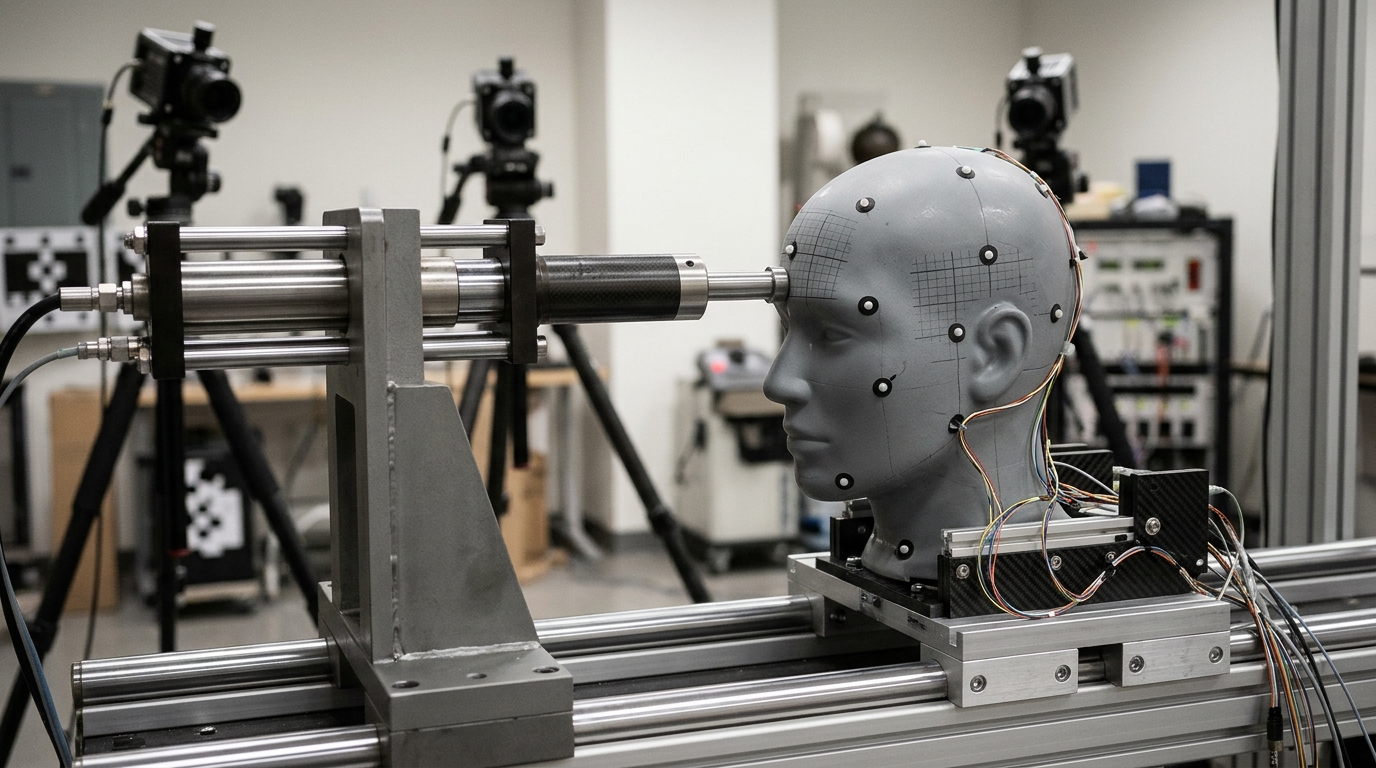
Frontal impacts produce consistently larger peak intracranial displacements and tissue strains than occipital impacts regardless of impactor compliance or gross kinematics, according to dynamic measurements of discrete anatomical regions in post-mortem human subject heads. The findings, reported in the Annals of Biomedical Engineering, demonstrate that internal mechanics within the human skull are sensitive to impact direction, impact site, and local boundary geometry.

Traumatic brain injury frequently arises from falls, sports collisions, violence, and transportation or industrial events, primarily driven by inertial loading that induces intracranial deformations, rotations, tissue strains, and resulting neuropathology. Computational tools such as finite element models are widely utilized to simulate these biomechanical responses and predict injury patterns, yet their accuracy relies directly on biofidelic experimental data capturing in situ brain–skull kinematics and regional deformation, which have historically remained limited.

To establish these experimental targets, the research team, led by Jean-Jacques Demiannay, Oren E. Petel, and colleagues, evaluated the dynamic response of the human brain when subjected to systematically varied head impact severities, directions, and impactor compliances. The investigators employed high-speed X-ray cinematography to record and quantify how discrete anatomical regions moved within post-mortem human subject specimens during each impact condition.

From these high-speed kinematic recordings, the researchers derived time histories of brain–skull relative displacement and tissue strain specifically formatted for finite element model validation and inter-model comparisons. Detailed regional analysis across the specimens showed that intracranial deformation was spatially non-uniform, with the greatest magnitudes of displacement and strain consistently concentrating in superior brain regions.

The investigators noted that the elevated deformations observed superiorly may be related to differences in local skull and meningeal geometry relative to the skull base. By providing experimentally grounded kinematic datasets, the authors stated that these measurements offer validation targets to improve finite element models, while advancing the understanding of neuropathology evolution and aiding the development of head protection strategies tailored to directional and regional vulnerabilities.

Subject of Research: Biomechanical measurement of intracranial brain deformation during head impacts

Article Title: Measurements of Intracranial Brain Deformation in Post-mortem Human Subject Specimens Subjected to Variable Impact Conditions

Article References: Demiannay, J.-J., Brannen, M., Xu, S., Azadi, A. H., Dehghan, P., Goodwin, S., Yahiaoui-Djerboua, W., Taylor, R., Poon, K., Brien, S., Vassilyadi, M., Cusimano, M. D., Karton, C., Hoshizaki, B., & Petel, O. E. (2026). Measurements of Intracranial Brain Deformation in Post-mortem Human Subject Specimens Subjected to Variable Impact Conditions. Annals of Biomedical Engineering. https://doi.org/10.1007/s10439-026-04419-9

Image Credits: AI Generated

DOI: 10.1007/s10439-026-04419-9

Keywords: traumatic brain injury, biomechanics, brain deformation, finite element models, impact kinematics, post-mortem human subjects, high-speed X-ray cinematography, intracranial strain, Measurements, Intracranial, Brain, Deformation

News Source: Cassandra Pierce. (November 7, 2026). Frontal Impacts Cause Greater Brain Deformation in Human Head Specimen Tests. Scienmag.


Tags: BiomechanicsBrainbrain deformationdeformationfinite element modelshigh-speed X-ray cinematographyimpact kinematicsIntracranialintracranial strainmeasurementspost-mortem human subjectsTraumatic Brain Injury
Share12Tweet7Share2ShareShareShare1

Related Posts

Targeting Macrophages Offers New Therapeutic Pathways to Prevent Chronic Organ Transplant Rejection

Targeting Macrophages Offers New Therapeutic Pathways to Prevent Chronic Organ Transplant Rejection

November 18, 2026
Survey Reveals Severe Staffing Shortages Constrain Korean Medicine Education Units

Survey Reveals Severe Staffing Shortages Constrain Korean Medicine Education Units

November 18, 2026

Review Examines Electrical Impedance Tomography Across 116 Pediatric and Neonatal Studies

November 18, 2026

Criteria-Based Nanocarrier Selection May Aid Clinical Translation in Drug Delivery

November 18, 2026

POPULAR NEWS

  • Neural Network Inverse Design Optimizes Broadband Hybrid Plasmonic Leaky Wave Antenna

    Neural Network Inverse Design Optimizes Broadband Hybrid Plasmonic Leaky Wave Antenna

    29 shares
    Share 12 Tweet 7
  • Livestock Holdings and Agroecology Shape Carnivore Conservation Attitudes in Southern Ethiopia

    29 shares
    Share 12 Tweet 7
  • Researchers Identify GRAM Genes Across Cultivated Sweetpotato and Two Diploid Relatives

    29 shares
    Share 12 Tweet 7
  • Sensor Weighted Crop Simulations Significantly Improve Drone Maize Leaf Area Retrieval

    29 shares
    Share 12 Tweet 7

About

We bring you the latest biotechnology news from best research centers and universities around the world. Check our website.

Follow us

Recent News

Targeting Macrophages Offers New Therapeutic Pathways to Prevent Chronic Organ Transplant Rejection

Global Modeling Reveals Potential Health Gains of H. pylori Screening Strategies

Survey Reveals Severe Staffing Shortages Constrain Korean Medicine Education Units

Subscribe to Blog via Email

Enter your email address to subscribe to this blog and receive notifications of new posts by email.

Join 88 other subscribers
  • Contact Us

Bioengineer.org © Copyright 2023 All Rights Reserved.

Welcome Back!

Login to your account below

Forgotten Password?

Retrieve your password

Please enter your username or email address to reset your password.

Log In
No Result
View All Result
  • Homepages
    • Home Page 1
    • Home Page 2
  • News
  • National
  • Business
  • Health
  • Lifestyle
  • Science

Bioengineer.org © Copyright 2023 All Rights Reserved.