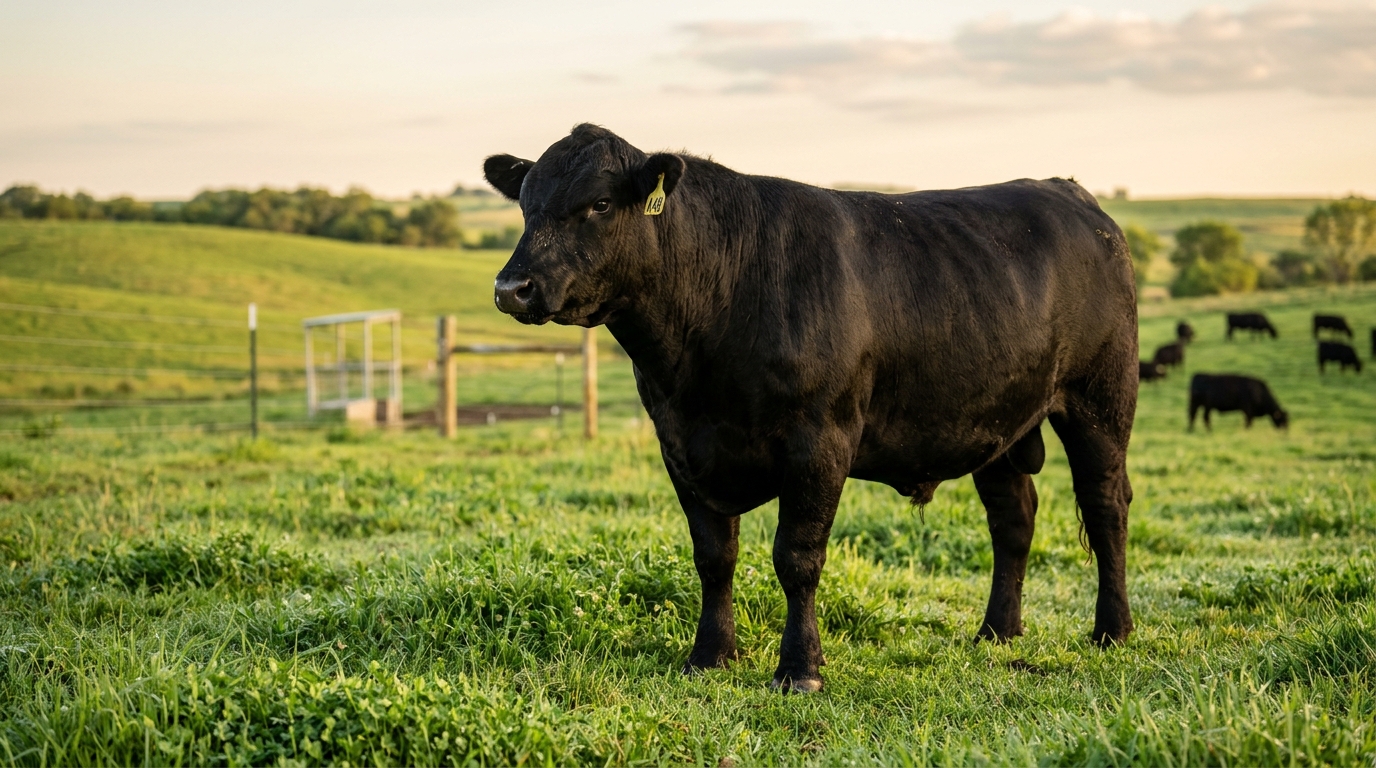
Researchers have built and tested a new way to quantify how much of the energy a growing beef animal consumes actually ends up in body growth. In a study of American Angus cattle, a team led by Qianqian Huang and Luiz F. Brito of Purdue University, working with colleagues at institutions including INRAE, the University of Illinois, the University of Wisconsin-Madison, and Angus Genetics Inc., defined an energy allocation coefficient to growth, denoted α, as the ratio of estimated net energy retained in growth to the estimated net energy available for growth after predicted maintenance requirements are accounted for. The work, published in Genetics Selection Evolution on 31 October 2026, examined whether this derived coefficient contains additive genetic variation and how strongly it is genetically related to conventional growth, feed efficiency, and body composition traits.
The coefficient was derived from routinely recorded feed intake and body weight data using a nutritional energy-balance framework. Metabolizable energy intake was calculated from dry matter intake assuming a constant metabolizable energy density of 3.0 Mcal per kilogram of dry matter, because farm- and test-specific diet composition was not available in the dataset. Maintenance requirements were estimated from shrunk mid-test body weight and mean environmental temperature during the feeding test, following the National Academies of Sciences, Engineering, and Medicine beef cattle energy system. Net energy retained in growth was estimated with a comparative slaughter-based retained energy equation, which allows the estimated energy retained in growth to vary with both body size and rate of gain rather than assuming a constant energetic value per unit of gain. The partial efficiencies of metabolizable energy utilization were fixed at 0.70 for maintenance and 0.50 for growth, consistent with commonly used approximations for high energy beef cattle diets.
The study population was large. Phenotypic and pedigree data came from the American Angus Association, with an initial dataset of 39,071 purebred Angus cattle comprising 27,882 bulls, 3,964 steers, and 7,225 heifers tested between March 1991 and January 2025. Animals were evaluated in 903 feed intake test contemporary groups across 179 farms in 32 U.S. states, with an average test duration of 73.0 days. After quality control that removed records outside biologically plausible ranges and animals born before 2005, 35,772 animals remained across 851 contemporary groups. The pedigree contained 132,465 individuals. Genotypes imputed to a common density of 54,609 SNPs were reduced to 39,412 autosomal SNPs on 14,090 genotyped animals after genomic quality control. In total, 35,276 animals had valid α phenotypes.
The derived α averaged 0.77 with a standard deviation of 0.28 and ranged from 0.07 to 3.10. Because α is a derived ratio rather than a bounded proportion, values greater than 1 can occur when estimated net energy retained in growth exceeds the estimated net energy available for growth. The authors note that such values may reflect discrepancies between assumed and actual dietary energy density, errors in feed intake or other input measurements, or individual deviations from the assumptions of the adopted energy system. After natural log transformation, which was applied to improve normality and stabilize residual variance before genetic analyses, log(α) averaged −0.34 and ranged from −2.60 to 1.13.
To estimate genetic parameters, the researchers compared two complementary modeling strategies. In the two-step approach, the derived log(α) was treated as a pseudo-phenotype and analyzed with a linear animal model, using either the pedigree-based relationship matrix or the single-step matrix that combines pedigree and genomic information. In the one-step approach, empty body weight gain was modeled directly as a nonlinear function of α within a mixed-model framework, jointly estimating breeding values and variance components without constructing pseudo-phenotypes. Six model specifications were compared, differing in whether contemporary group was fitted as a fixed or random effect and which relationship matrix was used. The one-step models were implemented in R using Template Model Builder, and only pedigree-based versions were fitted because incorporating the single-step structure into the nonlinear likelihood would have been computationally demanding.
The results showed that log(α) is heritable, with within-contemporary-group heritability estimates of roughly 0.13 to 0.20 depending on the model. Modeling the contemporary group as fixed or random had little impact on additive genetic and residual variance estimates, and Spearman rank correlations between breeding values from the corresponding fixed- and random-group models exceeded 0.92. When the two-step and one-step approaches were compared under the same pedigree-based relationship structure, the two-step approach produced a slightly larger estimated additive genetic variance and a slightly smaller residual variance, yielding a heritability of 0.19 versus 0.15 for the one-step model. Despite these modest differences in variance partitioning, breeding value rankings were highly concordant, with a Spearman rank correlation of 0.94 and an 84.3 percent overlap among animals ranked in the top 25 percent. Given this stability and the availability of genomic information, the two-step model with fixed contemporary groups and the single-step matrix was selected as the reference model.
Under that reference model, log(α) showed moderate to strong genetic correlations with growth and feed efficiency traits. The genetic correlation was 0.63 with average daily gain, 0.61 with residual average daily gain, −0.80 with feed conversion ratio, and −0.54 with residual feed intake, all with standard errors of about 0.02 to 0.03. The genetic correlation with dry matter intake was weak at −0.14, indicating limited genetic association between the allocation coefficient and feed intake itself in this population. A weaker positive genetic correlation of 0.29 was observed with yearling hip height. According to the authors, these correlations indicate substantial but incomplete genetic overlap with conventional growth and feed efficiency traits, meaning α is not genetically equivalent to them and may capture additional genetic variation.
Genetic correlations with body composition traits were generally weak. Log(α) was negatively correlated with ultrasound rib fat thickness at −0.12 and ultrasound rump fat thickness at −0.13, while correlations with ultrasound ribeye area, at 0.04, and intramuscular fat percentage, at −0.05, were close to zero. The authors suggest that the weak negative correlations with subcutaneous fat thickness, together with the near-zero correlation with ribeye area, may be consistent with differences in the energetic costs of lipid and protein deposition and with previous findings that more feed efficient cattle tend to have lower subcutaneous fatness. Phenotypic correlations generally followed the same direction as the genetic correlations for growth and feed efficiency traits, with the strongest associations observed for feed conversion ratio, average daily gain, residual average daily gain, and residual feed intake.
Interpreting α requires attention to the assumptions built into its derivation. The framework applies the same maintenance-requirement equation to all animals after accounting for body size and mean environmental temperature, so individual deviations from predicted maintenance requirements, which may themselves be partly heritable, are not separately identified. A common dietary energy density and fixed partial efficiencies of energy utilization were assumed across animals, and the absence of test-specific diet energy information prevented direct adjustment for variation in dietary energy density across tests. The authors emphasize that these unmodeled sources of variation are biologically relevant: lower maintenance costs or more efficient utilization of energy for growth would be expected to increase α, and variation in non-growth energy demands such as activity, thermoregulation, or immune responses may also contribute. However, these processes were not directly measured, so their relative contributions to variation in α cannot be determined from this study.
From a breeding perspective, the authors position α as a complementary view of efficiency that frames between-animal differences in terms of relative energy allocation toward growth rather than feed use alone. They conclude that the two-step framework is compatible with standard genetic evaluation procedures and provides a practical approach for genetic analysis of this derived coefficient, while the one-step approach offers an alternative statistical formulation without pseudo-phenotype construction. Whether the additional genetic variation captured by α provides useful information for breeding remains to be established, and the results support further evaluation of α rather than its immediate use as an independent selection criterion. The team recommends evaluating α jointly with health, resilience, fertility, and other functionally important traits, and notes that longitudinal individual feed intake records, repeated body weight and body composition measurements, and test-specific diet composition data would improve future applications of the framework.
Subject of Research: Genetic analysis of a derived energy allocation coefficient for growth in American Angus cattle
Article Title: Genetics of energy allocation to growth in Angus cattle: trait derivation, model comparison, and relationships with feed efficiency and body composition traits
Article References: Huang, Q., Friggens, N. C., de Oliveira, H. R., Schinckel, A. P., Rosa, G. J. M., Garcia, A., Retallick, K., Santana, M. H. A., & Brito, L. F. (2026). Genetics of energy allocation to growth in Angus cattle: trait derivation, model comparison, and relationships with feed efficiency and body composition traits. Genetics Selection Evolution, 58(1), Article 79. https://doi.org/10.1186/s12711-026-01102-4
Image Credits: AI Generated
DOI: 10.1186/s12711-026-01102-4
Keywords: Angus cattle, energy allocation, feed efficiency, residual feed intake, genetic parameters, heritability, body composition, animal breeding, nutritional energy balance, growth rate, dry matter intake, beef cattle
News Source: William Thompson. (November 7, 2026). Geneticists quantify how Angus cattle allocate energy to growth. Scienmag.